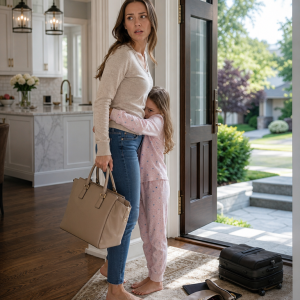
The Invitation That Arrived Eight Years Too Late
The message came on a Tuesday evening in December, just as the last gray light was fading behind the towers of downtown Seattle and the windows of my office were beginning to reflect the warm lamps behind me. I had spent most of the day reviewing expansion plans for the employee-benefits company I had built from a rented room above a neighborhood pharmacy, and by six-thirty I was tired enough to consider going home, heating up soup, and letting my four children argue over which Christmas movie we had already watched too many times.
Then my phone lit up.
Julian Mercer.
For several seconds, I simply stared at the name.
Eight years had passed since I had seen my former husband. Eight years since he had walked out of our apartment after I told him I was expecting a child, accusing me of inventing the pregnancy because our marriage was already failing and, in his words, I needed a way to keep him from leaving. Eight years since he had filed for divorce through an attorney, changed his number, transferred to another office, and disappeared before I had even learned that one baby was actually four.
I had once imagined what I would say if he contacted me again. In those early years, when sleep came in fragments and four bassinets filled my tiny rented house outside Tacoma, I imagined anger. Later, when the children began school and life grew steadier, I imagined indifference.
What I had never imagined was a Christmas invitation.
His message was brief.
Come to Christmas dinner at my mother’s place outside Jackson on the twenty-fifth. Everyone will be there. It might be good to see each other one last time.
I read it twice, then a third time, and with each reading the meaning became clearer.
Julian was not reaching out because he regretted anything.
I knew him too well for that.
He believed I was still the frightened twenty-six-year-old woman he had left behind, the one who had called his office until a receptionist stopped putting me through, the one who had written letters that came back unopened, the one his family had dismissed as desperate and difficult. Somewhere, somehow, he had apparently decided that inviting me into a room filled with people who had chosen his version of our marriage would be amusing.
Perhaps he expected me to arrive alone.
Perhaps he wanted his new girlfriend to see the woman he had supposedly escaped.
Perhaps, after all those years, he still needed an audience.
My operations director, Paige Holloway, appeared in the doorway carrying a folder and took one look at my face.
“Everything okay?”
I turned the phone toward her.
She read the message, lifted one eyebrow, and handed it back.
“Please tell me you’re not considering this.”
Beyond the glass, traffic moved through the wet streets below, headlights stretching across the pavement like ribbons. On my desk sat a framed photograph taken the previous spring: four eight-year-olds on a rocky Oregon beach, laughing so hard that none of them was looking at the camera.
I picked up the photograph.
Then I smiled.
“Actually,” I said, “I think Christmas in Wyoming sounds lovely.”
Four Children in the Snow
Christmas morning came clear and bright, with fresh snow covering the mountains around Jackson and a pale winter sun turning every ridge silver-white. Because the roads near Helen Mercer’s property were difficult after heavy weather, the final part of our journey was made by chartered helicopter, a practical arrangement that I knew would look considerably more dramatic than I intended.
My children, naturally, thought it was the greatest thing that had ever happened.
Owen pressed his face toward the window.
“Mom, is that where they live?”
“Somewhere down there.”
Beside him, Miles adjusted the small red tie he had already loosened twice.
“So we’re really meeting Dad’s family?”
The word Dad still unsettled me, though I never let the children see it.
I had told them the truth in careful pieces as they grew older. I had never invented a heroic father traveling abroad, never claimed Julian had vanished because of circumstances beyond his control, and never taught them to despise a man they had never met. I simply explained that their father had left before they arrived and had chosen not to remain in contact.
My daughters, Lily and Emma, sat shoulder to shoulder across from me in matching dark green wool coats, whispering about whether their grandmother might have a dog. The boys wore navy jackets. All four had Julian’s hazel eyes, though each child carried the resemblance differently. Owen had the same crooked smile. Miles had the same square jaw. Lily lifted one eyebrow exactly as Julian did when skeptical, while Emma had inherited the small dimple near his left cheek.
There had been times, especially when they were babies, when looking at them had hurt in ways I could not explain.
Now it mostly reminded me how little Julian knew.
The helicopter settled on a wide field beside the Mercer estate shortly before noon. Snow lifted around us in great white clouds before slowly falling back to earth, and through the windows of the stone-and-timber house I could already see people moving toward the front entrance.
I stepped out first.
Then Owen.
Miles.
Lily.
Emma.
The children gathered around me as the rotors slowed.
At the house, the front door opened.
A tall woman in a cream sweater stood motionless on the porch. Even at that distance I recognized Helen Mercer, my former mother-in-law, though eight years had softened the sharp angles of her face and silvered her carefully styled hair.
She saw me.
Then she saw the children.
A glass slipped from her hand and broke against the stone step.
I took a slow breath.
“Ready?” I asked.
Four heads nodded.
We walked toward the house together.
Julian appeared behind his mother before we reached the porch. He was older, naturally, and a little broader through the shoulders, but still polished in the way he had always valued: expensive watch, perfectly fitted sweater, every strand of hair in place. Beside him stood a striking blonde woman in a burgundy dress, one hand resting lightly near his arm.
I knew immediately who she was.
Brooke Avery.
His girlfriend.
Or perhaps more than that, judging from the small velvet box Julian had been holding before he noticed us.
His expression changed so quickly that I almost missed the stages of it.
Confusion first.
Then recognition.
Then something quieter as his gaze moved from Owen to Miles, from Miles to Lily, and finally to Emma.
The box slid from his hand and landed on the rug inside the doorway.
Brooke looked at him.
“Julian?”
He did not answer.
“Who are these children?”
Still nothing.
I stepped into the foyer and unbuttoned my coat while every conversation in the house faded around us. Aunts, cousins, family friends, and neighbors turned in their chairs. Somewhere deeper inside, Christmas music continued playing at an absurdly cheerful volume.
I rested my hand on Emma’s shoulder and looked at the people who had spent years believing I had lied.
“Merry Christmas,” I said.
Helen gripped the edge of the doorframe.
“Mara… what is this?”
I met her eyes.
“I brought the grandchildren you never knew.”
For a moment no one moved.
Then Owen, who had never understood the usefulness of avoiding an uncomfortable question, looked directly at Julian.
“Are you really our father?”
The Truth at the Christmas Table

Julian seemed to shrink inside his expensive clothes.
I had once known him as a man who could command a boardroom without raising his voice, a hotel-development executive who negotiated multimillion-dollar properties before lunch and still complained if the restaurant forgot his preferred sparkling water. Yet in that room, facing four children who carried unmistakable pieces of his face, he could not form a sentence.
Owen waited.
Finally, I touched his shoulder.
“Sweetheart, you don’t have to ask anything else.”
But he looked up at me with the honest puzzlement only a child can possess.
“You said grown-ups sometimes make choices they wish they could change.”
I nodded.
He turned back to Julian.
“Do you wish you had chosen us?”
Helen covered her mouth.
Brooke slowly moved away from Julian’s side.
At last, he looked at me.
“Mara, tell me what’s happening.”
I almost smiled at the old habit in his voice, the assumption that an unpleasant reality required an explanation from someone else.
“Their names are Owen, Miles, Lily, and Emma,” I said. “They were born seven weeks early. They spent almost a month under hospital care. Miles needed extra breathing support during the first few days. Lily was the smallest. Emma made enough noise for all four of them. Owen was the first child I was allowed to hold for more than a few minutes.”
Julian’s lips parted.
I continued.
“They are eight years old. And yes, Julian, they are yours.”
Brooke turned toward him so slowly that the movement itself carried more force than shouting would have.
“You told me your marriage ended because she lied to you.”
Julian’s eyes flickered toward her.
“She did.”
The response came automatically, as though he had repeated it for so many years that the words no longer required thought.
I stepped closer.
“Say that again.”
He stared at me.
“Go ahead,” I said. “Say it in front of your children.”
No answer came.
Brooke folded her arms.
“What exactly was the lie, Julian?”
He looked around the room, perhaps hoping for rescue from his mother, his uncle, anyone. No one offered it.
Finally he said, “She told me she was pregnant.”
Brooke blinked.
“And you decided she wasn’t?”
“The marriage was already bad. I thought she was trying to stop me from leaving.”
I let the silence remain between us.
Eight years earlier, I had stood barefoot in our kitchen with a pharmacy test in my hand, trembling from fear and happiness, and watched my husband look at me as though I had staged an inconvenience. Weeks later, when the ultrasound showed four tiny heartbeats, I had called the new number his office gave me. It had already been disconnected. I sent emails. They came back. I visited his office building and was politely shown outside.
That was the day something in me finally changed.
I stopped asking a man to believe in children who would soon need all the strength I had.
Helen stepped forward now, her face pale.
“Why didn’t you contact us?”
I looked at her for a long moment.
“I did.”
Her shoulders stiffened.
“I called your house three times. The first time you told me Julian needed space. The second time you said that if I cared about him, I would let him begin again. The third time, someone on your household staff told me you would no longer accept my calls.”
Helen’s lips trembled.
“I thought you were trying to trap him.”
“No,” I said quietly. “I was trying not to go through childbirth alone.”
Emma moved closer and curled two fingers around my sleeve.
“Mom, can we leave?”
That one question changed the room for me.
Until then, I had been focused on the past: Julian’s disbelief, Helen’s rejection, the years of silence. But I had not brought my children to Wyoming so adults could use them as evidence in an old argument.
I knelt beside my daughter.
“We can leave whenever you’re ready.”
Behind me, Julian spoke quickly.
“Please don’t.”
Everyone turned.
For one dangerous instant, I saw the young man I had once loved, the one who brought coffee when I studied late and danced with me in our first cheap apartment because we owned no decent speakers. Then another memory followed: four hospital bassinets, my mother asleep upright in a chair because she refused to leave me, and the empty space where my husband might have stood.
I rose.
“You don’t get to ask us to stay.”
Julian lowered his eyes.
“I know.”
“No, you don’t. You missed first words and first days of school. You missed stomach bugs, science fairs, birthday cakes, lost teeth, parent conferences, and Saturday mornings when all four of them climbed into my bed. You missed Owen learning to read because he wanted to read stories to his sisters. You missed Miles believing his breathing condition made him weaker than the other boys until his coach taught him otherwise. You missed Lily drawing your face from an old wedding photograph. You missed Emma asking why everyone else had a father at school pickup.”
Julian pressed one hand over his mouth.
I had imagined making him regret leaving me, many years ago.
Standing there, I discovered regret was not satisfying to witness.
It was simply late.
Brooke removed the ring from her finger.
The small click it made against the dining table was almost lost beneath the Christmas music.
“Brooke,” Julian said.
She raised one hand.
“Don’t.”
Her voice remained calm.
“You told me your former wife invented stories. You told me you were the one who had been betrayed. You invited her here because you thought watching her walk into this house alone would prove something.”
Julian looked away.
Brooke glanced toward me, then at the children.
“I can forgive a person for being foolish. I cannot build a marriage with someone who abandons his own family and turns another person’s pain into holiday entertainment.”
She picked up her coat.
At the door, Julian reached toward her, then stopped himself.
Brooke looked back only once.
“You’re asking the wrong woman to stay.”
Then she left.
What Four Children Asked of a Stranger
For several moments Julian stood facing the closed door, as though he had not yet understood that two different lives were slipping beyond his control on the same Christmas afternoon.
Miles looked at me.
“Is he upset because she went away?”
I answered honestly.
“Yes.”
My son thought about that.
“Were you upset when he went away?”
The question was so simple that I had to look toward the windows before answering.
“Yes, honey. I was.”
Miles turned to Julian.
“Then you should apologize.”
No accusation.
No performance.
Just the moral arithmetic of an eight-year-old child.
Julian slowly lowered himself to one knee so he could face all four children.
“I am sorry.”
Owen frowned.
“For what?”
Julian swallowed.
“For leaving.”
Owen looked unconvinced.
“That’s not very specific.”
A few adults shifted awkwardly, but I said nothing. He was right.
Julian nodded.
“Okay. You deserve a real answer.”
He looked from one child to the next.
“I was selfish. I was scared of responsibility, and instead of admitting that, I decided your mother must be lying because that made leaving easier. I wanted my life to stay exactly the way I had planned it. When she needed me, I chose myself.”
Helen began to cry quietly.
Julian turned toward her.
“And Mom helped me believe I had done nothing wrong.”
Helen stepped back.
“I thought I was protecting you.”
“You were protecting me from consequences.”
It was the first thing Julian had said that afternoon that sounded entirely honest.
Helen’s proud posture seemed to fold. She looked toward Lily, then at me.
“May I speak to her?”
Lily checked my face first. I gave a small nod.
Helen knelt carefully.
“I’m your grandmother,” she said. “And I am deeply sorry.”
Lily studied her for several seconds, then touched the pearl necklace at Helen’s throat.
“Those are pretty.”
A shaky laugh escaped Helen.
“Thank you, sweetheart.”
Something in the room softened after that, though not enough to erase anything. Someone lowered the Christmas music. An aunt brought cocoa. The children, hungry after the journey, accepted cookies and sandwiches while adults who had expected an entirely different afternoon tried to understand the four young people sitting near the fireplace.
I remained standing.
I had not come to return to the Mercer family.
I had already built a family of my own.
Julian approached carefully.
“Can I sit with you?”
“No.”
He stopped.
“Fair enough.”
For a while we watched the children in silence.
Finally he said, “They’re incredible.”
“They’re loved.”
His eyes lowered.
“Do they hate me?”
I looked toward them.
“They don’t know you well enough.”
His face tightened.
“I want to make it right.”
That was when I turned fully toward him.
“There is no making eight years disappear. There are only better choices from this point forward.”
Hope appeared too quickly in his expression.
I stopped it before it could become entitlement.
“And any relationship with them happens at their pace, not yours. You do not get to arrive because you finally feel ready and expect four children to rearrange themselves around your regret.”
He nodded.
“Whatever you want.”
“It isn’t about what I want. That has always been your problem.”
Before he could answer, his uncle stepped in from the foyer.
“Julian, there are two men outside asking for you.”
Julian frowned.
“Who?”
“One says he’s an attorney.”
The room changed again.
The Envelope at the Door

The doorbell rang before anyone could ask another question.
Helen looked toward the clock.
“On Christmas Day?”
Her brother opened the door.
A silver-haired man in a charcoal overcoat entered first, carrying a leather document case. Behind him stood a younger man, tall and broad-shouldered, his face partly hidden by the collar of his winter coat.
The older man removed his gloves.
“Julian Mercer?”
Julian straightened.
“Yes.”
Then the stranger looked at me.
“Mara Ellison?”
I stiffened.
“Yes.”
His gaze moved toward the fireplace.
“And those are Owen, Miles, Lily, and Emma?”
Every protective instinct in me rose at once.
“Who are you?”
The man opened his case.
“My name is Gideon Shaw. I represent a private trust established by Arthur Mercer.”
Helen sank into a chair.
Arthur Mercer had been Julian’s father, a reserved and unusually observant man who had passed away several months after my marriage ended. I had met him only a handful of times, yet I remembered one conversation with extraordinary clarity. During a tense family dinner, he had looked at me across the table and said that a person could always tell when a house no longer felt safe to speak honestly in.
At the time, I had not understood why he said it.
Gideon removed a sealed envelope.
“Shortly before Mr. Mercer’s passing, he amended a confidential trust after becoming concerned that his son might have an unborn child.”
Julian stared at him.
“That’s impossible.”
“It is not.”
“My father’s estate was settled years ago.”
“Most of it was.”
Gideon looked toward the children.
“This portion remained inactive because no qualifying heirs had been formally identified.”
I tightened my arm around Emma.
“Why are you here now?”
“Because the trust becomes active when any qualifying child reaches eight years of age. Several months ago, a private investigator working under the trust’s terms located public birth records in Washington State.”
Julian looked at me.
“Did you tell my father?”
“No.”
Gideon answered for me.
“Arthur became suspicious after a conversation with you, Julian. Apparently you mentioned that Mara had claimed to be expecting a child, and you dismissed it. Your father did not.”
The realization moved through the room slowly.
Arthur Mercer had listened where his son had refused to.
Gideon handed Julian several pages.
“The trust directs a substantial ownership interest in Mercer Lodging Group to any biological children of Julian Mercer born within the specified period following the amendment.”
Julian scanned the page.
His fingers began to tremble.
“How much?”
Gideon’s answer was calm.
“Collectively, the four children hold fifty-one percent of the voting shares.”
No one spoke.
Near the fireplace, Owen was helping Emma break a cookie in half. Lily was explaining something to Miles with tremendous seriousness. Four children who had arrived asking whether a stranger was truly their father now held controlling interest in the business that stranger had spent his adult life treating as the measure of his worth.
I felt no triumph.
Only disbelief.
Gideon turned toward me.
“Because the children are minors, their voting rights will be administered through the designated guardian structure until they reach adulthood. Under the trust documents, you are the acting trustee.”
Julian lifted his head.
“Mara.”
I knew that tone.
Eight years earlier, he had looked at me and seen an obstacle to freedom.
Now he looked at me and saw the person standing between him and the company he worshipped.
I gave him a faint smile.
“You once accused me of wanting your family’s money.”
“Please. We need to talk privately.”
“No,” I said. “We really don’t.”
Then, from behind Gideon, another voice entered the room.
“Actually, all of us need to talk.”
The younger man removed his coat.
Helen rose so abruptly that her chair scraped across the floor.
Julian went completely still.
I looked from the stranger to a row of framed family photographs along the hallway wall and felt a strange chill pass through me.
The resemblance was unmistakable.
There was a photograph of the same man at twenty, standing beside a much younger Julian. I remembered being told that Julian’s older brother had vanished from the family’s life decades earlier and was presumed never to be returning.
Helen whispered one word.
“Nathaniel?”
The man looked at her.
“Hello, Mother.”
Julian stepped backward.
“This isn’t possible.”
Nathaniel Mercer gave him a tired, humorless smile.
“You always did prefer that sentence whenever reality became inconvenient.”
Gideon closed the document case.
“There is another provision in Arthur Mercer’s papers,” he said. “It concerns why Nathaniel disappeared twenty years ago, why Arthur created the trust, and why certain company records were kept outside the family’s control.”
The room filled with overlapping questions.
Helen demanded an explanation.
Julian insisted his brother had no right to enter the house.
The children stopped eating and looked toward me.
I was already moving closer to them when Nathaniel spoke.
“Mara, your children inherited more than company shares. Their existence activated records Arthur protected for years.”
I stared at him.
“Records of what?”
Nathaniel looked at his younger brother, then at Helen.
“A financial scheme that began long before those children were born.”
Julian’s face changed.
For the first time that day, his fear seemed unrelated to me.
Gideon placed one final envelope on the table.
“Arthur spent his last years trying to document what happened. He believed the truth would surface only when ownership of the company passed beyond the people who had reason to conceal it.”
Outside, snow continued falling beyond the tall windows. Near the fireplace, my four children stood together, no longer merely the family members Julian had refused to know, but the unexpected heirs to a history none of us understood.
Then a phone began ringing somewhere upstairs.
Once.
Twice.
Again.
No one moved to answer it.
Nathaniel kept his eyes on Julian and said quietly:
“That call is probably from the one person who hoped I would never come home.”
And in that moment, I understood that the Christmas invitation Julian had sent to embarrass me had opened a door to something far larger than our failed marriage, something his family had kept hidden for years—and whatever waited on the other side was finally ready to step into the light.