The Frightened Girl Who Entered Cedar Ridge Roadhouse
The front door of Cedar Ridge Roadhouse swung open so suddenly that every conversation inside stopped.
A small girl stood in the doorway, breathing as though she had run farther than her legs were meant to carry her.
She looked about eight years old. Her pale-blue winter coat was too large, one shoelace had come undone, and strands of light-brown hair clung to her damp cheeks. She held a stuffed fox against her chest with both arms, as though it were the only thing keeping her steady.
For several seconds, she remained frozen beneath the doorway light.
Then she looked around the room.
She ignored the bartender, the families eating near the windows, and the two men playing darts beside an old jukebox.
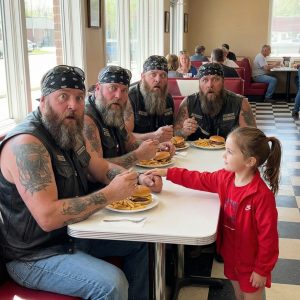
Her eyes stopped on six motorcycle riders sitting around a wooden table near the fireplace.
The man at the head of the table was Everett Danner, though most people called him Rook. He was fifty-six, broad-shouldered, and quietly imposing, with a short gray beard and a faded mark near his left eyebrow. Despite his rough leather vest and weathered hands, his eyes were calm.
The girl walked directly toward him.
Every rider at the table became silent.
Rook slowly placed his coffee mug down.
The child stopped a few feet away, trembling so badly that the stuffed fox shook in her arms.
“Please,” she whispered. “Can you help my mom?”
Rook did not stand or reach for her. He understood that frightened children needed space before they needed questions.
He leaned forward and lowered his voice.
“I’ll try, sweetheart. First, tell me your name.”
The girl swallowed.
“Callie.”
“All right, Callie. My name is Everett, but my friends call me Rook. Where is your mother?”
Callie glanced behind her as though she expected someone to appear through the door.
“She’s at home. She told me not to leave, but she couldn’t stand up this morning.”
A rider named Hollis Wynn slowly removed his glasses and set them on the table.
Rook kept his expression gentle.
“Did your mom fall?”
Callie shook her head.
Her fingers moved toward the sleeve of her coat. When she pulled it back, several dark marks were visible around her wrist.
The riders exchanged troubled looks, but no one raised his voice.
Rook felt something tighten in his chest.
“Did someone hurt you and your mother?”
Callie’s eyes filled with tears.
“Mom said we weren’t supposed to tell anyone. She said he would get angrier if people knew.”
Rook looked at the child’s untied shoe, her shaking hands, and the old stuffed fox with a torn tail.
No child should have understood fear this well.
He rose slowly from his chair.
“Where do you live, Callie?”
She pulled a folded grocery receipt from her pocket. An address had been written on the back in uneven handwriting.
“Lot twenty-four at Pine Hollow Court.”
Hollis was already reaching for his phone.
Rook turned toward him.
“Call Dr. Keaton. Tell her we may be bringing in a woman who needs immediate care.”
Then he looked at another rider, Malcolm “Mack” Farrow.
“Bring the SUV around. Quietly.”
Callie wiped her face with her sleeve.
“What if he comes home?”
Rook crouched so they were at the same height.
“Then the adults will handle it. You have already done the hardest part.”
“What part?”
“You found the courage to ask for help.”
The Ride Toward Pine Hollow
The riders did not leave on their motorcycles.
The noise of several engines would have warned half the neighborhood before they arrived. Instead, Rook, Mack, Hollis, and a former paramedic named Lionel Burke climbed into a dark-gray SUV.
Callie sat in the middle of the back seat beside Rook.
She continued holding the stuffed fox.
Mack glanced at it through the mirror.
“What’s your fox’s name?”
Callie looked down.
“Rusty.”
“That’s a good name,” Mack said. “He looks dependable.”
Callie touched the fox’s torn tail.
“Mom fixed him twice. The second time she used thread from her green sweater.”
Rook could see the mismatched stitches.
“Your mother must care about him a lot.”
“She cares because I care,” Callie answered.
Those words remained in the vehicle as they passed the final stores at the edge of Briar Glen, Pennsylvania, and turned onto a narrow county road.
Rook studied the address.
“Who lives with you?”
Callie’s voice became smaller.
“My mom and Brent.”
“Is Brent your father?”
She shook her head.
“He’s Mom’s boyfriend. He was nice when he first moved in. Then he started getting upset about everything.”
Lionel looked out the window, his jaw tightening.
Rook asked the next question carefully.
“Is Brent at home now?”
“No. He works at a warehouse. He comes back after four.”
The dashboard clock showed 1:38 p.m.
They had time, but Rook knew time could disappear quickly when someone was in danger.
“You did exactly the right thing by coming to the roadhouse,” he told her.
Callie stared through the window.
“I saw your motorcycles there before. Mom once said bikers look scary, but she also said some scary-looking people have the kindest hearts.”
Mack gave a soft laugh.
“Your mom sounds smart.”
For the first time, Callie’s mouth almost formed a smile.
The Woman Behind the Locked Door
Pine Hollow Court sat beyond an abandoned garden center, hidden behind tall weeds and bent mailboxes.
The homes were small and close together. Some had bright curtains and children’s bicycles outside. Others looked forgotten by everyone except the people forced to live inside them.
Callie pointed toward a faded cream-colored mobile home near the end of the lane.
“That one.”
Mack parked several spaces away.
Rook turned toward Callie.
“You will stay here with Mack. Keep the doors locked. Lionel, Hollis, and I are going to check on your mother.”
Callie grabbed Rook’s sleeve.
“Please don’t leave her there.”
He met her worried eyes.
“We came here to bring her out.”
Rook, Hollis, and Lionel walked toward lot twenty-four.
The porch railing leaned to one side. A broken flowerpot rested near the steps, and the curtains had been drawn tightly across every window.
Rook knocked.
No one answered.
He knocked again.
“Ma’am, my name is Everett Danner. Callie found us and asked us to check on you.”
A faint sound came from inside.
Rook tried the handle, but the door was locked.
Then a weak voice called from beyond it.
“The spare key is beneath the planter.”
Hollis lifted the broken flowerpot and found a small silver key taped underneath.
They entered slowly.
The living room was dim despite the afternoon sunlight outside. Unwashed dishes covered a side table. A chair had been knocked over near the kitchen, and a lamp lay on the carpet.
A woman rested on the couch beneath a thin blanket.
She looked to be in her early thirties. Her dark-blonde hair was tangled, her face was pale, and visible marks covered one side of her neck and arms. She tried to sit up but immediately caught her breath and pressed a hand against her side.
Lionel moved forward.
“Please don’t try to stand yet. I used to be a paramedic. May I check your breathing?”
The woman looked toward Rook.
“Where is Callie?”
“She is safe in our vehicle,” he answered. “She brought us here because she was worried about you.”
The woman closed her eyes.
Tears moved quietly across her face.
“I told her never to leave the house alone.”
“She left because she believed you needed her,” Rook said. “She may have saved both of you.”
The woman’s name was Dana Ellery.
Lionel examined her carefully and determined that she needed professional medical attention as soon as possible. Her breathing was shallow, and even the slightest movement caused visible discomfort.
“You need to leave this house,” Lionel told her. “Today.”
Dana’s face changed immediately.
“I can’t. Brent will find us.”
Rook knelt beside the couch.
“There is a private family-support center outside Briar Glen. Its location is protected, and the people there know how to help mothers and children start over safely.”
Dana shook her head.
“I tried leaving once. He found the motel before midnight.”
“This will not be a motel,” Rook replied. “And you will not be alone.”
She searched his face.
“Why are you doing this? You don’t even know us.”
Rook glanced toward the front window, where Callie was barely visible inside the SUV.
“A child ran through a cold town because she believed someone might listen. I refuse to prove her wrong.”
The First Safe Afternoon
Dana was frightened, but she finally agreed to leave.
Lionel helped her sit upright while Rook packed a small bag with clothing, important papers, and Callie’s schoolbooks. Hollis collected Dana’s phone and charger from the kitchen.
When they stepped outside, Callie unlocked the SUV before Mack could stop her.
She rushed toward her mother but slowed when she saw how carefully Dana was walking.
“Mom!”
Dana opened one arm.
Callie stepped into it gently.
“I’m sorry I left,” the girl whispered.
Dana kissed the top of her head.
“No, baby. You were brave. I’m sorry you had to be.”
They drove to Willow Haven, a private support home hidden among wooded hills outside town.
The building looked more like a peaceful country house than a facility. There were yellow curtains, clean guest rooms, warm soup on the stove, and a small shelf filled with children’s books.
The director, Maribel Sloan, met Dana at the entrance.
She did not overwhelm her with questions.
She simply said, “You and Callie are welcome here. Tonight, your only job is to rest.”
Dr. Ingrid Keaton arrived shortly afterward and examined Dana privately.
The injuries would require treatment and several weeks of careful recovery, but Dana was expected to heal.
Callie also received a gentle examination.
Dr. Keaton noticed the marks on her wrist but did not force the child to explain everything at once.
“Your body has been carrying a lot of fear,” the doctor said. “We’re going to help it feel safe again.”
Callie looked toward Rook, who stood near the doorway.
“Is he staying?”
Rook stepped closer.
“I’ll stay until you’re settled.”
“And tomorrow?”
“I’ll come back.”
She studied him for a moment.
“Promise?”
“Promise.”
Doing Things the Right Way
Rook understood that moving Dana and Callie was only the beginning.
He contacted an attorney named Jocelyn Baird, who regularly worked with Willow Haven. She helped Dana document what had happened, request legal protection, and communicate with local authorities through safe channels.
Rook’s club did not threaten Brent or attempt to force him out of town.
Instead, they helped build a careful record.
Hollis saved the messages Brent had sent to Dana’s phone. Lionel documented what he had observed before Dana received treatment. The support center preserved photographs and medical notes. Neighbors quietly confirmed that they had often heard arguments but had been too afraid to become involved.
When Brent returned to lot twenty-four that evening, he discovered Dana and Callie were gone.
He called repeatedly.
Dana did not answer.
Later, he sent messages demanding to know where they were, followed by apologies and promises that everything would change.
Jocelyn read each message.
“Do not respond,” she told Dana. “Every message is part of the record now.”
Within two days, Brent was formally ordered not to contact Dana or Callie. His workplace was notified that he was not permitted to use company information to locate them.
For the first time in years, Dana went to sleep without listening for his truck.
Callie slept beside her with Rusty tucked beneath her chin.
In the morning, she woke and asked, “Are we still safe?”
Dana looked around the warm room, then toward the locked door.
“Yes,” she said. “We are still safe.”
A Home With Windows Left Open
Recovery did not happen all at once.
Dana sometimes woke in the middle of the night believing she had heard footsteps outside. Callie became nervous whenever a man raised his voice in public, even if he was only cheering during a football game.
Maribel arranged counseling for both of them.
Rook and the other riders visited on Saturdays. They fixed a loose fence behind Willow Haven, brought groceries, repaired donated furniture, and never asked Dana to tell them more than she wanted to share.
Three months later, Dana moved into a small apartment above a flower shop in Westbridge.
It had two bedrooms, pale walls, and large windows overlooking a quiet street.
At first, Dana kept every curtain closed.
One sunny morning, Callie opened them.
“I want to see outside,” she said.
Dana’s hand paused over the curtain.
Then she let it remain open.
She found work at a family-owned bakery, where the morning shifts allowed her to meet Callie after school. The owner, a patient woman named Florence Neal, never treated Dana like someone who needed to be rescued forever.
She treated her like a capable person rebuilding her life.
Callie joined an after-school art club. She drew trees, houses, animals, and motorcycles with enormous wheels.
One drawing showed six riders standing beside a little girl holding a fox.
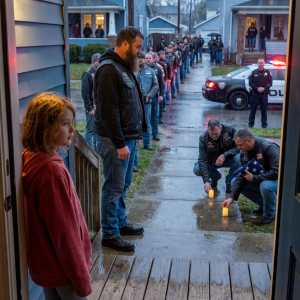
Above them, Callie had written, “The day people listened.”
The Photograph Rook Returned
One afternoon, Rook visited the apartment carrying a framed picture.
He had found it inside a drawer while helping Jocelyn retrieve Dana’s belongings from the old home.
The photograph showed Dana and Callie sitting on a park bench beside a lake. Dana looked younger and relaxed. Callie had ice cream on her nose.
When Dana saw it, she covered her mouth.
“I thought Brent threw this away.”
Rook handed it to her.
“Some things deserve to be returned.”
Callie studied the picture.
“That was the day Mom let me feed the ducks even though the sign said not to.”
Dana laughed—a real, unguarded laugh.
“You were supposed to keep that secret.”
“We don’t keep scary secrets anymore,” Callie replied.
Dana became quiet.
Then she pulled her daughter close.
“No,” she agreed. “We don’t.”
Before leaving, Rook placed a small card on the kitchen counter. It contained his phone number, Mack’s number, and Willow Haven’s emergency contact.
“You may never need these,” he said. “But keep them anyway.”
Callie hugged him around the waist.
“You said you would come back, and you did.”
Rook rested one hand gently on her shoulder.
“A promise only matters when someone keeps showing up.”
The Girl Who Grew Into an Answer
Fourteen years passed.
Callie Ellery became a confident young woman with her mother’s kindness and a determination that belonged entirely to her.
She studied social work and later joined a community organization that supported families in difficult situations.
A framed drawing still hung in her office.
It showed six motorcycles, a stuffed fox, and a little girl beneath the words, “The day people listened.”
One rainy afternoon, a nervous mother entered Callie’s office holding the hand of a young boy.
The woman looked exhausted. The boy kept his eyes on the floor.
“I’m sorry,” the mother said. “I didn’t know where else to go.”
Callie walked around her desk and pulled out two chairs.
She remembered the cold air in Cedar Ridge Roadhouse. She remembered Rook lowering his voice so she would not feel frightened. She remembered the first sentence that made her believe her future could be different.
Callie smiled gently.
“You came to the right place.”
The woman’s eyes filled.
“Are you sure?”
Callie reached across the table.
“Yes. You do not have to face this alone.”
Outside her office window, an older man with a gray beard waited beside a parked motorcycle.
Rook was seventy now. He walked more slowly, and his hands were not as steady as they once were, but he still visited every month.
Callie looked toward him and smiled.
Years earlier, he had shown her that strength did not always arrive wearing a uniform or making loud promises.
Sometimes strength sat quietly at the back of a roadhouse, listened to a frightened child, and decided not to look away.
Asking for help does not make someone weak, because it often takes extraordinary courage to admit that a situation has become too heavy to carry without the support of another person.
A frightened child should never be expected to protect the adults around them, yet when a child finally speaks, every responsible adult has a duty to listen carefully and respond with patience rather than doubt.
Real kindness is not measured by appearances, clothing, profession, or social status, but by what someone chooses to do when another person arrives with fear in their eyes and nowhere safe to turn.
Leaving a harmful environment is rarely as simple as walking through a door, because fear, financial pressure, uncertainty, and past disappointments can make freedom feel more frightening than the life someone already knows.
People rebuilding their lives do not need constant reminders of what happened to them; they need respect, practical support, safe choices, and the freedom to decide who they will become next.
Silence may prevent an argument for one evening, but lasting peace can only begin when the truth is heard, believed, and handled by people who value safety more than convenience.
Healing often appears through ordinary moments—a full night of sleep, an open curtain, a peaceful breakfast, a child laughing at school—because a new life is created through small experiences of safety repeated over time.
Keeping a promise does not always require a dramatic act; sometimes it means answering the phone, returning the next day, remembering an important detail, or continuing to stand nearby after everyone else has moved on.
One person’s decision to listen can change the direction of an entire family, and the compassion shown in a single afternoon may continue through future generations in ways no one could have predicted.
The past may explain why someone feels afraid, guarded, or uncertain, but it does not have the authority to determine every chapter ahead, because love, support, and brave choices can slowly build a future where hope feels natural again.