The Circle That Everyone Misunderstood
At 4:23 on a humid Thursday afternoon, traffic suddenly slowed along Cypress Ridge Road in Osceola County, Florida.
Dark clouds hung low over the highway, trapping the summer heat close to the pavement. A county patrol vehicle stood sideways near the shoulder, its emergency lights flashing across the road. Cars reduced their speed as they approached the curve, while several drivers leaned toward their windows to see what had happened.
From a distance, the scene appeared deeply troubling.
A uniformed officer was kneeling in the middle of the road.
Motorcycles were arriving from both directions.
At first, there were only three riders. Then five more appeared. Within minutes, a long line of motorcycles filled the shoulder, their engines creating a steady rumble beneath the heavy afternoon sky.
The riders wore dark leather vests, worn jeans, faded boots, and expressions that revealed nothing.
They parked carefully, stepped away from their motorcycles, and walked toward the officer.
Then they formed a circle around him.
Inside nearby vehicles, people began making assumptions.
Some believed the officer had been surrounded.
Others lifted their phones, certain they were about to record a confrontation.
But no one outside that circle could see what was happening on the pavement.
The officer was not reaching for his radio.
He was not giving orders.
He was pressing both hands against the chest of a small child.
Up.
Down.
Up.
Down.
And the bikers were not there to threaten him.
They were there to make sure no vehicle came close enough to place the child in greater danger.
The Little Bicycle Near the Curve
Deputy Silas Brenner had been the first emergency responder to reach the scene.
The original call had described a bicycle accident near a sharp bend where drivers often traveled faster than they realized. Silas expected to find a frightened child with a scraped knee or perhaps a damaged bicycle.
Instead, he found a small boy lying completely still on the road.
A blue bicycle rested several feet away, its front wheel bent beneath the frame. A green backpack had opened near the shoulder, scattering a notebook, two pencils, and a small plastic dinosaur across the pavement.
The boy’s mother, Dana Kessler, was kneeling in the grass.
Her hands shook so badly that she could barely hold her phone.
“Please help him,” she cried. “Please, he isn’t answering me.”
Silas immediately dropped beside the child.
The boy appeared to be about seven years old. His skin was pale, and his breathing could not be clearly detected. Silas checked quickly, called for medical assistance, and began the lifesaving procedure he had practiced countless times during training.
He placed his hands carefully and started counting.
“Come on, buddy,” he whispered. “Stay with me. You’re not alone.”
His arms moved in a steady rhythm.
Thirty compressions.
A short pause.
Then again.
The boy’s mother continued calling his name from the edge of the road.
“Micah! Mommy is right here! Please open your eyes!”
That was how Silas learned the child’s name.
“Stay with us, Micah,” the deputy said, his voice growing strained. “Help is coming.”
The Sound of Motorcycles
The first motorcycles arrived less than two minutes later.
One rider had been traveling nearby when he saw the emergency lights. He recognized the child’s bicycle and immediately contacted other members of his local riding group.
The riders came quickly, but they did not rush into the center of the scene.
They understood that Silas needed room.
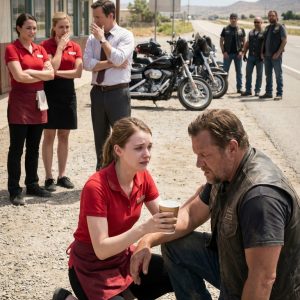
Without being instructed, they spread across the roadway and shoulder. Several riders stood far enough from the child to avoid interfering, while still creating a visible barrier against approaching vehicles.
A large man with silver hair raised one hand toward traffic.
“Slow down and stay back,” he called. “There’s a child in the road.”
His voice was firm, but it held no aggression.
Another rider moved the damaged bicycle away from the traffic lane. A third collected the boy’s school supplies and placed them inside the open backpack.
None of them shouted at the deputy.
None of them stepped into his working space.
They simply formed a protective wall.
Yet from the line of waiting vehicles, the truth remained hidden.
A driver in a pickup truck spoke nervously to the woman beside him.
“That officer is surrounded.”
A passenger in another car began recording.
“Something bad is about to happen,” he said.
But inside the circle, the only struggle was the fight to keep a small boy breathing.
The Father Who Could Not Move
Tate Kessler arrived with the second group of riders.
He was forty-two years old, tall and broad-shouldered, with a trimmed brown beard and a weathered leather vest he had owned for nearly fifteen years.
Someone had sent a brief message to the riders’ group chat.
Child down near Cypress Ridge curve. Blue bicycle. Emergency vehicles coming.
Tate had not known the child’s identity.
Then he pushed through the outer edge of the circle and saw one small red sneaker beside the deputy’s knee.
He recognized it immediately.
He had bought those sneakers for his son three weeks earlier.
For several seconds, Tate could not move.
The sound of engines disappeared from his awareness. The flashing lights became nothing more than blurred colors. He could only see Micah’s small body beneath the deputy’s hands.
Dana looked toward him from the grass.
“Tate,” she cried. “He was coming home from his friend’s house. I found him here. He won’t wake up.”
Tate took one step forward, but stopped himself.
Every part of him wanted to run to his son. He wanted to hold Micah, call his name, and demand that someone explain what was happening.
But he saw the deputy’s concentration.
He saw the careful rhythm.
He understood that interfering could cost precious seconds.
Tate turned toward the other riders.
“Give the deputy room,” he said, forcing his voice to remain steady. “Nobody steps inside this circle unless the medics ask.”
The riders immediately moved back.
Two of them walked farther down the road to warn approaching drivers. Another stood beside Dana without touching her, simply making sure she did not collapse.
Tate remained near the edge of the circle.
His fists were closed at his sides, and his eyes never left his son.
A History Between Them
When Silas briefly looked up, he recognized Tate.
Nearly nine years earlier, Silas had stopped him on a rural highway after receiving reports of motorcycles traveling too quickly through a residential area.
Tate had been given a citation. Because he was already struggling financially at the time, the consequences affected his work and placed additional pressure on his young family.
For years, Tate had blamed Silas.
Whenever he saw the deputy’s patrol vehicle around town, he remembered that difficult season. In Tate’s mind, Silas represented a moment when authority had felt cold and unforgiving.
Now that same deputy was kneeling in the road, using every ounce of strength he had to save Tate’s son.
Silas continued the compressions.
His shoulders began to ache.
Sweat ran from his forehead and darkened the collar of his uniform.
Still, he did not slow down.
“Come on, Micah,” he whispered. “Your family is waiting for you.”
Tate heard the words.
Something inside him shifted.
The man he had resented for years was not behaving like an uncaring stranger. He was fighting as though the child beneath his hands belonged to someone he loved.
The Arrival of Backup
A second patrol vehicle pulled up from the opposite direction.
Two deputies stepped out and immediately noticed the large group of riders surrounding Silas.
For a brief moment, their posture tightened.
One deputy called from a distance.
“Everyone needs to step away from the emergency area.”
Tate raised both hands where they could be seen.
“We’re keeping traffic back,” he explained. “The child is my son. We won’t interfere.”
Silas did not stop working, but he spoke loudly enough for the deputies to hear.
“They’re helping secure the road.”
The tension eased.
The newly arrived deputies moved toward the waiting vehicles and began redirecting traffic. They did not order the riders to leave. Instead, they worked beside them.
Uniforms and leather vests now stood along the same roadway, united by one purpose.
Keep the area clear.
Give the child a chance.
The Siren Everyone Needed to Hear
The ambulance siren first sounded far in the distance.
Tate closed his eyes for half a second.
The sound grew louder as the vehicle approached the curve. The riders instantly widened the opening in the circle.
The ambulance stopped only a few yards from Micah.
Two paramedics hurried forward carrying medical equipment and a folded stretcher.
Silas continued until one paramedic knelt beside him and placed a hand on his shoulder.
“We have him,” she said.
Silas leaned back, breathing heavily.
The medical team worked quickly, checking Micah and providing additional support. Tate stood beside Dana, holding her hand so tightly that neither of them could feel their fingers.
The seconds seemed endless.
Then one paramedic looked up.
“We have a pulse,” he announced. “It is weak, but it is there.”
Dana covered her face and began sobbing.
Tate lowered his head, unable to speak.
Several riders turned away, pretending to study the sky or their motorcycles because they did not want anyone to see the emotion in their eyes.
Silas remained on his knees.
His hands were shaking from exhaustion.
For the first time since arriving, he allowed himself to take a full breath.
What the Drivers Finally Understood
The paramedics carefully moved Micah onto the stretcher.
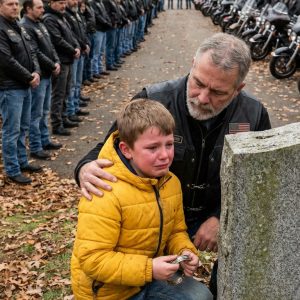
As they carried him toward the ambulance, the bikers opened their circle without being asked. They created a clear path and kept the crowd from moving closer.
The people who had been filming began lowering their phones.
A woman stepped out of her car and approached one of the backup deputies.
“I thought those men were surrounding your officer,” she admitted quietly.
The deputy looked toward the riders.
“They were,” he answered. “But not for the reason everyone assumed.”
She glanced at the marks on the roadway where the child had been lying.
“They were protecting him.”
“Yes,” the deputy said. “They were protecting all of them.”
The scene had looked like a confrontation from far away.
Up close, it was cooperation.
The riders had not gathered to challenge the deputy.
They had built a human barrier around a vulnerable child and the man trying to save him.
The Words Beside the Ambulance
Before the ambulance doors closed, Dana climbed inside to accompany Micah.
Tate would follow on his motorcycle with several riders behind him.
But before leaving, he walked toward Silas.
The deputy had stood up, though his legs still felt unsteady. His uniform was damp with sweat, and his arms hung heavily at his sides.
Tate stopped several feet away.
For a moment, neither man spoke.
Years of frustration stood between them, but so did the image of Micah lying in the road.
Finally, Tate said, “You could have stopped when the medics were close.”
Silas shook his head.
“Close wasn’t enough.”
Tate swallowed hard.
“You kept going even when your arms were shaking.”
Silas looked toward the ambulance.
“He is seven years old. He deserved every chance we could give him.”
Tate nodded slowly.
Then he extended his hand.
“Thank you for fighting for my boy.”
Silas accepted it.
“I would do the same for any child.”
The answer was simple, but Tate understood its meaning.
Silas had not acted because Micah was connected to someone important.
He had acted because a child needed him.
Waiting Beneath the Hospital Lights
That evening, Tate stood in a hallway at Pinecrest Children’s Medical Center in Kissimmee.
His vest was unzipped, his hair was damp from the heat, and his hands still carried tiny traces of road dust from collecting Micah’s belongings.
Dana sat nearby, holding their son’s green backpack against her chest.
More than thirty riders waited quietly outside the hospital. Only four had entered the building, respecting the family’s need for space.
No one played music.
No one made unnecessary noise.
They simply remained close.
Shortly after eight, a doctor entered the hallway.
“Micah is stable,” she said. “He has a concussion and several painful injuries, but he is breathing normally now. We expect him to recover.”
Dana began crying again, this time from relief.
Tate placed both hands over his face.
The doctor continued gently.
“The early help he received was extremely important. Whoever began assisting him on the road gave us valuable time.”
Tate looked down the hallway.
Silas had just arrived.
He was no longer wearing his patrol hat. His expression was tired, and there was a faint redness across his palms.
Tate walked toward him.
“The doctor said he is going to recover.”
Silas released a breath he had been holding since the afternoon.
“That is the best thing I have heard all day.”
The Conversation That Changed Two Men
They stood near a vending machine while the hospital continued moving around them.
Nurses passed with folders. Families spoke quietly in nearby rooms. A machine hummed at the end of the hallway.
Tate looked at Silas.
“I was angry with you for years.”
Silas nodded.
“I remember the traffic stop.”
“That citation came at the worst possible time.”
“I know.”
Tate expected the deputy to defend himself, but Silas did not.
After a pause, Silas said, “I believed I was doing what I was supposed to do. But that does not mean the situation was easy for you.”
Tate glanced toward Micah’s room.
“Today you did more than your job.”
“Today I saw a child who needed help.”
Tate extended his hand for the second time that day.
This time, the handshake felt different.
It was not only gratitude.
It was the end of an old resentment neither man needed to carry any longer.
The Boy Who Opened His Eyes
Micah opened his eyes shortly before midnight.
The room was quiet except for the soft sounds of medical equipment. Dana sat on one side of the bed, while Tate stood on the other.
Silas remained near the doorway, ready to leave without interrupting the family.
Micah blinked several times.
“Dad?”
Tate leaned closer immediately.
“I’m right here, buddy.”
Micah looked confused.
“Did I fall off my bike?”
“You had an accident near the big curve,” Tate explained gently. “But a lot of people helped you.”
Micah slowly turned his head and noticed Silas.
“Were you there?”
Silas stepped closer.
“I was.”
The boy studied him for several seconds.
“Did my dad bring all the motorcycle guys?”
Tate laughed softly, though his eyes filled with tears.
“Not all of them,” he said. “Only enough to fill the parking lot.”
Micah managed a weak smile.
Then he looked back at Silas.
“Thank you for not leaving me.”
The deputy lowered himself beside the bed.
“I was never going to leave you, Micah.”
The boy’s eyes slowly closed again, but this time everyone knew he was simply resting.
The Quiet Ride Home
The riders began leaving the hospital after learning Micah was safe.
Their motorcycles started one by one beneath a clear night sky.
There was no loud celebration.
No one raced from the parking lot.
They rode away in small groups, carrying relief with them.
Before the last riders departed, Tate stepped outside and addressed them.
“You protected my family today,” he said. “I will never forget that.”
The silver-haired rider placed a hand on Tate’s shoulder.
“That is what a circle is supposed to do,” he replied. “It keeps danger out and holds the people inside together.”
Tate looked toward the hospital entrance, where Silas was preparing to leave.
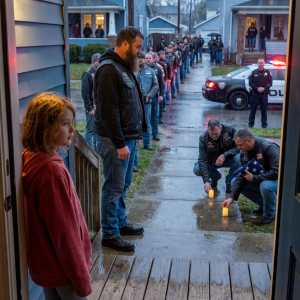
Hours earlier, the roadside circle had appeared threatening to everyone watching from a distance.
But the people inside it knew the truth.
It was built from discipline.
From loyalty.
From restraint.
And from the shared belief that saving one small life mattered more than history, appearance, pride, or misunderstanding.
What Real Strength Looked Like That Day
The story spread through the county over the following days.
Some people shared the videos they had recorded, but the earliest clips showed only what they had expected to see: a lone officer surrounded by bikers.
Later recordings revealed the full picture.
They showed riders directing traffic away from the scene.
They showed deputies working beside them.
They showed Silas refusing to stop until the medical team took over.
Most importantly, they showed how wrong first impressions could be.
Tate visited Silas at the sheriff’s office after Micah returned home.
Micah came with him, walking carefully but smiling.
He carried a thank-you card covered in drawings of motorcycles, patrol vehicles, and one large circle around a stick figure lying safely in the middle.
Silas read the message inside.
“Thank you for helping my heart keep going. My dad says you are part of our riding family now.”
Silas smiled.
“I do not own a motorcycle.”
Micah shrugged.
“Dad says we can make an exception.”
Tate laughed and looked at the deputy.
For the first time, there was no bitterness between them.
Only respect.
The circle on Cypress Ridge Road had protected a child that afternoon.
But it had also done something no one expected.
It had brought together people who had spent years standing on opposite sides of an old memory.
And it reminded an entire community that true strength is not measured by how loudly people demand attention.
Sometimes strength looks like an exhausted officer refusing to stop.
Sometimes it looks like a frightened father choosing not to interfere.
Sometimes it looks like dozens of riders standing quietly in the heat, using their bodies to keep danger away.
And sometimes the scene that appears most threatening from a distance becomes an unforgettable example of compassion when people finally move close enough to see the truth.
Never decide who someone is based only on clothing, profession, appearance, or reputation, because the person you misunderstand from a distance may be the very person quietly protecting someone when no recognition is offered.
Real strength does not always enter a difficult moment with raised voices or dramatic gestures; often, it appears through discipline, patience, and the willingness to remain steady while everyone else is controlled by fear.
The strongest communities are not built by people who always agree, but by people who can set aside old differences long enough to protect an innocent person whose future depends on their cooperation.
A uniform does not automatically reveal the character of the person wearing it, just as a leather vest does not tell the whole story of the heart beneath it, because compassion belongs to individuals rather than appearances.
Resentment may feel justified when we carry memories of difficult experiences, but life sometimes offers an unexpected moment that allows understanding, gratitude, and forgiveness to replace the weight we have carried for years.
Helping someone does not always require taking control of the situation; sometimes the most valuable contribution is creating space, reducing confusion, and allowing the person with the right training to do what must be done.
Children often survive their hardest moments because adults who do not know one another choose responsibility over pride, proving that humanity becomes strongest when everyone focuses on the life that needs protecting.
Before recording, judging, or sharing a tense scene, pause long enough to understand what is truly happening, because a partial image can create a completely false story about people whose intentions are honorable.
Gratitude can rebuild a bridge that anger once destroyed, especially when one sincere act reveals that the person we blamed for an old wound may still possess courage, kindness, and deep respect for human life.
The circle formed on that road reminds us that protection does not have to look aggressive, loyalty does not have to be loud, and people with very different histories can still stand together when compassion matters more than conflict.