Part 1 – The Child in the Cardiology Hallway
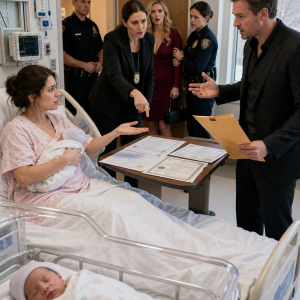
Fourteen months after her divorce became final, Dr. Allison Grant encountered her former husband outside the pediatric cardiology department of Riverbend Children’s Hospital in Columbus, Ohio.
She was carrying a tablet loaded with surgical schedules and quality-review reports, while the identification badge clipped to her white coat displayed the title Director of Pediatric Anesthesiology. A staffing meeting would begin in ten minutes, and Allison might have continued walking if Blake Mercer had not positioned himself directly across the hallway as though the encounter were something he had been rehearsing.
He stood beside an expensive stroller, wearing a navy overcoat and polished shoes that reflected the ceiling lights. One hand rested on a leather diaper bag, while the other adjusted the blanket covering a small boy with pale brown hair and wide gray eyes.
Beside him stood Tessa Vaughn, Allison’s closest friend throughout medical school, residency, and the first decade of her marriage. Tessa held a bottle against her chest and looked considerably less confident than Blake.
Allison had once trusted Tessa with details she had not shared with her own sisters. Tessa attended fertility consultations, brought food after failed treatment cycles, and sat beside Allison while she cried over another negative test. During those same years, she was quietly becoming the person Blake called after leaving their home.
Blake saw Allison and immediately smiled.
“Well, this is unexpected,” he said loudly enough for the nurses at the reception desk to hear.
Allison stopped several feet away.
“Hello, Blake.”
His expression tightened because her voice remained calm. During their marriage, Blake collected emotional reactions and later rearranged them into evidence that Allison was difficult. Tears proved she was unstable, anger proved she was hostile, and silence proved she was incapable of intimacy.
He had never known what to do with composure.
Blake glanced at her badge.
“Still building your entire identity around the hospital?”
Tessa lowered her eyes toward the stroller.
“I enjoy my work, and my patients benefit from that commitment,” Allison replied.
“You always had a polished explanation for choosing work over a family.”
Several people nearby became still. A nurse stopped typing, while a father beside the vending machines lowered his coffee. Blake moved closer to the stroller, ensuring Allison could see the child clearly.
The little boy reached for a stuffed elephant attached to the safety bar. None of the bitterness above him belonged to him, and Allison refused to let her gaze become another instrument used against an innocent child.
Blake placed one hand on the stroller handle.
“Leaving you was the first honest decision I made in years,” he said. “Some men eventually accept that a marriage cannot become a family when the woman involved is incapable of giving them children.”
Tessa whispered his name, but Blake continued because the audience had grown.
“Fortunately, life corrected itself. Tessa and I have a healthy fourteen-month-old son, and he has given me everything our marriage never could.”
Allison remembered eight years of consultations, blood tests, injections, surgical procedures, and silent drives home from fertility clinics. She remembered apologizing to Blake for the failure of a body she believed had betrayed them. He accepted every apology without once suggesting the problem might not belong to her.
Now he stood in a children’s hospital using those years as entertainment.
Allison looked at the child again. He had Tessa’s narrow chin and dark lashes, although neither feature matched Blake. More importantly, Tessa’s hand around the bottle was trembling.
Fear appeared in her posture rather than pride.
Allison returned her attention to Blake and offered a small, controlled smile.
“Really?”
His confidence faltered.
“What is that supposed to mean?”
“It means I heard what you said.”
Her phone vibrated inside her coat pocket. The message came from attorney Evelyn Price, who had represented Allison during the divorce.
URGENT. FINANCIAL DISCOVERY COMPLETE. I AM IN THE MAIN LOBBY WITH THE COURT FILING.
Blake stepped closer.
“You always did enjoy pretending you knew more than everyone else.”
“Our marriage taught me that appearances and facts are frequently unrelated.”
Tessa’s face became pale.
Allison excused herself and continued toward the elevators without looking back. Behind her, Blake laughed as though he had won the exchange, although his voice lacked its earlier certainty.
Part 2 – The Diagnosis He Allowed Her to Carry
Evelyn waited near the hospital’s central atrium with two folders and a laptop. She had requested post-divorce financial discovery after Blake applied for a commercial development loan and declared assets inconsistent with the disclosures he submitted during their settlement.
They entered a private consultation room normally used for families awaiting surgical updates.
“The lender contacted the title company about several properties transferred through Mercer Development Holdings,” Evelyn explained. “Those transfers revealed accounts Blake omitted during the divorce.”
The hidden assets included two rental properties, investment shares, and nearly eight hundred thousand dollars routed through a management company controlled by Blake’s cousin. Some funds had been accumulated during the marriage, which meant Allison had been entitled to disclosure regardless of whose name appeared on the accounts.
“We can reopen the property judgment because he signed sworn statements declaring those assets did not exist,” Evelyn continued. “However, the financial discovery uncovered something else.”
She opened the second folder.
During the original divorce, Blake resisted producing records from a private reproductive health clinic. He claimed the files contained unrelated personal information. The new court order compelled complete disclosure because several payments to that clinic came from a concealed account.
The earliest report was dated eighteen months before Allison and Blake began fertility treatment together.
It stated that Blake had a genetic condition causing permanent infertility. Multiple specialists confirmed that natural conception was medically impossible, and the report recommended donor conception or adoption.
Allison read the conclusion several times.
“He knew before our first appointment.”
“Yes,” Evelyn said. “He also signed a document refusing permission for the clinic to share the diagnosis with a spouse or future treatment provider.”
The room seemed to lose its dimensions.
Allison remembered physicians focusing every consultation on her hormone levels, uterine structure, age, weight, and work schedule. Blake provided limited samples at a separate clinic and later claimed his results were normal. Whenever Allison suggested obtaining another opinion, he accused her of refusing to accept responsibility.
His mother called her defective during a Thanksgiving dinner. Blake remained silent, then later asked Allison not to embarrass him by creating family conflict.
He had watched her undergo years of invasive treatment while carrying the truth in a locked file.
“Why did the fertility clinic proceed without his complete records?” Allison asked.
“He used different facilities and presented altered summaries. We found payments to a records consultant who later lost his license for falsifying medical documentation.”
Allison placed the report on the table.
Her first response was not rage. It was a strange physical emptiness, as though years of grief had been lifted from her body before she knew where to place them.
“He did not merely lie about being infertile,” she said. “He constructed a medical history that made me responsible.”
Evelyn nodded.
“There is another complication. Blake used these concealed records when applying for life insurance six months ago, so the verified diagnosis appeared in the underwriting file. That recent disclosure establishes that he still knows the condition is permanent.”
Allison thought about the child in the stroller.
“Then he cannot be the biological father.”
“Not through natural conception,” Evelyn replied. “The records show no surgical retrieval, donor arrangement, or assisted reproductive procedure involving Blake.”
Tessa had once worked as a research coordinator at the same private clinic. If she knew Blake’s condition, the deception extended far beyond infidelity.
Allison remembered the fear in Tessa’s face and understood that the woman might have discovered the truth only after the child was born.
Evelyn slid a petition across the table.
“We can address the hidden assets and medical fraud without involving the child’s parentage. However, Blake used the child as evidence of his alleged fertility in sworn financial documents, claiming increased family obligations while requesting reduced payments under the settlement.”
By placing the child inside a legal argument, Blake had made paternity relevant.
“File the petition,” Allison said. “Request the records, but protect the child’s identity as much as the court permits.”
Part 3 – The Message from the Woman Who Betrayed Her

Tessa contacted Allison two days later through an encrypted hospital messaging system.
PLEASE MEET ME WITHOUT BLAKE. I FOUND DOCUMENTS THAT DO NOT MAKE SENSE.
Allison considered ignoring her. Friendship did not survive simply because the betrayer became frightened by the person she had chosen. However, the child’s welfare mattered more than Allison’s desire for distance.
They met in a quiet café near the hospital after Allison’s final procedure.
Tessa arrived without makeup, carrying a thick envelope beneath her coat. The confident woman from the cardiology hallway had disappeared.
“Blake believes I am taking our son to a specialist appointment,” she said.
“Why does your child need a cardiologist?”
“A murmur was detected during his routine examination. The physician believes it is probably harmless, but Blake insisted we use Riverbend because he wanted the best department.”
The explanation made the hallway encounter feel even more deliberate. Blake had seen Allison’s name on the department leadership page and expected the possibility of meeting her.
He had brought a sick child into a public performance.
Tessa placed the envelope on the table.
Inside were copied tax records, property statements, and correspondence between Blake and the medical records consultant. One message discussed preserving the infertility diagnosis as leverage if Tessa ever attempted to leave.
“When did you learn he was infertile?” Allison asked.
Tessa’s mouth trembled.
“Three weeks ago. I found the insurance application in his office after he left the drawer unlocked.”
“Did you believe he was the father before that?”
“Yes. We began seeing each other during your final year of marriage, but I had also been involved with someone else shortly before Blake promised to leave you.”
Allison remained silent.
Tessa explained that the other man was Daniel Cross, a clinical researcher who worked with her at a university laboratory. Their relationship ended when Blake demanded exclusivity. She learned about the pregnancy several weeks later, and Blake immediately claimed the child as his because the timing appeared possible.
“He refused a prenatal paternity test,” Tessa said. “He told me trust mattered more than genetics, and I thought that meant he loved the baby regardless.”
“Now you believe he already knew the child could not be his.”
“Yes. I believe he wanted a son he could display while hiding the diagnosis that embarrassed him.”
Tessa covered her face briefly.
“He used the child to prove you had been the problem. He also used us to improve his image with investors who preferred a family-oriented developer.”
Allison looked through the correspondence. One draft press release described Blake as a devoted father whose painful first marriage had prevented him from experiencing family life. Another document referred to the child as evidence of personal renewal.
“Did Daniel know about the pregnancy?”
“I never told him. He moved to Arizona before the birth, and Blake convinced me contacting him would create unnecessary confusion.”
Allison pushed the documents toward Tessa.
“You need your own attorney. The child deserves a truthful medical history, particularly if the murmur becomes relevant.”
Tessa’s eyes filled.
“I know I have no right to ask for forgiveness.”
“You do not.”
The answer landed without cruelty because cruelty was unnecessary.
“You listened while I blamed myself for years,” Allison continued. “You attended appointments and comforted me while sleeping with the man who knew the diagnosis belonged to him.”
“I did not know about the diagnosis then.”
“You knew about the affair.”
Tessa lowered her head.
“Yes.”
“That truth is enough.”
They agreed to share evidence through their separate attorneys. Allison did not promise reconciliation, emotional support, or secrecy beyond what protected the child.
Part 4 – The Hearing Blake Expected to Control
The emergency hearing took place in Franklin County Domestic Relations Court three weeks later. The courtroom was closed to the public because the filings involved confidential medical information and a minor child.
Blake entered wearing a dark suit and the expression he once used during hospital fundraisers, where charm operated as a form of currency. His attorney argued that Allison was reopening old wounds because she remained resentful about Blake’s new family.
“Dr. Grant’s allegations combine financial speculation with an improper attempt to question a child’s legitimacy,” the attorney said. “Mr. Mercer has moved forward, while his former wife appears unable to accept that outcome.”
Allison sat beside Evelyn without reacting.
Judge Marjorie Bennett reviewed the hidden property records first. Bank statements, loan applications, and title transfers established that Blake knowingly omitted marital assets. His signature appeared on sworn disclosures and subsequent financial documents describing the same assets as personal property acquired years earlier.
The judge rejected his explanation that accountants had made classification errors.
Then Evelyn introduced the reproductive health records.
Blake’s confidence changed.
His attorney attempted to block the documents, but the judge ruled that Blake had made fertility relevant by using his claimed biological child to request financial relief and support a narrative that Allison caused the couple’s infertility.
“Mr. Mercer,” the judge said, “did you know before marrying Dr. Grant that medical specialists considered you permanently infertile?”
Blake looked toward his attorney.
“I received an uncertain diagnosis, but physicians sometimes make mistakes.”
Evelyn presented reports from three specialists, genetic testing, and the recent insurance application in which Blake confirmed the condition.
“Did you disclose this diagnosis to your former wife before she underwent fertility treatment?” the judge asked.
“Our reproductive decisions were private and complicated.”
“That response does not answer the question.”
Blake’s composure began to fracture.
“No, I did not disclose it.”
Allison heard Tessa inhale sharply from the opposite table.
The court then considered the child’s parentage because Tessa’s attorney requested immediate genetic clarification for medical reasons. Daniel Cross had voluntarily provided a sample after being contacted and learning he might have a son.
The laboratory report confirmed a biological relationship between Daniel and the child with overwhelming probability. Blake had no genetic relationship.
Tessa closed her eyes. Her bottle from the hospital hallway had fallen from her hand when Daniel first entered the attorneys’ conference room five minutes after Blake’s public boast. That was the man whose arrival had transformed her fear into certainty.
Daniel did not appear triumphant in court. He looked devastated that fourteen months of his son’s life had passed without his knowledge.
Blake stood abruptly.
“I raised that boy. A laboratory report does not erase what I have done for him.”
The judge ordered him to sit.
“Biology does not erase an established emotional relationship, but deception cannot be ignored when determining future custody and legal responsibility.”
Tessa’s attorney introduced messages showing that Blake knew the child was unlikely to be his before birth. He discouraged testing because public fatherhood strengthened his development company’s image and allowed him to humiliate Allison through a visible proof of fertility.
The truth was uglier than simple doubt. Blake had selected a child as a symbol.
The judge ordered temporary parenting arrangements supervised by a child specialist, recognized Daniel’s right to pursue legal paternity, and prohibited Blake from using the child in business promotion or public statements.
She reopened the divorce property judgment, sanctioned Blake for false disclosures, and referred the altered medical documents to prosecutors and the state insurance fraud unit.
Blake looked at Allison as officers collected copies of the evidence.
“You destroyed my family because you could not tolerate seeing me happy.”
Allison answered without raising her voice.
“I did not create the diagnosis, hide the assets, alter the records, or choose a child as proof of your pride. I only stopped accepting responsibility for decisions you made.”
Part 5 – Two Women Leaving the Same Lie
The months after the hearing were complicated rather than satisfying.
Daniel began supervised visits with his son while establishing legal paternity. He approached the process carefully, understanding that a fourteen-month-old child could not reorganize his attachments simply because adults discovered the truth.
Blake requested continued contact. The child specialist recommended limited supervised visits because the boy recognized him as a caregiver. Allison privately agreed with that recommendation, although she owed Blake nothing.
A child’s emotional stability should not become collateral damage in an adult reckoning.
The financial case ended with Blake surrendering the concealed properties and paying substantial penalties. Prosecutors charged him with perjury, insurance fraud, and falsification of medical documentation. His development company removed him after lenders concluded that his personal disclosures could not be trusted.
He did not lose everything because Allison possessed greater power. He lost control over assets and positions obtained through false statements.
Tessa moved into a smaller apartment and returned to work after maternity leave. She and Allison met once more at Tessa’s request.
They chose a restaurant halfway between their neighborhoods, where neither had memories attached to the tables.
“Daniel has been patient,” Tessa said. “He is angry, but he does not direct it toward the baby.”
“That is the minimum the child deserves.”
Tessa nodded.
“Blake has started telling people I deceived him. He says I deliberately gave him another man’s child.”
Allison almost smiled at the predictability.
“He will continue rewriting the story until every version protects him.”
Tessa looked down at her hands.
“I once believed you were exaggerating when you described the way he changed conversations. I told myself you were bitter because the marriage was ending.”
“You believed the version that allowed you to continue the affair.”
“Yes.”
The admission was quiet and complete.
Tessa apologized without requesting that Allison restore their friendship. She acknowledged that remorse did not return the years she spent helping Blake isolate his wife.
“I hope you eventually believe that I regret what I did,” Tessa said.
“I believe you regret it now. That does not mean I can trust you again.”
They left the restaurant separately.
Allison did not forgive Tessa in the traditional sense, nor did she carry active hatred. She understood that closure sometimes meant recognizing another person’s remorse without offering them continued access to your life.
Part 6 – A Future Without Medical Evidence Against Herself
Six months after the hearing, Allison accepted a position as chief medical officer for a regional pediatric care network expanding across central Ohio. The role combined clinical standards, physician support, and patient safety, allowing her to influence hospital systems without abandoning medicine.
During the transition, she packed the remaining boxes from the house she once shared with Blake. Old fertility calendars, medication schedules, and appointment folders occupied an entire cabinet.
For years, Allison regarded those documents as evidence of personal failure. Now they showed how thoroughly she had worked to save a marriage built around concealed truth.
She kept the records required for legal purposes and destroyed the rest through a confidential medical disposal service.
On her final morning in the old house, Evelyn arrived with coffee and the completed property judgment.
“Everything is finished,” the attorney said. “Blake has no remaining claim against your retirement accounts or the hospital equity plan.”
Allison looked around the nearly empty kitchen.
“I expected freedom to feel louder.”
“Most important endings happen without an audience.”
Blake later sent a letter through counsel. He claimed fear had prevented him from disclosing his infertility and insisted that he genuinely loved the child despite knowing the biological uncertainty. He asked Allison to acknowledge that his pain had also been real.
She believed part of that statement. Blake probably had experienced shame, grief, and attachment. Those feelings did not transform deception into innocence.
Allison did not respond.
At Riverbend, she occasionally crossed the pediatric cardiology hallway where the encounter occurred. The reception desk remained busy, parents continued holding clipboards, and children continued reaching for toys while adults carried private fears above them.
The hallway no longer belonged to Blake’s insult.
One afternoon, Allison saw Daniel leaving an appointment with Tessa and the little boy. Daniel carried the diaper bag while Tessa pushed the stroller. Their posture suggested cooperation rather than romance, and the child appeared healthy.
Tessa noticed Allison and offered a restrained nod. Allison returned it before continuing toward a leadership meeting.
No confrontation followed. No public apology was necessary.
A year earlier, Blake believed fatherhood could be displayed as proof that Allison had been the defective person in their marriage. The court revealed that his performance depended on hidden records, stolen time, and a child whose identity he treated as an instrument.
Allison’s freedom did not come from discovering that Blake was infertile or learning that the boy belonged biologically to another man. It came from understanding that she had never required his diagnosis to validate her own worth.
She had been a physician, mentor, friend, and complete human being during every year Blake trained her to describe herself as insufficient.
As the elevator doors opened, Allison entered with her tablet beneath one arm and a coffee in the other. Her schedule contained interviews for new department leaders, a patient-safety review, and dinner with colleagues who knew nothing about her former marriage unless she chose to tell them.
The doors closed behind her.
For the first time, the future did not feel like a life rebuilt after Blake. It felt like a life that had always belonged to her, finally continuing without his version of the story.
THE END