Part 1 – The Gift Placed Beside Her Cradle
The silver rattle made a bright, delicate sound when Vivian Carrington lifted it from the velvet box and held it above my six-week-old daughter.
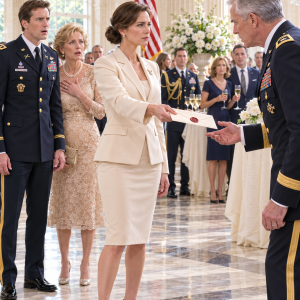
At first glance, the object appeared expensive enough for the conservatory gathering surrounding us. Its handle was engraved with curling vines, while a tiny crown decorated the top. White peonies filled tall glass arrangements along the windows, waiters carried champagne between clusters of relatives, and polished automobiles lined the circular drive outside the Carrington family estate near Richmond.
Then Vivian turned the rattle around, revealing the words engraved across the back.
PROPERTY OF THE CARRINGTON HOUSEHOLD.
Several people laughed.
My daughter, Emma, slept against my chest in a pale blue wrap, unaware that her grandmother had commissioned an heirloom declaring ownership over her before she could hold up her own head.
Vivian smiled at the audience before looking directly at me.
“Since my son has been generous enough to bring you into this family, I thought the baby should receive something explaining where her opportunities come from.”
Another wave of laughter traveled through the room.
My husband, Andrew, stood beside the fireplace holding a drink he had barely touched. His discomfort appeared in the way he adjusted his collar, but he did not interrupt his mother.
The Carringtons believed I came from an ordinary family in western Pennsylvania and worked as an administrative analyst for a federal agency. They knew my father had served in the military, although nobody had ever asked what he did or why senior officials occasionally called me directly.
Vivian preferred the simpler story.
I was the practical daughter-in-law without society connections, inherited property, or a recognizable surname. She gave me kitchen appliances for birthdays, corrected my pronunciation at charity dinners, and once introduced me to a state senator as the woman who helped Andrew remain organized.
In reality, I was Lieutenant Colonel Mara Sullivan, an intelligence officer assigned to a joint national-security command. Most of my work could not be discussed outside secure facilities, so allowing Vivian to dismiss it had once seemed easier than explaining why silence sometimes protected more than pride.
Motherhood changed that calculation.
Every humiliation I accepted now threatened to become a lesson Emma might someday inherit.
I looked at the rattle again.
“Please return it to the box,” I said.
Vivian’s smile narrowed.
“Do not be oversensitive. It is a family joke.”
“A joke requires more than one person finding it amusing.”
The relatives nearest us stopped laughing.
Vivian stepped closer and shook the rattle gently above Emma’s head. The sound awakened her, and she began to cry.
“Give her to me,” Vivian said. “You are making her anxious.”
I moved backward.
“No.”
The single word quieted the conservatory more effectively than shouting could have done.
Vivian looked toward Andrew.
“Are you going to allow your wife to insult me in my own home?”
Andrew placed his glass on the mantel.
“Mother, perhaps we should put the gift away.”
His answer arrived too late and too softly. Vivian heard it as negotiation rather than refusal.
“This gathering celebrates my granddaughter, and I will not be lectured by someone who has spent three years resenting every tradition she cannot understand.”
I removed my phone from the diaper bag and activated the camera.
Vivian noticed.
“What exactly are you doing?”
“Preserving the context you will later claim everyone misunderstood.”
Her cheeks darkened.
I recorded the rattle, the engraving, the guests who had laughed, and Andrew standing several feet away with the expression of a man waiting for someone else to rescue his marriage.
Then I lifted the diaper bag.
“I am taking Emma home.”
Andrew followed me into the hallway.
“Mara, do not leave like this. Mother was trying to provoke you, and you are giving her exactly what she wanted.”
I turned toward him.
“Your mother placed an ownership label beside our daughter and waited to see whether you would defend us.”
“It was a cruel joke, but leaving will turn it into a permanent conflict.”
“No, Andrew. Your silence already made it permanent.”
I drove away without raising my voice.
Inside the car, my hands began trembling only after the estate disappeared behind the trees. I sent the unedited recording to my father, General Daniel Sullivan, who had recently retired after four decades in military intelligence.
He called immediately.
“Are you and Emma safe?”
“Yes.”
“Send me the full guest list, every prior message from Vivian, and anything involving financial or custody arrangements.”
His tone changed slightly before he added, “Do not return to the estate alone.”
The next morning, Andrew arrived at our townhouse looking exhausted.
“My father has ordered everyone from yesterday’s gathering back to the estate at noon,” he said. “He says attendance is mandatory.”
I waited.
Andrew swallowed.
“Your father will be there, along with an attorney and someone from his former command.”
Part 2 – The Family Meeting Without Champagne
At noon, the Carrington estate looked almost identical to the previous afternoon, although nobody had opened the champagne.
The flowers remained in place, their edges beginning to curl beneath the conservatory heat. Uneaten pastries sat beneath glass domes, while relatives occupied sofas in rigid silence.
I arrived in my own car with Emma sleeping against me.
My father stepped from a dark sedan behind us. He wore a simple charcoal suit rather than a uniform, but age had not diminished the quiet command in his posture. Beside him walked attorney Rebecca Holt and retired Major Isaac Bennett, who now worked in corporate and personal-security investigations.
Dad looked at my face first, then at Emma.
“How long has she been asleep?”
“Almost half an hour.”
He touched one finger lightly against her covered foot.
“Excellent judgment. She is avoiding the meeting.”
Despite everything, I smiled.
Before we entered, Dad studied me carefully.
“This conversation belongs to you. I am here to support your decisions, not replace them.”
That sentence mattered more than he probably realized.
Inside, Andrew stood near the doorway. His eyes moved from Emma to my father and then to the attorney’s document case.
“Mara,” he said quietly.
I acknowledged him with a nod.
Andrew’s father, Henry Carrington, waited near the fireplace. He was a reserved man whose habit of avoiding conflict had allowed Vivian to define the family’s emotional weather for thirty years.
Vivian stood at the center of the room wearing pearls and a dark green dress. The velvet box containing the rattle sat on the table before her.
Henry spoke first.
“Colonel Sullivan, General Sullivan, thank you for coming. Yesterday’s event became more serious than anyone intended.”
Dad looked toward the box.
“It became serious when your wife used an infant as an instrument of public humiliation.”
Vivian released a sharp breath.
“General, private family humor often sounds severe to outsiders.”
“Patterns reveal intention more accurately than labels do,” Dad replied. “My daughter has received degrading gifts and remarks for years. Yesterday, the pattern reached her child.”
Vivian looked at me.
“So this is what you wanted, Mara. You wanted to arrive with important people and make me appear cruel.”
Emma stirred against my shoulder. I placed one hand across her back.
“Yesterday, you already had an audience. Today, I want accountability.”
“For an engraved rattle?”
“For teaching everyone in this room that disrespecting me earns approval. For treating Andrew’s silence as permission. For attempting to pass the same message to my daughter.”
Andrew stepped forward.
“Mara is right.”
Vivian turned toward him so quickly that her pearls shifted.
“You are exhausted and embarrassed.”
“I am embarrassed by myself,” Andrew said. “I kept calling your behavior complicated because admitting it was cruel would have required me to confront you.”
The admission hurt because I had needed it before leaving the party, not after lawyers and parents entered the room. Still, late honesty remained more useful than continued denial.
Henry closed his eyes briefly.
“Vivian, apologize.”
She laughed in disbelief.
“You cannot be serious.”
“I am completely serious.”
Rebecca opened her case and placed one document on the table.
The agreement established boundaries rather than demanding money. Vivian would have no unsupervised contact with Emma until trust was rebuilt. There would be no derogatory gifts, remarks about my family, attempts to control photographs or medical information, or gatherings where phones were collected to restrict documentation.
Vivian stared at the page.
“You expect me to sign rules governing conduct inside my own family?”
“No,” I said. “I expect you to decide whether access to my daughter matters more than maintaining authority over everyone around you.”
Her expression shifted.
Emma was not a bargaining object, but protecting her required conditions Vivian could understand.
Vivian looked toward Andrew.
“You would choose this woman over your mother?”
His shoulders lowered as though he had carried that question since childhood.
“I am choosing my wife and daughter. That should never have been described as choosing against you.”
For the first time, Vivian appeared uncertain.
Henry opened the velvet box, removed the silver rattle, and handed it to Major Bennett.
“Take this away.”
Vivian stepped forward.
“Henry, that belongs to the family.”
“No child in this house will inherit it.”
As Bennett placed the rattle inside an evidence pouch rather than discarding it, Vivian scoffed.
“Evidence? This has become absurd.”
Rebecca looked toward the engraving.
“Preserving an object involved in a documented pattern is simply prudent.”
The word documented changed the atmosphere.
Vivian signed the agreement last. Her pen pressed so hard that the paper nearly tore.
Part 3 – The Package Vivian Did Not Purchase

The gathering might have ended after the signatures if the estate manager had not entered while Rebecca collected the documents.
Mr. Collins had worked for the Carrington family for more than twenty years. He approached Henry with the hesitant posture of someone deciding whether employment mattered more than conscience.
“Sir, there is something concerning the rattle box.”
Vivian’s face changed before he explained.
Henry noticed.
“What is it?”
Collins looked toward the velvet case.
“The package arrived yesterday morning through a private courier. Mrs. Carrington did not order it.”
Andrew stared at his mother.
“You told us you commissioned the engraving.”
Vivian folded her arms.
“I said it came from the family. I never described the purchasing details.”
“Was there a message?” Dad asked.
Collins nodded.
“A typed card was attached. I placed it in Mrs. Carrington’s dressing room.”
Vivian’s voice sharpened.
“It was meaningless, and I destroyed it.”
Major Bennett’s posture became attentive.
“What did it say?”
Collins struggled to remember.
“Something about beginning with the child so the mother would remember who opened the gate.”
Coldness moved through me.
Emma slept peacefully, her cheek warm against my collarbone.
Dad looked at Vivian.
“Where are the remains of the message?”
“I threw them away.”
Henry’s disappointment looked heavier than anger.
“You received an anonymous message involving your granddaughter and used the accompanying object at a party?”
Vivian’s composure weakened.
“I assumed one of the cousins sent it as a prank. If I displayed it confidently, the sender would lose the satisfaction of embarrassing me.”
“You protected yourself by transferring the humiliation to my wife and daughter,” Andrew said.
Vivian opened her mouth but found no answer.
Mr. Collins led Bennett and Rebecca toward the dressing room. They returned several minutes later with a wastebasket and two pieces of a torn card.
Rebecca arranged them while wearing gloves.
The message contained the sentence Collins remembered, followed by another line.
ASK HENRY WHY HE ERASED THE WOMAN WHO BUILT THE FIRST CARRINGTON FOUNDATION.
Everyone looked toward Henry.
His face lost its color.
Vivian sat down.
Andrew stared at his father.
“What woman?”
Henry gripped the fireplace mantel.
“My older sister, Rose.”
Nobody in the younger generation appeared to recognize the name.
The Carrington family discussed its history constantly. Their ancestors appeared in portraits, foundation brochures, hospital plaques, and university buildings. Yet Rose Carrington had been omitted from every story.
“What happened to her?” Andrew asked.
Henry looked toward the windows.
“Rose created the community medical fund that later became the Carrington Foundation. She organized the first clinics, raised the earliest donations, and persuaded our grandfather to contribute unused property.”
“Then why have I never heard of her?”
Henry’s voice became rough.
“Because she refused to let the family control whom the clinics served.”
In the early nineteen-nineties, Rose wanted the foundation to support migrant families, uninsured workers, and women leaving abusive homes. Henry’s father believed those programs would damage relationships with wealthy donors.
Rose also became engaged to Dr. Luis Navarro, a physician from a working-class immigrant family. The Carrington patriarch considered him unsuitable and threatened to eliminate Rose’s funding, inheritance, and professional reputation.
“Did she leave?” I asked.
Henry nodded.
“She resigned from the foundation, married Luis, and established a small clinic in New Mexico.”
Andrew looked around at the portraits and silver-framed family photographs.
“You erased her because she left?”
Henry’s eyes filled with shame.
“My father removed her name from the original foundation records and credited the project to me. I was twenty-six, ambitious, and afraid of losing his approval. I allowed it.”
Vivian looked at her husband.
“You told me Rose contributed briefly and became unstable.”
“That was the story my father created.”
Dad’s attention remained fixed on Henry.
“Is Rose alive?”
Henry hesitated.
“I do not know. We stopped receiving letters nearly twenty-five years ago.”
Rebecca touched the anonymous message.
“Someone knows enough to connect Rose’s erasure with Mara and Emma. We need to determine why.”
Part 4 – The Ledger Hidden Behind the Portrait
Henry led us into the oldest section of the estate, where a narrow office had remained locked since his father’s death.
The room smelled of leather, dust, and cedar polish. A large portrait of Henry’s father dominated one wall, presenting him as a dignified philanthropist rather than the man described minutes earlier.
Henry removed the painting from its hook, revealing a shallow wall safe.
“My father kept original foundation records here,” he explained. “I have not opened it in years.”
Andrew stared at him.
“You knew the documents existed?”
“I knew something remained. I told myself protecting the current foundation mattered more than reopening the past.”
Henry entered the combination.
Inside the safe were ledgers, letters, legal papers, photographs, and a sealed envelope bearing Rose’s name.
The earliest ledger documented donations she personally obtained, clinic properties she negotiated, and programs she designed. Later pages had been altered, with her initials crossed out and Henry’s written above them.
Another file contained a proposed settlement offering Rose money in exchange for waiving claims to the foundation and agreeing never to use the Carrington name professionally.
She had refused to sign.
Among the photographs was one showing Rose standing beside Dr. Navarro outside a modest clinic. A young girl, perhaps five years old, held Rose’s hand.
The inscription on the back read Rose, Luis, and Elena – Santa Fe, 1998.
Henry lowered himself into a chair.
“She had a daughter.”
Vivian’s hands tightened around her handbag.
“Did you truly not know?”
“No.”
Mr. Collins cleared his throat from the doorway.
“Sir, your father knew.”
Henry looked up.
Collins explained that the elder Carrington received letters from Rose for years. He ordered staff to intercept them and instructed accountants to monitor her clinic. One autumn, Rose returned to Virginia with her daughter and requested a meeting with Henry.
“Your father refused to tell you she was here,” Collins said. “He sent them away through the garden entrance.”
Henry’s face collapsed.
“Why did nobody tell me?”
Collins lowered his eyes.
“Because employment inside this house depended upon obedience, and most of us were not brave.”
The honesty prevented Henry from directing all blame toward the staff.
“Neither was I,” he said.
Rebecca opened Rose’s sealed envelope after Henry gave permission. Inside was a letter written shortly after the failed visit.
Rose explained that Luis had died unexpectedly, leaving her to raise Elena and manage the clinic alone. She did not request inheritance. She asked only that the foundation restore her name to the original records and promise never to claim authority over Elena.
The final paragraph was addressed directly to Henry.
You helped me once by warning me what Father planned, but warning someone without standing beside them only gives them more time to understand they are alone. I hope you eventually become braver than we were allowed to be.
Andrew turned away toward the window.
I recognized the pain in his posture. Rose had described the same failure that defined his response to Vivian. He warned, softened, explained, and privately apologized without standing publicly beside the person being harmed.
“I became you,” he told Henry quietly.
Henry did not defend himself.
“Yes.”
Andrew looked toward me and Emma.
“I do not want our daughter growing up around this pattern.”
“Then recognizing it cannot be the final step,” I said. “You will need to act differently when doing so costs you something.”
He nodded.
“I understand.”
Vivian stood near the portrait, visibly shaken.
“My entire life here has been built around protecting a history that was edited before I entered it.”
I studied her.
“That may explain what you learned. It does not excuse what you chose to repeat.”
“I know.”
It was the first answer she gave without defending herself.
Part 5 – The Woman at the Garden Gate
Major Bennett began tracing Elena Navarro through public medical records and nonprofit registrations. Within hours, he found a Dr. Elena Navarro-Rose leading a maternal-health organization in Arizona.
She had recently contacted a Carrington Foundation archivist requesting access to early clinic records. The request disappeared after reaching an executive connected to Vivian’s charitable committee.
Rebecca arranged a secure video conversation that evening.
Elena appeared on screen from a small office lined with books and framed photographs. She was in her early thirties, with Rose’s eyes and Henry’s serious expression.
She did not seem surprised to see him.
“I wondered how long the rattle would remain funny,” she said.
Henry leaned toward the screen.
“You sent it?”
“I sent the package and the message. I did not expect Vivian to use it on an infant in front of sixty people.”
Vivian flinched.
Elena explained that her mother died eighteen months earlier. While sorting Rose’s records, she discovered evidence proving that the Carrington Foundation originated from Rose’s work. She also found correspondence showing that Henry’s father used lawyers and private investigators to pressure clinics that employed Rose.
Elena contacted the current foundation privately, hoping to correct the historical record without public conflict. Her letters disappeared. Then an anonymous caller warned her to stop pursuing the matter.
“Why involve my daughter?” I asked.
Elena’s expression softened.
“I did not intend to threaten Emma. The rattle was designed to expose how the family treats women it considers socially inconvenient. I believed Vivian would hide it because it revealed too much about the family’s values.”
“Instead, she used it.”
“Yes, and I am sorry that my calculation placed your child inside that moment.”
Her apology did not erase the decision, but she accepted responsibility without redirecting blame.
“The message said Emma was not the only child they tried to erase,” Andrew said.
Elena held up a document.
It was a legal petition prepared decades earlier by Henry’s father, seeking guardianship over Elena after Luis died. The petition portrayed Rose as financially unstable and claimed the Carrington family could provide a more suitable environment.
Rose learned about it before filing and fled the state with her daughter.
“My mother spent years believing someone would attempt to take me,” Elena said. “She built our entire life around avoiding institutions connected to this family.”
Henry covered his face.
“I did not know.”
“Not knowing was one of the benefits your silence purchased.”
Nobody attempted to soften the sentence.
Henry agreed to an independent historical audit, restoration of Rose’s name, and transfer of a portion of foundation governance to community representatives. Elena refused money for herself but requested funding for the clinic network her mother had built.
Vivian resigned from the charitable committee until the review ended.
Andrew moved with Emma and me into a temporary apartment while we began marriage counseling. I did not return home merely because he finally confronted his mother.
Trust required sustained behavior rather than one dramatic afternoon.
He accepted supervised visits with Emma at first, attended therapy, and publicly corrected relatives who described the party as a misunderstanding. When Vivian complained that boundaries made her feel excluded, Andrew answered without asking me to manage the conversation.
“Exclusion is what happens when someone is denied identity and history,” he told her. “Consequences are what happen when access is limited after harm.”
Part 6 – The Name Restored to the Foundation
One year later, the Carrington Foundation reopened its oldest community clinic under a new name.
THE ROSE NAVARRO CENTER FOR FAMILY HEALTH.
The ceremony was modest compared with the family’s usual events. Community physicians, clinic workers, former patients, and local families occupied most of the seats. The Carrington relatives sat among them rather than in a private front section.
Elena stood beside a large photograph of Rose and Luis outside their first clinic.
Henry addressed the audience briefly.
“This institution began through my sister’s work, courage, and refusal to limit compassion according to social approval. My family removed her name, accepted credit we did not earn, and protected that false history for decades.”
He did not describe himself as young, frightened, or manipulated. Those facts belonged in explanation, not absolution.
Vivian attended without pearls or prepared remarks. She had respected every restriction concerning Emma during the previous year and completed individual counseling, although I still did not allow unsupervised visits.
Change did not require immediate access as a reward.
Andrew stood beside me holding Emma, now thirteen months old. He had learned to ask before taking her from my arms, a small act that represented a larger shift in how he understood partnership.
Our marriage remained under reconstruction.
Some days I believed trust might return in a different shape. Other days I accepted that repair could lead to respectful separation rather than reunion. Andrew no longer demanded certainty as proof that his effort mattered.
After the ceremony, Elena approached Emma carrying a small wooden box.
“I promise there are no ownership declarations inside,” she said.
The box contained a hand-carved toy compass. On the back, one sentence had been engraved.
YOU BELONG FIRST TO YOURSELF.
I ran one finger across the words.
“My mother used to say that,” Elena explained. “She wanted every child at the clinic to understand that family names, money, and institutions could offer support without owning them.”
I handed the compass to Emma. She immediately placed one corner in her mouth.
Elena laughed.
“A thoughtful response.”
Dad joined us, wearing civilian clothes and carrying a paper cup of coffee. He looked toward Andrew, who was speaking quietly with Henry.
“Has he improved?”
“He has acted differently for twelve months.”
Dad nodded.
“That is more useful than promising forever.”
Across the courtyard, Vivian stopped several feet away and waited until I acknowledged her.
“May I say hello to Emma?”
I looked at my daughter, then at the woman who had once attempted to turn her into a symbol of inferior status.
“You may speak to her while I hold her.”
Vivian accepted the boundary.
“Hello, Emma,” she said softly. “You have grown considerably.”
Emma studied her with solemn curiosity, then returned to chewing the compass.
Vivian looked at me.
“I understand why you do not trust me alone with her.”
“Understanding is part of rebuilding trust, not evidence that rebuilding is complete.”
“I know.”
She stepped back without argument.
Later, as guests moved through the clinic, I stood before the restored historical display. Rose’s original ledgers appeared behind protective glass beside photographs of the women, physicians, and laborers who created the early programs.
The old Carrington history described progress as something wealthy men bestowed upon grateful communities. The corrected version showed a more complicated truth: institutions were built by people who challenged the families claiming ownership over them.
The silver rattle remained sealed inside Rebecca’s evidence archive. Nobody had requested its return.
I preferred the compass.
At the end of the afternoon, Andrew and I walked toward the parking area with Emma between us. He did not take my hand automatically. Instead, he looked toward me.
“May I?”
I considered the question before allowing my fingers to meet his.
The gesture did not erase the conservatory, Vivian’s laughter, or Andrew’s silence. It acknowledged that consent could exist even inside familiar relationships, and that love became safer when nobody treated access as automatic.
Emma shook the wooden compass, disappointed that it contained no bell.
“She appears dissatisfied with the design,” Andrew said.
“She will survive.”
He smiled, but the expression carried humility rather than relief.
Behind us, the Rose Navarro Center stood beneath the afternoon light, its name visible above the entrance.
The Carrington family once believed survival depended upon protecting the story written by its most powerful members. Rose’s legacy proved the opposite. Families survived honestly only when the people they silenced were restored to the record.
I looked at Emma and understood that my responsibility was not to give her a perfect family. No institution, marriage, or bloodline could offer perfection without creating another lie.
My responsibility was to teach her that dignity did not require permission, boundaries were not cruelty, and belonging should never resemble ownership.
The rattle had declared her property of a household.
The compass offered another direction.
She belonged first to herself, while the rest of us would have to earn the privilege of walking beside her.
THE END