The Call from Briar Glen

Gabriel Prescott was reviewing evacuation maps inside a wildfire command center in northern Nevada when his phone began vibrating across the metal desk. It was 1:46 in the morning, the hour when every unexpected call seemed to carry more weight than it should, and when he saw his ten-year-old daughter’s name on the screen, he answered before the second ring.
“Elsie?”
At first, he heard only shallow breathing and the muted sounds of hospital equipment. Then his daughter spoke in a voice so faint that he leaned forward as though doing so might bring him closer to her.
“Dad, I’m at St. Anne’s. Uncle Vaughn and Uncle Travis hurt me, and Mom pulled the curtains closed.”
For one long moment, Gabe forgot the maps spread before him and the dry Nevada wind pressing against the windows. Elsie was supposed to be staying with her mother in Briar Glen, West Virginia, while he completed a six-week assignment coordinating emergency crews during fire season. He had spoken to her the previous evening. She had told him she was going to a family cookout at her grandparents’ estate.
Now she was calling from a hospital nearly two thousand miles away.
Gabe had spent eighteen years managing emergencies, first as a county paramedic and later as a regional disaster-response coordinator. He knew that fear could make a frightened child retreat into silence, so he kept his voice steady even as every instinct urged him to demand answers.
“I’m right here, sweetheart. You don’t have to tell me everything at once. Just breathe with me.”
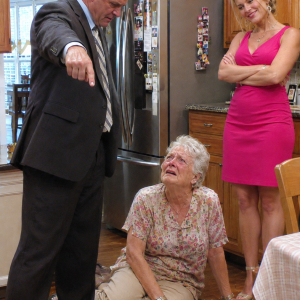
After several slow breaths, Elsie explained what she could. She had accidentally spilled a glass of lemonade on Vaughn’s expensive shoes. Both of her uncles had been drinking, and what began as shouting quickly became something far more serious. Her mother, Adrienne, had watched from an upstairs window. Elsie remembered calling for her, but Adrienne had stepped back and closed the curtains.
A nurse soon took the telephone.
“Mr. Prescott, your daughter is stable, but she has several serious injuries. She’ll need surgery, and she’s asking for you.”
Gabe looked at the clock, closed the folder in front of him, and called his supervisor.
“My daughter needs me. I’m leaving tonight.”
By sunrise, he was on the first flight east.
The Family That Owned the Town
When Gabe entered Elsie’s hospital room the following afternoon, she looked much smaller than she had during their last video call. Her arms were protected by casts, one leg rested beneath a raised blanket, and two fingers on her right hand were carefully supported. Dr. Meredith Sloan, the pediatric specialist overseeing her care, explained that Elsie had several fractures and would require months of rehabilitation.
“She should regain her mobility,” the doctor said gently. “But recovery won’t be only physical. She needs to know that the adults around her are listening now.”
Gabe sat beside the bed and rested his hand near Elsie’s, careful not to touch anything tender.
“You called me,” he said. “That was brave.”
Elsie stared at the blanket.
“Mom heard me.”
There was no accusation in her voice, which somehow made the words harder to bear.
“I know,” Gabe answered. “None of this was your fault.”
Briar Glen was a picturesque Appalachian town surrounded by forested hills and narrow rivers, but beneath its postcard beauty lay a system of influence that had been carefully built over four decades. Adrienne’s father, Alden Hawthorne, owned the region’s largest stone quarry, a private lending company, several rental developments, and the local newspaper. His businesses employed hundreds of residents, while Hawthorne Community Lending held the mortgages on many of their homes.
The Hawthornes, a prominent white American family, were treated less like citizens than royalty. Alden’s donations funded election campaigns, school renovations, and civic events. Marjorie Hawthorne, his wife, chaired nearly every charitable committee in the county. Vaughn and Travis had grown up believing that consequences were inconveniences meant for other people.
Gabe had seen that arrogance during his marriage to Adrienne. At first, he mistook the family’s confidence for loyalty, but over time he realized that their kindness always came with a condition. They expected obedience in return for every favor, and when Gabe and Adrienne separated, the Hawthornes treated the custody agreement as if it were a suggestion rather than a court order.
For four days, Gabe remained beside Elsie. On the fourth afternoon, his phone rang. Marjorie Hawthorne’s name appeared on the screen.
Gabe activated the recorder he routinely used for work calls and placed the phone on speaker.
“I hear you’ve come back to town,” Marjorie said. “You should take Elsie home when the hospital releases her and let this matter disappear. Alden has known the sheriff since high school, and no local court is going to turn against this family.”
Gabe said nothing.
Marjorie mistook his silence for surrender.
“And tell your friends to stay away from Vaughn and Travis. If you keep pushing, they’ll make sure you regret it.”
When the call ended, Gabe saved the recording in three secure locations. Then he contacted Elena Pierce, the former state emergency-management director who had mentored him early in his career.
After listening to the recording, Elena remained quiet for several seconds.
“What are you planning?” she asked.
“I want the truth documented so thoroughly that no one can purchase their way around it.”
“Then don’t confront them,” Elena replied. “Follow the records. Powerful families usually hide behind complicated paperwork because they assume ordinary people will never read it.”
That evening, another message arrived from an unfamiliar number. The sender was Sadie Hawthorne, Travis’s sixteen-year-old daughter and Elsie’s cousin.
“I have a video from the driveway,” she wrote. “You need to see what my family did.”
A Paper Trail Through the Mountains

Gabe rented a modest lake cabin thirty miles outside Briar Glen, where Elsie could stay after leaving the hospital. It was quiet, accessible, and far from the Hawthorne estate. He also invited four people he trusted to help examine information that could be obtained legally.
Elena Pierce understood government contracts and regulatory systems. Owen Beckett, a forensic accountant, specialized in tracing corporate ownership through public filings. Rachel Dwyer, a former labor inspector, knew how workplace reports could be altered without appearing obviously false. Peter Walsh, a retired state trooper, was there to protect the witnesses and maintain a careful record of every meeting.
They did not enter private property, intercept conversations, or remove documents. They searched court filings, tax records, property transfers, inspection reports, campaign disclosures, and emergency-service logs. Sadie met them with a child advocate present and explained where her grandfather’s companies stored duplicate ledgers. She also identified former employees who had been pressured into silence.
Within a week, a pattern emerged.
Hawthorne Stoneworks had repeatedly reported serious workplace incidents as minor events. Employees who could no longer keep up with their mortgage payments were referred to Hawthorne Community Lending, which offered short-term relief under harsh conditions. When those families fell behind again, a property company controlled by Alden acquired their homes for a fraction of their value.
Sheriff Wesley Pike’s office had altered several incident reports connected to the quarry. A private medical practice funded by the Hawthornes had signed questionable return-to-work forms, sending injured employees back before they were ready. County officials who approved Hawthorne developments had received unusually generous campaign support from businesses connected to Alden.
Gabe’s team gave the workplace evidence to state investigator Corinne Hale, an honest official who had once been removed from a quarry inquiry without explanation. Elsie’s medical records and Sadie’s video went to family-law attorney Natalie Rhodes. Owen’s financial analysis was delivered to federal investigator Diane Keller, who opened a broader inquiry into lending fraud, public corruption, and obstruction.
The changes began quietly. State inspectors arrived at the quarry without warning. Banking regulators requested years of lending records. Environmental officials tested water downstream from a Hawthorne processing site. The county newspaper called these visits routine, but Alden began making frantic telephone calls to people who suddenly stopped returning them.
The Hawthornes assumed a business rival was responsible. Gabe preferred that they continue believing it.