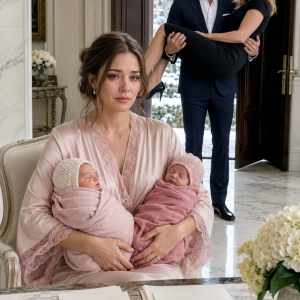
Part 1 – The Bed That Moved Across the Floor
At eleven forty-six on a rainy November night, thirty-one-week-pregnant Julia Whitaker lay inside a private maternity room in Charlotte, North Carolina, listening to her husband explain why another woman’s bracelet had appeared inside his coat pocket.
The fetal monitor beside her produced a steady electronic rhythm, while rain streaked the tall windows overlooking the hospital gardens. Julia had been admitted that afternoon after experiencing abdominal pain and light bleeding during a design consultation. Her obstetrician wanted continuous monitoring because the placenta appeared dangerously low, although the baby’s heartbeat remained strong.
Her husband, Harrison Whitaker, arrived three hours late with his communications director, Paige Lawson.
Paige wore the bracelet.
Julia recognized the narrow gold links because the purchase appeared on a credit-card statement Harrison had insisted was unavailable. He had classified the charge as hospitality expenses connected to a municipal redevelopment conference.
“You brought her here wearing the evidence,” Julia said.
Harrison closed the door behind him.
“Paige drove me because my driver was unavailable. Do not turn an ordinary gesture into another accusation.”
Paige remained beside the window, one hand covering the bracelet.
“Harrison told me you already knew our marriage had changed,” Julia said.
Paige looked toward him rather than answering.
Harrison’s family company, Whitaker Civic Renewal, developed hospitals, libraries, affordable apartment complexes, and municipal buildings across the Carolinas. His name appeared on fundraising committees, university boards, and the bronze dedication plaque outside the hospital’s maternal-care wing.
He had spent eight years presenting himself as a thoughtful husband who supported Julia’s interior-design career. Inside their home, he controlled her schedule, reviewed every invoice, and described her professional work as emotionally exhausting whenever she accepted a project without consulting him.
Pregnancy intensified everything.
He insisted upon attending medical appointments, answering questions directed toward Julia, and requesting copies of every clinical note. When she objected, he said responsible fathers stayed informed.
Julia now understood that information had never been his goal.
Authority was.
“Leave the room, Paige,” Julia said.
Harrison stepped between them.
“She stays because she witnessed your behavior tonight.”
“My behavior?”
“You called fourteen times, accused me of stealing, and threatened to expose private company records while doctors are trying to protect our child.”
Julia reached toward the call button.
“I asked about transfers from the Community Housing Reserve into Paige’s consulting company.”
Harrison caught her wrist.
“You accessed records you were never authorized to examine.”
Julia pulled away.
The movement sharpened the pain across her abdomen, and the monitor accelerated.
“Those records belong to a foundation established by my father.”
Harrison’s expression changed.
Before marrying him, Julia had inherited voting rights in the Langford Community Trust, a nonprofit financing transitional housing and accessible medical facilities. Harrison became executive director after promising to expand the program without changing its mission.
During the previous month, Julia discovered that millions had been redirected toward Whitaker developments through intermediary companies, including Paige’s newly formed communications firm.
“You do not understand construction finance,” Harrison said. “Those transfers protected several projects from temporary liquidity pressure.”
“Then why were they hidden from the trustees?”
Paige moved toward the door.
“I should leave.”
Harrison turned sharply.
“Nobody leaves until Julia understands what she is doing.”
He released Julia’s wrist and struck the metal side rail with his palm. The bed shifted several inches.
Julia flinched.
Harrison saw the fear and mistook it for surrender.
“Tomorrow, you will sign the amended trust authorization and the medical-care directive. Afterward, we will announce that you are taking an extended break because pregnancy has affected your judgment.”
“I will sign nothing.”
He seized the bed rail and shoved it hard.
One wheel had not been locked after a recent examination. The hospital bed rolled across the polished floor, struck an equipment stand, and twisted sideways. Julia reached for the rail, but her shoulder slipped beyond the mattress.
She fell heavily against the floor.
Pain tore through her abdomen.
The monitor alarm began screaming.
Julia looked down and saw blood spreading across her hospital gown.
Nurse Hannah Park rushed through the door before Harrison could move. She immediately activated the emergency system and knelt beside Julia.
“Do not touch her,” Hannah ordered.
Harrison stepped backward.
“She tried to climb out of bed.”
Julia could barely breathe.
“He pushed it.”
Paige stood frozen near the window.
Hannah looked toward her.
“Did you see what happened?”
Paige opened her mouth, but Harrison answered first.
“She saw Julia become agitated.”
Two physicians entered with additional nurses. Harrison attempted to remain beside the bed while they transferred Julia onto a stretcher.
“I am her husband. I stay with her.”
Julia reached for Hannah’s sleeve.
“Do not let him come near me.”
Hannah positioned herself between them.
“Mr. Whitaker, you must leave immediately.”
His voice became cold.
“My family funded this wing.”
“Your wife is bleeding inside it.”
Security escorted Harrison and Paige into the hallway while physicians stabilized Julia. An ultrasound indicated a partial placental separation. The baby’s heartbeat remained present, but every minute carried risk.
With shaking fingers, Julia called her middle brother.
Evan Langford answered immediately.
“Julia?”
“Harrison pushed the bed. I am bleeding, and they may deliver the baby.”
Silence lasted less than a second.
“I am coming.”
Part 2 – The Brothers Who Chose Evidence Over Rage
Evan reached Queen Charlotte Medical Center twenty-three minutes later.
At forty, he operated a protective-services company providing security assessments for courthouses, hospitals, and corporate campuses. He had spent years teaching employees how to recognize escalating threats without creating additional violence.
That training became difficult to remember when he saw Harrison standing beneath the bronze donor plaque with blood on the edge of one polished shoe.
Evan stopped several feet away.
“Step away from my sister’s room.”
Harrison adjusted his jacket.
“Julia suffered a medical episode and fell. Your family is already turning an accident into a public spectacle.”
“Were you holding the bed when it moved?”
“I was trying to prevent her from leaving.”
“That was not my question.”
Paige stood beside two hospital administrators, staring at the floor.
Evan noticed the security camera above the hallway entrance.
“Preserve every recording from this floor,” he told the nearest administrator.
The man hesitated.
“The hospital will conduct an internal review.”
“Preserve it before the donor’s lawyers define internal review as deletion.”
Harrison stepped closer.
“You do not control this facility.”
“Neither do you.”
Harrison lowered his voice.
“Your sister has struggled with anxiety for years. She is frightened, pregnant, and confused.”
Evan’s hands tightened at his sides.
He wanted to strike Harrison, but he understood the trap. An angry brother attacking a prominent executive would allow Harrison to move the story away from Julia.
“You will not use her treatment history to explain your conduct,” Evan said.
Hannah emerged from the room.
“Mr. Langford?”
“How is she?”
“The bleeding has slowed, but the placenta remains unstable. The medical team is trying to delay delivery while protecting both patients.”
Harrison moved toward the door.
Hannah blocked him.
“Mrs. Whitaker authorized only her brothers and medical counsel.”
“I am the child’s father.”
“You are also the person she identified as causing the injury.”
One administrator spoke cautiously.
“Nurse Park, perhaps we should avoid conclusions until risk management—”
Hannah turned toward him.
“I watched the bed move while Mr. Whitaker held the rail. I watched the patient fall, and I heard her say she was afraid of him. Those are observations, not conclusions.”
Evan entered Julia’s room.
She looked smaller beneath the hospital blankets, one wrist swollen and her face nearly colorless. He sat beside her without touching her until she reached toward him.
“I should have listened to you,” she whispered.
“Tonight is not for apologies.”
“He will say I imagined everything.”
“Then we preserve what happened before he can rewrite it.”
Julia told him about the affair, the diverted trust money, the proposed medical directive, and Harrison’s threats to portray her as incapable.
Evan photographed visible injuries only after receiving her permission. He recorded the location of the equipment stand, the unlocked wheel, the damaged wall panel, and the blood on the floor before housekeeping arrived.
Hannah returned and quietly closed the door.
“Two executives are asking the technical department to restrict access to the hallway footage,” she said.
“Has it been copied?”
Hannah removed a hospital-issued evidence drive.
“The camera system automatically saves clinical emergencies to a patient-safety archive. I exported the relevant section according to incident-report procedure before access changed.”
“Will you testify?”
“Yes.”
Julia looked at her.
“They may threaten your job.”
Hannah’s expression remained steady.
“A hospital should not require a nurse to choose between employment and describing what happened to a patient.”
At three twelve in the morning, Julia’s eldest brother arrived from Washington.
Daniel Langford was a federal civil-litigation attorney specializing in institutional fraud, whistleblower retaliation, and public-contract misconduct. He entered the room carrying a laptop, an overnight bag, and the controlled expression Evan recognized from difficult trials.
The expression disappeared when he saw Julia.
Daniel kissed her forehead.
“Tell me everything from the beginning, including anything you previously thought was too small to matter.”
She spoke for almost an hour.
Daniel did not interrupt except to clarify dates, names, and documents. When she finished, he reviewed the footage Hannah had preserved.
The video showed Harrison gripping the rail and forcefully moving the bed. The fall occurred partly outside the camera’s angle, but the audio captured Julia’s refusal, the metallic impact, the monitor alarm, and Harrison saying:
“You forced me to stop you.”
Daniel replayed that sentence.
“He converted his decision into your responsibility before you reached the floor.”
Julia closed her eyes.
“What happens now?”
“We preserve the medical records, secure the trust accounts, notify law enforcement, and prevent anyone from changing your consent documents.”
Evan glanced toward the hallway.
“The hospital administration is already protecting him.”
Daniel opened a new legal memorandum.
“Then the hospital becomes part of the investigation if it chooses his donations over accurate records.”
Part 3 – The Signature Waiting on the Discharge Form

By eight the following morning, Harrison’s crisis team had occupied an executive conference room upstairs.
His attorneys, public-relations advisers, two hospital trustees, and the director of donor relations gathered beneath a framed photograph of Harrison opening the maternal-care wing.
He described Julia’s fall as a pregnancy-related episode.
“She attempted to leave while confused,” he said. “I reached for the bed because I feared she would injure herself.”
The hospital’s chief legal officer reviewed his notes.
“Nurse Park documented that you moved the bed during an argument.”
“Then amend the note to reflect uncertainty.”
Nobody answered.
Harrison placed both hands on the table.
“Whitaker Civic Renewal has donated more than twenty million dollars to this institution. Surely someone understands the difference between an observation and a frightened employee’s interpretation.”
A junior compliance manager spoke.
“Changing a clinical record after a donor objects would create serious legal exposure.”
Harrison looked at him.
“Then call it a documentation clarification.”
Downstairs, two administrators entered Julia’s room carrying voluntary-discharge paperwork.
Daniel stood between them and the bed.
“My client is not leaving against medical advice.”
One administrator forced a professional smile.
“Mrs. Whitaker previously expressed a desire to recover at home.”
Julia stared at him.
“I never said that.”
The administrator opened the document.
A signature already appeared above Julia’s printed name.
Daniel took the form without touching the signature area.
“Who witnessed this?”
Neither administrator answered.
Julia examined the handwriting.
“That is not mine.”
The document authorized Harrison to transport her, communicate with physicians, and make temporary medical decisions if she became distressed.
Daniel sealed it inside an evidence sleeve.
“You entered a room containing a hospitalized assault complainant and presented a forged discharge form granting authority to the accused spouse. Leave before I request officers to interview you here.”
The administrators withdrew.
Within an hour, Daniel obtained an emergency protection order preventing Harrison from approaching Julia, contacting her medical team, or altering trust and marital assets.
Harrison responded by filing a petition seeking temporary medical guardianship. The filing claimed Julia suffered prenatal delusions, financial paranoia, and dangerous resistance to treatment.
The supporting opinion came from Dr. Malcolm Reed, a psychiatrist Harrison had selected for marital counseling.
Julia remembered every appointment.
Harrison remained inside the room, answered questions for her, and paid Dr. Reed through Whitaker Civic Renewal’s executive-wellness program.
Daniel’s financial researcher found more than one hundred fifty thousand dollars in consulting payments from Harrison’s companies to the psychiatrist during the previous two years.
The emergency hearing occurred that afternoon by secure video.
Harrison’s attorney described him as a worried husband trying to protect his wife and unborn child.
Daniel played the hospital footage.
Then he displayed the forged discharge form, the consulting payments, Hannah’s sworn statement, and messages in which Harrison told Paige:
Once Julia is declared unstable, the trust board will accept that I need temporary control.
Judge Melissa Grant looked toward Harrison.
“Did you direct anyone to prepare a discharge form bearing your wife’s signature?”
“No, Your Honor.”
Daniel submitted audio from the hospital’s executive-floor conference system. An employee had preserved the recording after hearing Harrison demand that staff create a voluntary discharge.
His voice was unmistakable.
“Make the decision appear to be hers. I do not care which document accomplishes it.”
The judge denied the guardianship petition, expanded the protective order, froze disputed assets, and referred the forged medical document to prosecutors.
Julia began crying after the ruling.
She had spent years being told that disagreement proved instability. Hearing a judge distinguish fear from incapacity felt almost physically relieving.
Outside the courthouse, reporters surrounded Harrison.
“Did you pay a psychiatrist to support your petition?”
“Why was your wife’s signature placed on a discharge form?”
“Are investigators reviewing the Langford Community Trust?”
Harrison pushed through the microphones.
“My wife and her brothers are destroying everything I built.”
The clip spread quickly.
Inside the hospital, Julia watched it once.
“He still believes consequences are something we are doing to him.”
Evan sat beside her.
“Control teaches people that resistance is aggression.”
Part 4 – The Mother Who Brought Fifteen Years of Records
That evening, Harrison’s estranged mother arrived at the hospital.
Margaret Whitaker was sixty-nine, with silver hair gathered neatly at her neck and a worn leather case held against her coat. Harrison had prevented Julia from seeing her for nearly five years, claiming Margaret suffered from jealousy, confusion, and an irrational obsession with family money.
Margaret stopped beside the bed.
“I should have warned you more clearly.”
Julia shook her head.
“He would have said you were unstable too.”
“He did.”
Margaret opened the case.
Harrison’s father had established the Whitaker Housing Renewal Fund to rehabilitate neglected apartment buildings for elderly residents and low-income families. After his death, Harrison became executive director and gradually removed Margaret from financial oversight.
She had preserved copies before losing access.
Bank records showed millions transferred from housing projects into private development partnerships controlled by Harrison and Gordon Price, the company’s chief financial officer. Fictitious management fees, land-option payments, and consulting contracts financed Harrison’s commercial expansion.
Paige’s company had received substantial payments.
The Beverly Hills-style image Harrison cultivated in Charlotte had been built partly from money intended to repair leaking roofs, broken elevators, and unsafe heating systems.
“Why did you wait?” Julia asked.
Margaret accepted the question.
“Because admitting the truth meant admitting that my son used kindness as camouflage. I confronted him privately when that was no longer enough.”
She played an old recording.
A younger Harrison spoke during a meeting shortly before his wedding.
“Julia avoids conflict. Once the trust interests merge with our household, she will sign whatever protects the marriage.”
Julia stared at the laptop.
“He planned to use me before we married.”
Margaret gripped her hands together.
“I told myself he was speaking arrogantly rather than literally. That excuse protected him and endangered you.”
Daniel copied the records and distributed them to federal investigators, state regulators, the trust’s independent directors, and outside forensic accountants.
The financial structure began collapsing within days.
The trust suspended Harrison. Lenders froze several development accounts. The hospital removed him from its fundraising board and announced an independent inquiry into the forged discharge form.
Paige contacted Julia’s attorneys.
Harrison had destroyed her phone during an argument and blamed her for the publicity. She possessed cloud backups of vehicle recordings capturing his conversations with advisers, investigators, and hospital executives.
Paige did not claim innocence.
“I knew he was married, and I helped him humiliate Julia,” she told Daniel. “I did not know he intended to use a guardianship order to take the baby and the trust.”
The recordings showed that Harrison planned to remove Julia’s name from properties, discredit Hannah, fabricate allegations against her brothers, and seek custody immediately after the child’s birth.
One file captured his instructions to a private investigator.
“Find something damaging about Daniel or Evan. Accuracy is optional.”
Another recorded him speaking with a hospital administrator.
“If Nurse Park continues, make her licensing history difficult enough that she regrets choosing Julia.”
The conspiracy was no longer a marital dispute.
It involved witness intimidation, medical coercion, financial fraud, falsified records, and misuse of charitable funds.
Part 5 – The Child Born Before the Trial
Julia’s condition worsened two nights later.
The fetal monitor showed repeated decelerations, while imaging confirmed that the placental separation had progressed. Her obstetrician recommended immediate delivery.
“The baby is early,” Julia whispered.
Daniel held one hand, while Evan held the other.
“The neonatal team is ready,” Daniel said.
“What if she cannot breathe?”
Evan leaned closer.
“Then trained people will help her until she can.”
They did not promise an outcome nobody could guarantee.
As nurses prepared the operating room, shouting emerged from the hallway.
Harrison had entered through a service corridor despite the protective order. His suit was wrinkled, his hair wet from the rain, and two security officers followed him.
“I have a right to see my child!”
Evan positioned himself between Harrison and Julia’s stretcher.
“You have an order requiring you to remain away.”
“That baby carries my name.”
Julia looked directly at him.
“She is a person, not another asset carrying your brand.”
Harrison pointed toward the operating room.
“Your brothers have poisoned you against me.”
“They arrived after you pushed my bed.”
Officers approached from the elevators.
Daniel held up his phone.
“The violation has been documented.”
Harrison looked toward Julia.
“Tell them this is a misunderstanding.”
For years, she had apologized whenever his behavior created consequences.
This time, her answer required only one word.
“No.”
Police removed him while the surgical doors closed.
Amelia Langford was born forty-one minutes later, weighing three pounds and fourteen ounces. The operating room remained frighteningly quiet until a thin cry rose above the equipment.
Julia wept beneath the bright lights.
Amelia required respiratory support and several weeks of neonatal care, but physicians expected steady improvement.
Harrison remained detained after prosecutors argued that he had violated the protective order, attempted to influence witnesses, and demonstrated access to private hospital areas.
Julia filed for divorce and restored her maiden name.
She spent each day beside Amelia’s incubator, speaking about gardens, ocean towns, and rooms where nobody controlled the door from the outside.
Hannah continued working while cooperating with investigators. When the hospital offered her a management position, she accepted only after new policies protected employees who reported donor interference and medical coercion.
The hospital removed Harrison’s name from the maternal wing.
The replacement plaque honored clinical staff who placed patient safety above institutional pressure.
Part 6 – The Trial That Separated Wealth from Authority
Ten months later, Harrison entered federal court without the company, advisers, or reputation that had once surrounded him.
Whitaker Civic Renewal had entered restructuring. Legitimate housing and municipal projects continued under independent management, while fraudulent partnerships were liquidated to fund restitution.
The trial focused on charitable-fund fraud, witness intimidation, forged medical documentation, obstruction, and conspiracy. The assault case proceeded separately at the state level.
Hannah testified first.
“I watched a donor use his financial relationship with a hospital as though it gave him authority over a patient’s body and medical record,” she said.
Paige testified under a cooperation agreement. She admitted the affair, the false consulting invoices, and her role in Harrison’s public campaign against Julia.
“I liked being selected by someone powerful,” she said. “I ignored what his treatment of Julia revealed about the person doing the selecting.”
Margaret presented fifteen years of financial records.
Finally, Julia testified.
She described the gradual control that arrived disguised as care. Harrison managed her schedule because he worried she worked too hard. He reviewed her finances because he wanted to reduce stress. He joined therapy sessions because he wanted to support her. He isolated her from family because he claimed they resented the marriage.
By the time she recognized the cage, Harrison controlled nearly every key.
The prosecutor asked about the night at the hospital.
“Did you cause Mr. Whitaker to move the bed?”
Julia looked toward him.
“No. Another person’s cruelty is not created by a victim refusing to cooperate.”
The jury found Harrison guilty on every principal federal count.
The judge imposed a lengthy prison sentence, restitution, forfeiture of fraud-derived assets, and permanent restrictions against managing charitable organizations or public-development funds. The state assault case added further penalties under a concurrent sentencing agreement.
Before sentencing, Harrison addressed the court.
“I created jobs, hospitals, and housing. One terrible night should not erase a lifetime of contribution.”
The judge studied him.
“That night did not erase your history. It exposed the methods hidden beneath the history you advertised.”
Harrison looked toward Julia.
“I loved my wife.”
She did not respond.
Love no longer required her participation in his definition.
Part 7 – The Door Designed from the Inside
Four years later, Julia stood inside a newly completed transitional residence outside Asheville, watching sunlight cross a wide communal kitchen.
After Amelia’s discharge, Julia returned gradually to interior design. She specialized in residential spaces for pregnant women and families leaving coercive relationships.
The new residence contained private rooms, medical-support offices, childcare space, legal consultation rooms, and doors controlled entirely by the residents inside them.
The project was funded through recovered trust assets and an independent settlement, but Julia refused to place her daughter’s name on the building.
“Amelia deserves a childhood, not a permanent assignment as the symbol of what happened to me,” she explained.
Instead, the residence was called Open Harbor House.
Margaret served on its ethics board. Hannah developed hospital-transfer protocols. Daniel trained volunteer attorneys, while Evan designed security systems that protected residents without monitoring their private lives.
Amelia, now four, ran through the garden carrying a yellow pinwheel.
She knew her father existed and lived far away because he had made harmful choices. Julia answered questions honestly without transferring Harrison’s shame onto the child.
One afternoon, Amelia pointed toward the lock on their own front door.
“Why do I have to ask before opening it?”
Julia knelt beside her.
“Because doors protect people only when everyone respects who is allowed to control them.”
“Do I control my bedroom door?”
“You control privacy, although Mom still checks when safety requires it.”
Amelia considered the arrangement acceptable and returned to her toys.
That evening, Julia received another prison letter from Harrison. Earlier letters blamed her brothers, Paige, Margaret, the hospital, and public pressure. This one contained no request for forgiveness.
I thought providing buildings made me a protector. I never understood that protection without consent was another form of control.
Julia placed the letter inside the legal archive.
She did not answer.
Recognition did not recreate trust, marriage, or access to Amelia. It merely showed that consequences had finally reached a place argument never could.
At sunset, Julia, Amelia, Margaret, Daniel, Evan, and Hannah gathered on the porch of Open Harbor House. Residents prepared dinner inside, while children drew with chalk along the walkway.
Evan lifted Amelia onto his shoulders.
“Do not encourage her to climb the railing,” Julia warned.
“I was explaining structural balance.”
“You were showing her where to place her foot.”
Amelia laughed above them.
Julia looked through the windows at the rooms she had designed.
Each bedroom felt warm rather than institutional. Every resident received independent access, private storage, medical support, and legal information. No donor’s name appeared above the entrance.
Harrison once believed placing his surname on buildings transformed money into moral authority.
Julia had learned that a safe building required something less visible and more important: people inside it retained control over their bodies, records, choices, and doors.
Amelia reached toward the pinwheel spinning in the mountain wind.
“Mom, can we stay until it gets dark?”
Julia smiled.
“Yes. We have nowhere else we need to escape from.”
THE END