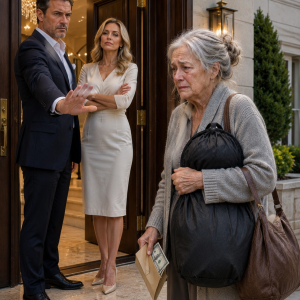
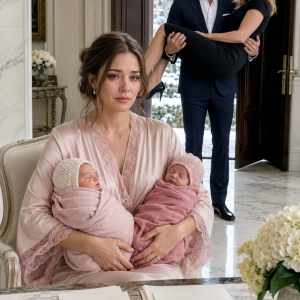
Part 1 – The Compliment He Could No Longer Pretend to Mean
When Adrian Keller told his wife that she had become difficult to look at, he delivered the sentence with the measured concern of a physician discussing an unfortunate diagnosis.
Late-afternoon sunlight filled the living room of their Spanish-style home in Santa Barbara, California, illuminating the terracotta floor, the cream linen curtains, and the framed coastal photographs that Adrian often accepted compliments for despite never having taken a single one.
Mara Bennett sat across from him wearing a pale gray dress she had purchased for their tenth wedding anniversary. Adrian had once said the color made her eyes appear brighter, although that compliment belonged to an earlier version of their marriage, when his criticism still arrived infrequently enough to resemble honesty.
He rested both hands on his knees.
“I do not want to be cruel, Mara, but you have stopped taking care of yourself.”
She glanced down at the dress.
“What exactly does that mean?”
Adrian exhaled as though her question placed another burden upon him.
“You look tired almost constantly, your hair has lost its shape, and you no longer make an effort before we attend company events. Attraction cannot survive when only one person keeps trying.”
The irony would have been almost amusing if it had not been so carefully designed. During the previous three years, Adrian had complained whenever Mara purchased clothing, scheduled a haircut, or spent money on skincare. He called those expenses indulgent, reminded her that his medical-device company faced uncertain quarters, and suggested that a woman approaching forty should appear confident enough to avoid chasing youth.
Then, after convincing her to stop spending money on herself, he criticized the results.
Mara folded her hands in her lap.
“Is there another woman?”
A small movement tightened his jaw.
“This conversation is about us.”
“That was not my question.”
“Your tendency to interrogate every difficult moment is one reason I no longer feel comfortable here.”
Adrian never answered questions that threatened his preferred story. He widened the subject until accountability disappeared inside a fog of mutual unhappiness, emotional distance, incompatible priorities, and supposedly shared mistakes.
Mara had recognized the technique three nights earlier.
Adrian left his tablet charging on the kitchen counter while he showered. A notification appeared across the locked screen from someone named Celeste.
The message contained no ambiguity.
You were right about her. She looks exhausted now, while you still walk into every room like you own it. Come home to me after the board dinner.
Mara photographed the screen without touching the device. She recorded the date, the time, and the visible account name, then returned the tablet to its original position.
She had lain beside Adrian that night listening to his breathing while something cold and precise replaced the confusion that had governed her for years.
The following morning, she drove to the public library and searched California divorce procedures, financial disclosure requirements, separate-property rules, and remedies for marital funds spent on an affair. Afterward, she called her former college roommate, Naomi Ellis, who practiced family law in Ventura.
Naomi listened without interrupting.
“Do not confront him about the evidence yet,” she said. “Copy financial records, preserve communications you can access lawfully, and locate every document connected to the house.”
Mara spent two days following those instructions.
What she discovered changed the shape of the marriage.
Adrian had been involved with Celeste Vaughn, his company’s director of physician partnerships, for nearly eighteen months. He paid the rent on her furnished apartment near Westlake Village, purchased jewelry through a corporate hospitality account, and charged private weekend trips to conferences that never occurred.
More than sixty thousand dollars had left the marital accounts.
The house revealed another truth.
Mara’s grandfather, Samuel Bennett, had created a real-estate trust before his death. The trust paid the entire down payment on the Santa Barbara property and retained title solely in Mara’s name. Adrian handled the closing papers and repeatedly described the house as jointly owned because, according to him, marriage made technical ownership irrelevant.
It had never been irrelevant to him.
That evening, while Adrian explained that Mara had become unattractive and emotionally draining, a complete file rested inside the locked cabinet of her former darkroom.
It contained bank statements, property records, copies of the tablet notification, and a timeline beginning several months before Celeste’s pregnancy.
Mara had not yet confronted him about that final discovery.
Celeste was nearly six months pregnant.
Adrian leaned forward, apparently mistaking Mara’s silence for devastation.
“I believe divorce would allow both of us to become more authentic.”
Mara looked at him calmly.
“Then we should stop delaying it.”
He blinked.
“You agree?”
“I agree that this marriage should end.”
His surprise revealed how thoroughly he had prepared himself for tears, pleading, or promises of transformation. He needed her collapse because it would confirm that he remained the valuable person leaving while she became the abandoned person begging to be chosen.
Mara stood and carried her empty coffee cup toward the kitchen.
“Have your attorney contact mine.”
Adrian followed her.
“You already hired an attorney?”
She placed the cup inside the sink.
“You wanted authenticity. This is what mine looks like.”
Part 2 – The Career That Disappeared Inside an Email
Adrian served Mara with divorce papers five days later.
He arrived home earlier than usual wearing a freshly pressed shirt and the expensive cologne Celeste had apparently selected for him. He placed a large envelope on the kitchen island while performing sadness with enough restraint to appear dignified.
“I wish we could have handled this privately without attorneys turning everything hostile.”
Mara accepted the envelope.
“Your attorney prepared the petition before our conversation.”
Adrian paused.
“I wanted to understand my options.”
“For how long?”
“That question no longer helps either of us.”
He expected to remain inside the house while the divorce proceeded. He also expected Mara to accept a settlement waiving reimbursement claims in exchange for modest monthly support.
Naomi sent him formal notice that evening confirming Mara’s sole title and requesting that he arrange temporary housing within the legally appropriate period.
Adrian called immediately.
“You cannot force me from my home because your grandfather used an outdated trust structure.”
“The structure appears current enough for your lawyer,” Mara replied.
“I paid the mortgage for years.”
“The mortgage came from our joint account, which included my income and the trust distributions you called household money whenever spending benefited you.”
His voice hardened.
“Celeste was right. You have been planning to humiliate me.”
Mara ended the call.
Two hours later, Adrian’s younger sister, Leah, appeared at the front door carrying an overnight bag and an expression filled with shame.
They sat inside the former darkroom, where shelves still held film canisters, lenses, and boxes of prints from the years before Mara abandoned professional photography.
Leah gripped a mug with both hands.
“Celeste is pregnant.”
“I know.”
Leah’s eyes widened.
“Adrian told everyone that the relationship began after you separated emotionally.”
“We were never separated.”
“I know that now.”
Leah explained that Adrian had informed his parents about Celeste’s pregnancy several weeks earlier. He described Mara as unstable, jealous, and increasingly obsessed with money. His mother, Diane, urged the family to remain neutral until the divorce ended.
“He said you stopped working because you could not handle professional pressure,” Leah added. “He told us you became withdrawn after your gallery rejected you.”
Mara looked toward the black camera bag resting on the highest shelf.
Before marriage, she had worked as an editorial photographer. Her images focused on ordinary labor, aging, immigration, and family life rather than polished commercial beauty. An experienced curator named Evelyn Shaw had once invited Mara to develop a traveling exhibition about women running small businesses along the California coast.
Mara prepared the first portfolio, then waited months for the next instructions.
No message ever arrived.
She eventually concluded that Evelyn had changed her mind.
After Leah left, Mara searched an archived email account shared with Adrian during the early years of their marriage. Hidden inside an exported folder was a conversation dated six years earlier.
Evelyn had written:
Your proposal remains one of the strongest submissions this year. We can fund a twelve-month project beginning in September, with exhibitions in San Francisco, Seattle, and Portland. Please confirm your availability.
The reply came from Mara’s account.
Thank you for the opportunity. Mara has decided to step away from photography indefinitely because our family responsibilities require her full attention. She asked me to decline on her behalf.
Adrian Keller.
Mara read the exchange repeatedly.
She had never asked him to decline.
At that time, Adrian was preparing to relocate for a promotion. He insisted that the move required stability and described Mara’s planned exhibition travel as impractical. She remembered arguing that the project could be adjusted, while Adrian claimed Evelyn had stopped responding.
He had not merely discouraged her.
He had entered her account and closed the door himself.
Naomi connected Mara with a forensic accountant and a digital-evidence specialist. They verified the archived message headers, account access history, and financial transfers connected to Celeste.
The preliminary review identified nearly ninety thousand dollars in marital and corporate funds spent on the affair.
Adrian had also used his employer’s reimbursement system to classify personal travel as physician-recruitment events.
While the investigation continued, Mara climbed onto a small ladder and removed the black camera bag from the shelf.
The camera her grandfather had purchased during her final year of college remained inside. Its leather strap had stiffened, and dust had settled around the lens cap.
Mara cleaned every component carefully.
The following Saturday, she attended an open photography walk organized by the Santa Barbara Arts Cooperative. She intended to remain anonymous and observe from the edge of the group.
Instead, workshop director Julian Hart noticed her photograph of an elderly flower seller arranging sunflowers beneath the morning light.
He studied the image on Mara’s camera screen.
“You understand where people hide their dignity,” he said.
Mara almost dismissed the compliment.
Then she stopped herself.
“I used to work professionally.”
“Used to?”
“I am reconsidering the tense.”
Part 3 – The Portraits That Did Not Ask Her to Become Younger

Mara returned to the cooperative every weekend.
At first, she photographed street vendors, retired teachers, restaurant owners, nurses finishing overnight shifts, and women repairing fishing nets near the harbor. She avoided self-portraits and refused every suggestion that she stand before the camera.
Julian respected the refusal until he began developing a project called Unedited Lives, a series examining how women over thirty-five understood beauty after illness, divorce, caregiving, job loss, or other changes that altered their public identity.
He asked Mara to photograph several participants.
After reviewing the first sessions, he made another request.
“The series needs you inside it.”
Mara shook her head.
“I belong behind the camera.”
“That may be true professionally, but the project also concerns who receives permission to be visible.”
“I am not interested in becoming an inspirational divorce story.”
“Neither am I. I am interested in a face that has stopped apologizing for knowing what happened to it.”
She refused twice more before agreeing.
The portrait session took place inside the cooperative’s simplest studio. Mara wore a white cotton shirt, dark trousers, and almost no makeup. Natural light entered through a north-facing window, showing every line Adrian had taught her to conceal.
Julian did not ask her to smile.
He asked her to look toward the light.
When Mara saw the images, she expected to notice exhaustion, age, and every flaw Adrian had cataloged.
Instead, she saw concentration.
She saw the face of a woman who had remained alert while somebody attempted to persuade her that confusion was part of her personality.
Several months later, an independent national arts magazine purchased the series for a special issue about women reclaiming creative work after long absences. The magazine selected Mara’s portrait for its cover and commissioned an essay featuring her return to documentary photography.
The publication was respected, although it was not the kind of celebrity platform that transformed lives overnight. More importantly, the editors also purchased twelve photographs Mara had taken.
For the first time in years, money entered her account because of her own images.
Meanwhile, the divorce became increasingly hostile.
Adrian demanded reimbursement for mortgage payments on Mara’s house and alleged that she had concealed the value of her photography equipment. He described the separate-property trust as an unfair technicality and argued that his career had funded their lifestyle.
Naomi responded with the affair expenditures, corporate reimbursements, falsified travel, and evidence that Adrian interfered with Mara’s professional opportunity.
His employer opened an internal investigation.
Celeste’s company-issued apartment allowance, travel records, and consulting arrangements entered the review. Although Celeste held a legitimate executive role, several expenses had no business justification, while Adrian approved bonuses affecting her compensation during their relationship.
The company placed both of them on administrative leave.
Adrian continued telling relatives that Mara intended to destroy the father of an unborn child.
Diane, his mother, requested a private meeting.
Mara agreed only after Leah offered to attend.
They met inside Diane’s home in Montecito one week before Thanksgiving. Mara brought copies of the relevant records, not because she required Diane’s approval, but because she refused to let Adrian’s version remain the only history his family heard.
Diane reviewed the apartment payments, travel charges, pregnancy timeline, and archived email to Evelyn Shaw.
Her hands began trembling.
“He told us you voluntarily abandoned photography.”
“He sent the message declining the exhibition.”
“Why would he do that?”
“Because my opportunity required travel during the year he wanted me available for his promotion.”
Diane removed her glasses.
“This was not one affair or one terrible decision.”
“No. It was a long process of reducing my choices until his preferences looked inevitable.”
Diane cried quietly.
Mara did not comfort her immediately. The older woman’s grief belonged to the collapse of an image she had chosen to trust.
Finally, Diane looked up.
“Adrian intends to bring Celeste to Thanksgiving dinner.”
Leah stared at her mother.
“You invited them?”
“He said excluding her would punish the baby.”
Mara closed the folder.
“The child has done nothing wrong. Neither has the child required Adrian to lie about me.”
Diane asked Mara to attend the dinner.
Mara agreed, but only under one condition.
“I will not argue for my own credibility. You already have the documents. Decide whether your home will reward deception before I arrive.”
Part 4 – The Dinner Where Nobody Protected His Version
Thanksgiving afternoon brought clear skies and cold coastal wind.
Mara arrived at Diane’s house carrying a pear-and-almond tart she had prepared from her grandfather’s recipe. She wore a cream blouse, dark tailored pants, and her old camera across one shoulder because she planned to photograph Leah’s children afterward.
Diane greeted her at the door and embraced her without performing reconciliation.
“Thank you for coming.”
“Thank you for reading everything.”
Relatives filled the living room, although conversation remained unusually restrained. Most had already learned that Adrian’s account was incomplete, but only a few understood how extensively he had controlled Mara’s work and finances.
At one fifteen, Adrian entered with Celeste.
Celeste wore a pale blue maternity dress and held Adrian’s arm tightly. She appeared nervous rather than triumphant.
Adrian saw Mara seated beside Diane at the dining table.
His expression became rigid.
“Why is she here?”
Diane remained standing.
“Because she was my daughter-in-law for ten years, and because the story you told this family was false.”
Adrian glanced around the room.
“This is a holiday, not a courtroom.”
Leah answered from beside the fireplace.
“Then stop treating every family gathering like a jury you need to influence.”
Celeste looked toward Mara.
“Adrian told me you had been separated privately for nearly a year.”
Mara held her gaze.
“We had not.”
Celeste turned toward him.
“You said she knew about us before I became pregnant.”
Adrian’s voice sharpened.
“Do not let her manipulate you. She has spent months building a revenge campaign.”
Diane placed the financial report on the table.
“Did you use marital money to pay Celeste’s rent?”
“The account was jointly managed.”
“Did you decline Mara’s exhibition without her knowledge?”
“The project would have damaged our marriage.”
Mara spoke before he could continue.
“You do not get to describe a decision you secretly made as something our marriage chose.”
Adrian stared at her.
“You were overwhelmed then. I protected you from a commitment you would have regretted.”
“You protected your convenience from my independence.”
Silence moved across the room.
Diane opened another document.
“Did you tell your employer that the Maui trip was a physician-recruitment conference?”
Adrian looked toward Celeste.
Her expression changed.
“You told me the trip came from your private bonus.”
“We can discuss this later.”
“Did company money pay for it?”
Adrian did not answer.
Celeste slowly removed her hand from his arm.
Mara had imagined this confrontation during sleepless nights, but the reality felt less dramatic. Adrian did not collapse beneath one devastating revelation. He simply lost each person’s trust through the same habit that had destroyed the marriage: he answered direct questions with explanations designed to protect himself.
Diane looked at her son.
“I believed you when you said Mara had become unstable and resentful. You used my concern to isolate her.”
“Mother, you are reacting emotionally.”
Leah gave a bitter laugh.
“There it is again.”
Adrian turned toward Mara.
“You came here to humiliate me in front of my family.”
“I came because your mother asked me to attend. The evidence existed before anyone opened this door.”
Celeste stepped backward.
“Is the Santa Barbara house yours?”
Mara answered honestly.
“It is titled solely in my name through my family trust.”
Celeste looked at Adrian.
“You told me we would raise the baby there after the divorce.”
Adrian reached for her hand.
She moved away.
“You lied about the marriage, the apartment, the trips, and the house. What exactly did you tell me that was true?”
“Celeste, do not make decisions while everyone is pressuring you.”
Her face tightened.
“That is how you speak whenever a woman stops agreeing with you.”
She left through the front door.
Adrian did not follow immediately. He appeared unable to decide which audience required him more.
Diane stepped away from the table.
“You should leave.”
“You are choosing Mara over your son?”
“I am refusing to choose your lies over the people they harmed.”
Adrian looked toward Mara one final time.
“You think this makes you powerful?”
Mara touched the camera strap across her shoulder.
“No. It makes the truth shared.”
He left without another word.
Part 5 – The Life That Did Not Need His Collapse

The months following Thanksgiving contained no miraculous transformation.
Mara still attended depositions, reviewed financial statements, completed therapy, and woke some mornings with Adrian’s criticism already moving through her mind before she opened her eyes.
The divorce settlement credited the marital estate for funds spent on the affair. Mara retained the house as separate property, while Adrian received a limited reimbursement for documented principal contributions reduced by his unauthorized withdrawals and other obligations.
The court also considered evidence that he interfered with Mara’s professional opportunity, although no amount could recreate the exhibition she lost six years earlier.
His employer concluded that Adrian violated expense rules, failed to disclose a relationship with an employee whose compensation he influenced, and submitted inaccurate travel documentation. He lost his executive position and repaid a portion of the improper expenses.
Celeste cooperated with the internal investigation. She and Adrian did not remain together.
Mara did not treat that outcome as victory. Celeste still faced pregnancy, professional consequences, and the realization that her future had been planned by a man who lied whenever truth threatened access.
Their child deserved adults capable of separating responsibility from resentment.
Mara converted Adrian’s former home office into a photography studio. The dark walnut desk disappeared, replaced by worktables, print drawers, lighting equipment, and a broad wall where she arranged contact sheets.
Her first independent exhibition opened eighteen months after the divorce.
The series, titled Rooms Women Return To, documented women rebuilding ordinary spaces after disruptive changes. One image showed a widow repainting her kitchen. Another portrayed a nurse returning to school at forty-seven. A third captured a woman repairing a dining chair after leaving a controlling marriage.
The photographs did not present survival as constant strength.
They showed fatigue, unfinished walls, financial uncertainty, humor, boredom, and the quiet dignity of people making decisions without seeking approval.
Evelyn Shaw attended the opening.
She stood before Mara’s newest portrait for several minutes.
“I owe you an apology,” Evelyn said. “When Adrian wrote that you were withdrawing, I accepted his authority to speak for you.”
“I wish you had contacted me directly.”
“So do I.”
Evelyn did not ask for immediate forgiveness. She offered Mara a future project documenting women who managed family-owned businesses along the Pacific Coast.
Mara accepted after negotiating authorship, schedule, compensation, and travel terms herself.
Julian became a trusted collaborator but not a romantic reward for leaving Adrian. Mara’s new life did not require replacing one relationship with another before it could feel complete.
Part 6 – The Face He Could No Longer Edit
Two years after Adrian called Mara unattractive, the special issue containing Unedited Lives appeared in airports, bookstores, libraries, and museum shops across the country.
Mara’s portrait occupied the cover.
The headline read:
MARA BENNETT
PHOTOGRAPHER, DOCUMENTARIAN, AND THE ART OF RETURNING
She wore no dramatic gown and no elaborate jewelry. Natural light rested across her face, showing the lines beside her mouth, the uneven texture of real skin, and eyes that no longer searched the room for permission.
Leah called from Los Angeles International Airport shortly after sunrise.
Her laughter arrived before the explanation.
“Adrian is standing inside a bookstore near the gates, staring at your cover like the magazine personally confronted him.”
Mara adjusted prints inside her studio.
“Did he purchase a copy?”
“He picked one up, read several pages, then put it back and left.”
Mara smiled.
“Then somebody else can buy that one.”
Later that afternoon, Adrian sent a message.
We need to talk. I understand now that I underestimated you.
Mara read the words once.
Underestimated suggested an innocent error, as though Adrian had simply miscalculated her professional potential. It did not describe the account intrusion, the stolen opportunity, the financial deception, or the years spent weakening her confidence before introducing the affair as proof of her failure.
She did not reply.
A month later, they met accidentally at a hospital foundation event where Mara had been hired to photograph nurses and patient advocates.
Adrian approached during a break.
He looked older and less polished, although consequence had not automatically produced humility.
“Congratulations on the magazine,” he said.
“Thank you.”
“I was wrong about you.”
Mara lowered the camera.
“You were not wrong about my appearance. You used appearance as a weapon because you needed me to question my value before you left.”
His eyes shifted away.
“I was unhappy.”
“Unhappiness did not write an email from my account.”
“I thought the project would take you away from us.”
“It would have taken me away from your schedule.”
Adrian remained silent.
“I am sorry,” he said eventually.
Mara studied him.
The apology was not meaningless, but neither was it a key capable of reopening anything.
“I hope you learn to stop making women smaller whenever their choices frighten you.”
She lifted the camera again.
“I need to return to work.”
Adrian stepped aside.
Mara walked toward a group of neonatal nurses waiting beside a bright hospital window.
She did not look backward because she was not performing strength for him.
The photograph in front of her mattered more.
Part 7 – The Permission She Stopped Waiting For
Three years after the divorce, Mara opened the Bennett Light Studio inside a renovated warehouse near the Santa Barbara waterfront.
The studio combined editorial photography, community workshops, and paid fellowships for women returning to creative careers after caregiving, divorce, illness, or financial control.
Participants did not receive speeches about confidence without resources. They received equipment access, childcare stipends, legal guidance concerning contracts, portfolio development, and paid assignments.
During the first workshop, a forty-five-year-old participant named Rosa held a camera with visibly trembling hands.
“My husband always said photography was something bored women did before finding real responsibilities,” she said.
Mara adjusted the strap without taking the camera from her.
“You do not need anyone’s permission to discover whether he was wrong.”
Rosa looked through the viewfinder.
“What should I photograph first?”
Mara pointed toward the open studio door, where afternoon light crossed the floor.
“Something you have been seeing without allowing yourself to name.”
After the workshop ended, Mara returned to her house.
The property no longer felt like evidence against Adrian. She had repainted the living room, replaced the furniture, and transformed every room through choices that required no defense.
Her grandfather’s camera rested inside a glass cabinet near the studio entrance, while her current equipment occupied the worktable.
On the wall hung neither the magazine cover nor the divorce judgment.
Instead, Mara displayed the first photograph she had taken after opening the old camera bag: the flower seller arranging sunflowers beneath morning light.
The image was imperfect. The framing leaned slightly, one highlight was too bright, and a passing bicycle appeared near the edge.
It also marked the first moment Mara created something without wondering whether Adrian would consider the time useful.
Outside, the evening sun settled across the tiled roof.
Mara opened the windows, brewed coffee, and reviewed photographs from the fellowship group. One woman had captured her mother repairing a quilt. Another photographed a mechanic washing grease from her hands. Rosa submitted an image of an empty chair beside an open bedroom door.
Mara wrote thoughtful comments beneath each file.
Her life had not become valuable because Adrian saw her on a magazine cover. The cover merely made visible what his contempt had never possessed the authority to erase.
She had been valuable while sitting across from him in the gray dress.
She had been valuable when her work disappeared inside an email she never wrote.
She had been valuable while doubting herself, collecting evidence, reopening the camera bag, and learning how to stand inside her own photographs.
Freedom did not begin when the world admired her face.
It began when she stopped accepting another person’s description of it.
THE END