Part 1 – The Envelope At The Lakeside Wedding
The envelope was heavy, cream-colored, and sealed with the navy crest my father used whenever he wanted cruelty to resemble tradition.
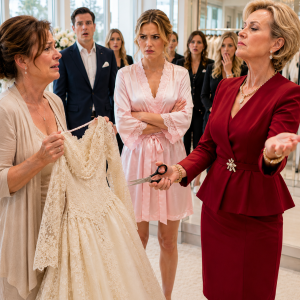
Henry Whitaker stood beside my table inside the glass ballroom of the Grand Mariner Hotel in Lake Geneva, Wisconsin, while nearly two hundred wedding guests watched through candlelight and reflected rain. My younger sister, Camille, remained several steps away in a pearl-beaded gown, one hand resting on the back of a chair and the other holding the smile she had practiced for photographs.
My father extended the envelope toward me.
“This is from the family, Laurel.”
The orchestra softened at exactly the right moment. Three cameras near the dance floor turned in my direction. Camille had arranged the humiliation carefully enough that nobody could later call it accidental.
I accepted the envelope, opened it, and read all four pages.
The letter formally removed me from Whitaker Harbor Group, denied me any authority to represent the family, terminated every discretionary trust payment, and declared that I would receive no future inheritance, property interest, or financial assistance connected to the Whitaker name.
My father had signed the final page. Camille and our uncle had signed as witnesses. The family attorney had notarized the document before dinner.
When I finished reading, I folded the pages, placed them inside my handbag, and smiled.
The smile unsettled them more than anger would have.
“What is amusing?” Henry asked.
“Nothing is amusing. I am grateful that you finally put everything in writing.”
Camille’s expression tightened.
“Please do not turn my wedding into one of your confrontations.”
“You placed cameras around my table and asked the orchestra to lower the music. This confrontation arrived before I did.”
A murmur moved through the ballroom. My father glanced toward the camera operators, and the first trace of fear entered his face.
“You should leave.”
“I intend to, but first I need confirmation that the recording includes sound.”
The lead videographer hesitated before nodding.
“The files upload automatically to our studio server.”
Henry moved toward him, but I raised one hand.
“Do not interfere with the recordings. They may become corporate evidence tomorrow morning.”
My new brother-in-law, Nolan Reeves, stepped beside Camille. He wore a perfectly cut tuxedo and the polished expression of a man whose charm had persuaded banks, investors, and my sister to trust him.
“Corporate evidence for what?”
“An emergency shareholder meeting concerning your debt acquisitions.”
His face changed for less than a second, although recognition moved through his eyes before discipline returned.
Camille looked from him to me.
“What debt acquisitions?”
The question confirmed that she knew nothing.
I opened my handbag and removed copies of loan assignments, beneficial-ownership filings, and wire records. For eight months, Nolan’s private fund had been purchasing Whitaker Harbor Group’s obligations through three concealed entities. If the company missed certain repayment targets, his firms could seize terminals, storage properties, and voting collateral.
My father had invited a creditor into the family and dressed him as a groom.
“Tomorrow the board will receive every document,” I said.
Nolan stepped closer.
“You will not leave this hotel with those papers.”
The nearest microphone captured every word.
“The originals are already with counsel.”
Camille struck me across the face. The sound carried across the ballroom.
“You came here to destroy me.”
I touched my cheek.
“No. You invited me because you wanted everyone to watch Father destroy me first.”
Henry seized my arm as I turned toward the exit.
“Withdraw your challenge,” he whispered, “and I will tell you where your mother is.”
My mother had supposedly died in a highway fire when I was thirteen.
The ballroom vanished around me.
“What did you say?”
His fingers tightened.
“Your mother is alive.”
Part 2 – The Clause My Grandmother Designed
I pulled free and demanded an explanation, but Henry’s face returned to its familiar stillness.
“Renounce the voting claim, and I will arrange contact.”
“You buried an empty casket.”
“This is not the place.”
“You made it the place.”
Camille approached, asking what he had said, but he dismissed her without looking away from me. That single gesture disturbed her more than the accusation about Nolan’s debt purchases.
I left the ballroom and found my attorney, Thomas Hale, waiting near a service corridor. He had spent six years preparing for the document now hidden inside my handbag.
My grandmother, Evelyn Whitaker, had founded the family shipping business with two lake freighters and a leased warehouse in Milwaukee. Before her death, she created a succession provision designed to prevent one heir from controlling another through financial dependence.
If a direct descendant was formally and publicly expelled from the family, that person would immediately gain control of a protected voting block held in reserve.
Thirty-one percent.
My grandmother had also transferred twenty-one percent to me through a dormant trust.
The letter my father delivered at Camille’s wedding activated both interests, giving me fifty-two percent of Whitaker Harbor Group.
Henry believed the reserve clause had expired. It had not.
“The recording establishes public expulsion,” Thomas said. “The signed letter establishes formal intent. We can notify the trustee tonight.”
“Father says my mother is alive.”
Thomas stopped walking.
His reaction was not surprise.
“You knew something.”
“Three months ago, an investigator found payments to a woman using your mother’s maiden name. They came from a trust connected to the protected voting block.”
“Where is she?”
“We have not confirmed the identity. The money moves through foreign custodians and private medical accounts.”
We entered the underground garage, where Margaret Sloan waited beside a dark sedan. Margaret had served as my grandmother’s executive assistant for more than thirty years and disappeared from public life after the funeral.
She opened the trunk and revealed a small teak box marked with Evelyn’s initials.
Six years earlier, my grandmother had given me a brass key and said,
“Use this only after someone officially decides you no longer belong.”
I opened the box.
It contained no stock certificates or legal opinions. Only a recent photograph showed my mother standing beside a lakeside café, older but unmistakably alive.
Nolan Reeves stood beside her.
A message on the back read:
Ask who actually financed the first ship.
Beneath the photograph lay a letter written in my mother’s hand.
My dearest Laurel,
If Henry has finally forced you out, do not trust the board, the family attorneys, or anyone claiming Whitaker Harbor Group belongs to the Whitakers.
The original ownership records remain where the first vessel came home.
Find them before Nolan does.
Do not believe I chose to leave you and Camille.
The first vessel had returned to Dock Seventeen in Milwaukee Harbor, a property my father believed had been sold years earlier.
Margaret shook her head.
“Your grandmother transferred it into a separate trust. The same trust that has been paying your mother’s expenses.”
A black SUV entered the garage at high speed and struck Thomas’s sedan. Two masked men emerged.
One reached for the teak box.
Margaret pulled me toward a service stairwell while Thomas remained behind, shouting for us to run.
At the lower landing, Nolan appeared with a handgun pressed against Thomas’s ribs.
“Bring me the box, Laurel.”
“Where is my mother?”
“Alive, for now.”
He promised to take me to her if I surrendered the key and withdrew my voting claim.
I almost stepped downward.
Then I remembered the warning written in my mother’s letter.
Nolan did not know where the records were.
He needed me to find them.
Part 3 – The Truth Nolan Inherited

Nolan kept the weapon against Thomas while two masked men blocked the stairwell below.
“You married Camille to gain access to the company,” I said.
“I married Camille because Henry promised access to assets stolen from my family.”
His father, Charles Reeves, had once been Evelyn Whitaker’s business partner. Family history described him as an embezzler who diverted millions and died in prison.
Nolan claimed the story had been manufactured.
“My father financed the first ships. Evelyn controlled operations, while he secured investors. When the company expanded, your family erased his ownership and blamed him for missing money.”
“Then why threaten Camille?”
“I did not threaten her. I gave her the version of me she wanted.”
The cruelty of that sentence sounded exactly like my father.
Henry entered through the lower door, accompanied by hotel security contractors.
“This has become unnecessarily dramatic,” he said.
Nolan lowered the gun slightly.
“You promised me the reserve shares.”
“I promised access after the marriage. Laurel’s claim was supposed to disappear tonight.”
Their alliance was collapsing in front of me.
I looked at Henry.
“You knew Nolan was buying our debt.”
“His capital preserved the refinancing.”
“You used Camille as collateral.”
“Her marriage aligned his interests with ours.”
Nolan laughed.
“You never intended to honor the agreement.”
The emergency lights failed suddenly. Darkness swallowed the stairwell, followed by shouting and a single gunshot.
Margaret grabbed my wrist.
“Move now.”
She had disabled the garage power through an old service panel. We escaped into a maintenance tunnel leading behind the hotel.
Before disappearing, she handed me a map of Dock Seventeen.
“Your grandmother built a secure records room beneath the original warehouse.”
“Why did you wait so long?”
Margaret’s face tightened.
“Because I helped Evelyn protect the company when we should have protected the truth.”
She admitted that Charles Reeves had not been innocent. He and Evelyn had used company vessels to conceal stolen antiquities and illegal weapons shipments during the company’s earliest years. When Charles wanted to disclose the network, Henry—then a young executive—altered records to make Charles appear solely responsible.
Evelyn permitted the deception to preserve the company.
My mother later discovered the original ledgers and threatened to contact federal investigators. Henry sabotaged her car, but she survived. Evelyn found her before police arrived and hid her under private medical supervision, claiming exposure would destroy the business and endanger her daughters.
Protection became imprisonment.
Margaret altered the Dock Seventeen transfer documents years later, ensuring Henry could not sell the property or reach the records.
“The original ownership may belong to neither Whitaker nor Reeves,” she said. “Your mother learned something else before the crash.”
My telephone displayed seventeen missed calls from Camille. A voicemail arrived.
“Laurel, I heard everything in the garage. Nolan saw me. Do not go to Dock Seventeen because they already know.”
The message ended abruptly.
Then a photograph appeared.
Camille sat in the back of a vehicle, her veil torn and blood visible near her mouth.
Beside her sat our mother.
Under the image were seven words:
BRING THE KEY TO DOCK SEVENTEEN ALONE.
Part 4 – The Warehouse At The Edge Of The Lake
Rain blurred the highway toward Milwaukee.
Dock Seventeen stood beyond abandoned grain elevators and dark water, its warehouse windows covered with rusted metal panels. One office near the end of the pier remained lit.
Nolan opened the door before I knocked.
Inside, Camille was tied to a chair beneath an industrial lamp. Our mother sat beside her, thinner than I remembered but alive.
“Laurel.”
Hearing my name in her voice erased twenty-three years for one devastating second.
I moved toward her, but Nolan blocked me.
“The key.”
I placed the teak box on an old table and opened it.
Nolan searched the velvet lining.
“Where are the records?”
“The box contained only the photograph and letter.”
Henry emerged from the shadows and gripped my arm.
His tuxedo was torn from the struggle at the hotel, and a dark bruise covered his jaw.
“You never knew when to stop asking questions.”
“You kidnapped your wife and daughter.”
“I contained a crisis created by disloyalty.”
My mother looked at him with undisguised hatred.
“You said the same thing the night you cut my brake line.”
Camille stared at him.
“You caused the accident?”
My mother answered.
Henry had followed her along a rain-soaked highway after learning she possessed the original financial ledgers. When the damaged brakes failed, her car crossed a barrier and caught fire. Henry left her there.
Evelyn’s men recovered her before emergency crews arrived and substituted another body identification to support the death story.
For more than two decades, my mother lived in guarded residences under changing names. Each escape attempt brought threats against Camille and me.
“You made us mourn her,” I said.
“I kept you alive.”
“You kept your secrets alive.”
Nolan demanded the brass key.
Before I could answer, my mother spoke.
“Your father lied to you too, Nolan.”
He turned toward her.
She explained that neither the Whitakers nor the Reeves family originally owned the company. The first two vessels had been financed by her mother, Ruth Calder, a wealthy but private Great Lakes trader whose capital had been hidden because banks and port authorities refused to recognize a woman as controlling owner.
Evelyn Whitaker and Charles Reeves managed the business under contracts that gradually erased Ruth’s name.
When Evelyn’s son Henry married Ruth’s daughter, he believed the union consolidated the ownership permanently.
The original shares passed through the maternal line.
My mother remained the lawful controlling heir.
After her, Camille and I inherited equally.
Nolan looked toward Henry.
“Is that true?”
For the first time, my father seemed defeated.
“Yes.”
Nolan raised the gun toward him.
“You let me believe your family stole everything from mine.”
“Your father was compensated.”
“He died in prison.”
“Because he threatened the company after participating in the crimes.”
The history was not a clean battle between thieves and victims. Every powerful adult involved had preserved some part of the system until it turned against them.
Sirens sounded in the distance.
Camille smiled despite the blood on her lip.
“I called emergency services before they took my phone.”
Nolan struck her and turned toward the door.
My mother kicked the table into his knees. I pulled free from Henry, while Camille threw her weight sideways, dragging the chair into Nolan’s legs.
The gun discharged into the ceiling.
Rotten floorboards collapsed beneath the table, sending Nolan and the teak box into a hidden chamber below.
A mechanical alarm began sounding.
Dark harbor water rushed through old pipes into the underground records room.
Henry laughed with exhausted relief.
“Evelyn designed the chamber to flood if breached. Every original document will disappear.”
My mother reached inside her coat and removed a metal cylinder.
“The originals were never stored here.”
Part 5 – The Archive Beneath The Wedding Hotel

Police and federal agents secured the warehouse while rescue teams pulled Nolan from the flooded chamber.
My mother handed me the cylinder. Coordinates etched into the metal led back to the Grand Mariner Hotel, where Camille’s wedding reception had begun only hours earlier.
The hotel had once served as Evelyn’s private lakeside residence before conversion. My grandmother constructed a concealed archive beneath its original wine cellar.
Margaret had already returned there with Thomas.
Federal investigators, alerted through evidence Thomas transmitted before the garage attack, were securing the building when we arrived.
The archive opened through a brass lock matching my key.
Inside were corporate charters, shipping manifests, original stock ledgers, letters from Ruth Calder, and financial records documenting decades of smuggling, bribery, false ownership transfers, and concealed trust payments.
The earliest charter identified Ruth Calder as majority owner.
Later documents proved Evelyn and Charles diverted her shares through forged assignments. Henry subsequently used the smuggling accounts to finance expansion and political influence.
The archive also contained a recorded statement from Evelyn.
“I allowed reputation to become more important than justice. I protected the company from Charles, then protected Henry from the consequences of framing him. When Eleanor discovered the truth, I called imprisonment protection because I lacked the courage to dismantle what I built.”
My mother’s name was Eleanor Calder Whitaker.
Evelyn had funded her confinement, medical care, and surveillance through the reserve trust. The same trust created the disinheritance clause because Evelyn believed Henry might eventually expel one daughter to secure control through the other.
The clause had not been designed simply to reward me.
It had been designed to remove Henry the moment he publicly demonstrated the coercion Evelyn had enabled.
Federal agents arrested Henry for kidnapping, attempted murder, obstruction, financial crimes, and offenses connected to the original smuggling enterprise.
Nolan was arrested for kidnapping, assault, extortion, illegal debt manipulation, and attempted corporate seizure.
The hotel cameras, ballroom recordings, garage footage, Camille’s emergency call, and archive documents eliminated the private explanations both men intended to construct.
Camille sat beside me while paramedics treated her injuries.
“I helped Father humiliate you,” she said.
“Yes.”
“I believed he loved me more because I was easier to love.”
“He rewarded obedience. That is not the same thing.”
She began crying.
I did not promise that one apology would repair our relationship. However, I held her hand while our mother sat on the other side.
For the first time since childhood, all three of us were together without Henry controlling the story.
Part 6 – Who Should Control Whitaker Harbor Group
The board meeting occurred two days later under federal observation.
My disinheritance letter had activated the reserve trust, but the archive revealed that the Whitaker ownership structure itself was fraudulent.
I could have relied upon the fifty-two percent voting claim and taken immediate control. My attorneys believed the argument would survive long enough to remove hostile directors.
My mother opposed that approach.
“We should not repair stolen ownership by claiming another convenient document.”
Instead, we petitioned the court to place Whitaker Harbor Group under temporary independent supervision while ownership, criminal proceeds, and victim claims were reviewed.
The board removed Henry and suspended executives linked to the hidden debt structure.
Nolan’s creditor entities were frozen. Several loan assignments had violated disclosure rules and contained triggers designed to manufacture default rather than manage risk.
Camille filed to annul the marriage after investigators proved Nolan had used false representations about his intentions and concealed material financial conflicts.
She refused any settlement requiring silence.
The archive revealed that the smuggling network had harmed dockworkers, displaced small shipping companies, and moved stolen cultural property through Great Lakes ports. Some original owners and affected families could still be identified.
My mother testified first.
For twenty-three years, Henry and Evelyn had described her as unstable, dead, or voluntarily absent. She told the court exactly how fear, medication, restricted movement, and threats against her daughters maintained the confinement.
Margaret also testified.
“I believed preserving the company protected thousands of employees,” she said. “In reality, I protected powerful people and required everyone else to carry the danger.”
The court appointed an independent trustee and forensic accounting team. Ruth Calder’s maternal-line ownership was recognized provisionally, but my mother declined personal control until restitution and employee protections were established.
“A family name should not decide who rules this company again,” she said.
Part 7 – The Restitution Plan
The investigation lasted eighteen months.
Henry was convicted of attempted murder, kidnapping, obstruction, financial fraud, and conspiracy connected to the historical smuggling operation. He received a sentence ensuring that he would remain in prison for the rest of his life.
Nolan accepted a plea after several creditor executives agreed to testify against him. His sentence covered kidnapping, extortion, securities violations, conspiracy, and assault.
Other officers, attorneys, and financial intermediaries faced separate convictions.
Whitaker Harbor Group survived, but it became a different company.
Illegal assets were sold, disputed property was returned where possible, and a restitution fund compensated affected workers, small carriers, and communities harmed by the smuggling and debt schemes.
The company’s controlling shares moved into a public-benefit trust governed by employee representatives, independent maritime experts, community members, and limited seats for the Calder descendants.
My mother, Camille, and I each received one nontransferable family seat rather than private majority ownership.
I became chair of the transition committee for two years, then stepped down after governance reforms were complete.
Camille trained in corporate compliance and began rebuilding her life without Father’s allowances or Nolan’s image of success.
Our relationship remained cautious.
Some wounds needed consistency rather than dramatic forgiveness.
My mother moved into a small house near the lake and spent months learning ordinary choices again. She selected groceries, opened her own mail, and kept her own keys. Nobody reported her movements or decided which telephone calls she could receive.
One afternoon, she asked whether I resented her for not escaping sooner.
“I resent what they did to make escape dangerous,” I answered. “I do not blame you for surviving inside the choices they left.”
She cried quietly, then asked whether I would stay for dinner.
I did.
Part 8 – The Wedding Film We Kept
Two years after Camille’s wedding, the Grand Mariner Hotel reopened after investigators released the property.
We converted the concealed archive into a public maritime history center documenting Ruth Calder’s ownership, the erased labor of women and immigrant workers, the smuggling network, and the consequences of protecting institutions at the expense of truth.
The wedding ballroom remained in use.
Camille asked whether the original video should be destroyed.
The footage showed Father handing me the disinheritance letter, Nolan threatening me, Camille striking my face, and nearly two hundred guests witnessing the performance.
“I hate who I was in that recording,” she said.
“Then let it remind you that people can stop being that person.”
We preserved the footage inside the archive with legal records and testimony explaining what followed.
The disinheritance letter was displayed nearby.
Visitors often assumed it represented rejection.
To me, it represented the moment a system designed around fear accidentally produced a document strong enough to challenge itself.
On the anniversary of my mother’s return, the three of us stood outside the hotel overlooking the lake.
Camille asked whether we were still a family after everything we had learned.
My mother answered carefully.
“We are related by blood. We become family through what we choose now.”
The distinction mattered.
Henry had treated blood as ownership. Nolan treated marriage as access. Evelyn treated secrecy as protection. All three believed love could be measured through control.
We had inherited their company, their damage, and their unfinished truth, but we were not required to inherit their definitions.
The storm that night moved far across the lake, leaving the harbor bright beneath a clear evening sky.
I once believed being expelled meant losing my place.
Instead, the letter forced open every locked room the family had built around me.
What waited inside was not a throne.
It was responsibility.
THE END