The Morning I Came Home Early

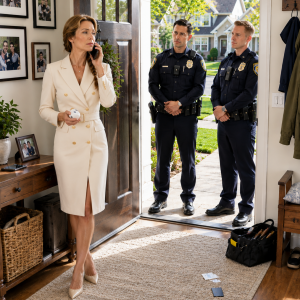
My mother was standing in the middle of my living room, pointing at my five-year-old daughter as though she were identifying a dangerous stranger rather than a small child clutching a plastic doll against her chest.
“Take her somewhere and teach her a lesson,” she told the two police officers near the front door. “She needs to understand that actions have consequences.”
I had returned to Raleigh, North Carolina, a full day earlier than expected because a commercial design presentation in Chicago had been canceled at the last minute. Instead of staying at the airport hotel, I caught the first flight home, imagining how delighted my daughter, Willa, would be when I appeared at breakfast with the cinnamon rolls she loved.
Nothing could have prepared me for what I found when I unlocked our apartment.
Willa was curled into the corner of the cream-colored sofa, her knees pulled tightly beneath her chin. Tears covered her cheeks, but she made no sound. She looked as though she had decided that even crying might make the adults angrier.
My mother, Diane, stood with her arms folded. My older sister, Kelsey, was holding her four-year-old daughter, Brianna, who appeared remarkably calm for a child supposedly involved in an emergency. She was eating animal crackers from a paper cup while pretending to sniffle whenever someone looked in her direction.
One of the officers had crouched beside Willa and was speaking to her in a gentle voice.
“Nobody is taking you anywhere,” he said. “You’re staying right here in your home.”
I dropped my suitcase beside the door.
“What is happening?”
The older officer rose and glanced from me to my mother.
“We received a 911 call about an altercation between two children. The caller said the child’s mother was out of state.”
I turned toward Diane.
“You called 911 over an argument between two little girls?”
Kelsey answered before my mother could.
“Willa shoved Brianna. She became aggressive because she wouldn’t share a doll.”
Willa finally looked at me. Her eyes were swollen, and her small hands were trembling around the doll.
“Grandma said the police were going to put me in a room where bad children go.”
Something hot and painful rose in my chest, but I did not raise my voice. I sat beside her, pulled her into my arms, and felt her body collapse against mine.
The younger officer looked directly at Diane.
“Ma’am, emergency services should not be used to frighten a child during a disagreement over a toy. No one was injured, and there is no reason for police action. Making exaggerated emergency reports can have serious consequences.”
Kelsey frowned.
“So you’re not documenting what she did?”
The officer stared at her for a moment.
“She is five years old.”
Before leaving, he crouched in front of Willa again.
“You are not a bad kid. Pushing someone is not a good choice, but it does not mean people can scare you. When you feel upset, find a grown-up you trust and ask for help.”
When the door closed, my mother remained in the center of the room as if she expected me to apologize for interrupting her lesson.
I stood slowly.
“You will never be alone with my daughter again.”
Diane did not blink.
“You indulge her too much. Someday someone will have to correct her.”
“You made her believe she could be taken away.”
“Maybe she’ll remember that the next time she refuses to share.”
Kelsey insisted they had acted for Willa’s own good. Then, from beneath my arm, Willa whispered what had actually happened. Brianna had tried to pull away the doll her father had mailed for her birthday. Diane had ordered Willa to hand it over because Brianna was supposedly more careful with her belongings.
That evening, while I washed shampoo from Willa’s hair, she told me something even more troubling.
“Grandma said you would be embarrassed when you found out. She said maybe you wouldn’t want to be my mom anymore.”
I wrapped her in a towel and held her until her breathing slowed.
After she fell asleep, I sat at the kitchen table and opened my banking app.
For years, automatic payments had left my account every month. I paid my mother’s supplemental health plan, a portion of her utility bills, Kelsey’s car loan, occasional home repairs, and countless expenses that were always presented as emergencies.
I had told myself that helping them was what a good daughter did. I had also believed that paying those bills helped Willa remain close to her grandmother, her aunt, and her cousin.
That night, I canceled every transfer.
I did not call anyone. I did not make threats or announce my decision. I simply pressed the cancel button until there were no scheduled payments left.
Five days later, my mother discovered what I had done.
Once she realized she could no longer control my money, she went after the safest place my daughter had outside our home.
The Story They Sent to Her School
The first messages were written with such artificial sweetness that they felt more insulting than anger.
Kelsey texted first.
“Natalie, I think there might be a problem with your bank. The car payment didn’t go through.”
My mother followed twenty minutes later.
“I’m worried something may be wrong with your account. The utility payment is missing, and my furnace has been acting up again. Please check when you have time.”
I did not answer.
For nearly four years, I had served as the emergency fund for two capable adults. Diane was widowed, and Kelsey worked as an office assistant at a private daycare, so every request came wrapped in the language of family responsibility.
Over time, assistance became expectation. Expectation became obligation. Somehow, I was welcomed as long as I continued solving their problems.
Two days later, Kelsey arrived at my apartment with Brianna beside her.
Willa immediately moved behind my leg.
“You can’t cut us off without warning,” Kelsey said.
“You didn’t warn me before calling police officers into my home to frighten my daughter.”
“That was Mom’s idea.”
“And you stood there supporting it.”
Kelsey lowered her voice.
“If the bank takes my car, I could lose my job.”
“Then call the lender and make arrangements. I’m not paying for the privilege of watching you humiliate Willa.”
The next morning, Diane called.
“Do not act surprised when your choices come back to you.”
I assumed she was trying to make me nervous. I was wrong.
A week later, I arrived at Willa’s elementary school for afternoon pickup. Several parents who normally greeted me suddenly found reasons to study their phones. The change was so obvious that I stopped beside a woman whose daughter often played with Willa.
She looked uncomfortable.
“Natalie, an anonymous email went around. It says Willa has serious behavior issues and that the police have already been involved.”
My stomach tightened.
The principal, Mrs. Hanley, invited me into her office and showed me a cropped image that appeared to be part of a police incident report. Important sections were missing. There was no explanation that the call concerned a toy dispute, no statement that officers found no injuries, and no conclusion clearing Willa of any serious concern.
Only a few phrases remained visible: “aggressive minor,” “parent away,” and “possible risk to other children.”
Willa’s teacher joined us and shook her head.
“This does not reflect the child I teach. Willa is sensitive and cooperative. When she gets frustrated, she usually asks an adult for help. The document also looks edited.”
That afternoon, Willa’s father, Bradley, received the same anonymous message.
Bradley had moved to Tennessee when Willa was a toddler. He sent regular support payments and mailed gifts on birthdays, but he rarely remembered what size clothing she wore or what books she liked. Suddenly, he wanted to discuss changing custody.
“Maybe she would be more stable with me,” he said over the phone.
“You don’t know the name of her teacher, but one anonymous email has made you an expert on what she needs.”
I ended the call and returned to the school.
In writing, I removed Diane and Kelsey from every authorized pickup list. I stated clearly that neither woman was allowed to visit Willa, approach her classroom, request information, or remove her from school property.
Mrs. Hanley also gave me copies of the anonymous messages and their attachments.
That night, a friend from my company’s technology department helped me examine the files. The document had been created using an account connected to the daycare where Kelsey worked.
But we found something else.
Behind one of the cropped sections was a nearly invisible incident number.
I requested the official police record and learned that the caller had contacted dispatch three times that morning, changing the story each time in an effort to make officers respond more quickly. During the third call, she claimed Willa had threatened another child with a sharp object.
There had been no sharp object.
There had only been a plastic doll lying on the carpet.
The dispatch center had retained the audio. When I listened to it, I recognized my mother’s voice immediately.
Then I heard what Diane and Kelsey said after they mistakenly believed the call had ended.
The Recording They Thought No One Heard

The dispatcher had asked Diane to remain on the line while an officer was sent to the apartment. Diane apparently set her phone on the kitchen counter without disconnecting.
Her voice came through clearly.
“The incident number is all we need. When Natalie comes home, we’ll tell her that next time we’ll call child services. Then she’ll stop challenging us.”
Kelsey responded.
“What if she gets angry and stops helping with the bills?”
“She won’t. She’s too afraid of looking like a bad mother. We can also tell Bradley that she leaves Willa unsupervised whenever she travels.”
“Brianna barely even fell.”
“That doesn’t matter. Willa needs to learn who is in charge, and so does Natalie.”
The exchange lasted less than a minute, but it changed the way I understood my entire family.
This had not been a careless overreaction. They had deliberately used my daughter’s deepest fear to keep me obedient.
As I listened, memories from my own childhood returned with uncomfortable clarity.
Diane rarely needed to shout. She punished with silence, wounded expressions, and carefully chosen words that made me question my own character. When I cried, she asked what I had done to create the problem. Kelsey, three years older, learned early that siding with our mother earned approval. She became the dependable daughter, while I was described as difficult whenever I asked questions.
Our father, Raymond, was gentle, but gentleness was not the same as protection. When Diane upset me, he brought hot chocolate to my bedroom and told me to give her time. I spent years confusing comfort after harm with someone preventing the harm in the first place.
I left home at nineteen, worked in a furniture showroom during the day, and studied interior architecture at night. Willa was born when I was twenty-eight. Bradley moved away before her second birthday, leaving me to build a life that was peaceful, if not always easy.
When my father passed away unexpectedly several years later, Diane returned to my life with casseroles, thoughtful messages, and promises that our family could begin again. I wanted to believe grief had softened her.
At first, the money requests were small: a medical copay, a plumbing repair, an overdue electric bill. Then came the insurance plan, the car payment, and fixed monthly transfers. Over four years, I had sent more than forty thousand dollars without ever receiving a clear statement of where it all went.
Any question was met with the same accusation.
“After everything this family has done for you, you’re counting dollars?”
The recorded conversation showed that Diane knew exactly which old wound to press. She knew I had spent my life afraid of being called ungrateful, selfish, or unfit to raise my child. Now she was attempting to place that same burden inside Willa.
I collected everything: the complete incident report, confirmation of the three calls, the audio, the anonymous emails, and the school’s written evaluation of Willa.
Mrs. Hanley also discovered that Kelsey had used a workplace computer to prepare the altered image and had accessed family contact information without permission.
“I have to report this to the daycare’s administration,” she told me. “An employee cannot use parent information to target a child.”
I did not feel pleased. I felt tired.
Kelsey would probably lose the job she claimed she had been trying to protect, but that outcome had not been created by me. It came from using a school system as an instrument of retaliation.
With help from a family-law attorney, I filed complaints concerning harassment, misuse of private information, and the false emergency reports. I also requested a temporary protective order preventing Diane and Kelsey from contacting or approaching Willa.
Six hours after the legal notices were delivered, my phone began filling with messages.
Diane cried in the first voicemail. In the next, she called me heartless. Then she said my father would be ashamed of me. Later, she claimed her health would worsen without my financial support and that I would have to live with the guilt.
Kelsey alternated between apologies and accusations.
“We were only trying to correct Willa.”
“You’re taking Brianna’s family away from her.”
“How am I supposed to work without my car?”
“Withdraw everything, and we can discuss this privately.”
I saved every message and sent it to my attorney.
For the first time in my life, I did not defend myself.
The Door I Finally Closed
The court hearing took place three weeks later.
Diane arrived in a beige suit, composed and dignified, wearing the expression she reserved for church services and family gatherings. Kelsey looked exhausted. Their attorney described the situation as a misunderstanding that had grown out of an ordinary family disagreement.
My mother testified that she had been concerned for Brianna and claimed I had responded dramatically because I had always been emotionally unstable. She also suggested that she had practically raised Willa while I traveled for work.
My attorney placed school calendars, travel records, childcare receipts, and Diane’s messages on the table. Those messages showed that she had watched Willa only occasionally and often requested money in return.
Then the recording was played.
When Diane heard her own voice saying, “Willa needs to learn who is in charge, and so does Natalie,” she stopped looking at the judge.
Kelsey covered her face.
One of the officers who had visited my apartment testified by video. He confirmed that Willa had not injured anyone, that she had been deeply frightened, and that the caller’s claim about a sharp object was untrue.
“The only object related to the disagreement was a child’s plastic doll,” he explained.
The judge turned to Diane.
“Do you understand the seriousness of teaching a five-year-old that police officers can be summoned as punishment?”
My mother lifted her chin.
“In my generation, children respected adults.”
The judge’s voice remained calm.
“Respect is not built through fear, and being a grandparent does not give you authority above a child’s parent.”
The protective order was granted for six months. Diane and Kelsey were prohibited from approaching Willa, visiting her school, communicating through relatives, or sharing information about us. The other complaints would continue through separate reviews.
Outside the courthouse, Kelsey hurried after me.
“Please, Natalie. If you don’t withdraw this, I’m going to lose my job.”
“You were already suspended for using private family information.”
“I have a daughter to support.”
“So do I.”
Her face tightened.
“Brianna is going to suffer because of you.”
I stopped walking.
“Do not place your child in front of the consequences of your choices. That is exactly what you and Mom did with Willa.”
For one brief moment, I saw the sister who had grown up beside me, another child trained to survive by pleasing Diane. Part of me wanted to rescue her.
Then I remembered Kelsey holding Brianna while watching my daughter shake in front of two police officers.
Being shaped by our mother explained some of Kelsey’s behavior. It did not excuse it.
“Find a counselor and get help,” I said. “But do not ask me to finance what you are unwilling to change.”
A month later, the daycare ended Kelsey’s employment. Her lender reclaimed the car after several missed payments, and she began using the bus while working part-time at an office supply store. Diane switched to a lower-cost medical plan and sold several pieces of jewelry she had kept for decades.
She told our extended family that I had abandoned them.
Several aunts called.
“Your mother gave you everything,” one said.
“I am protecting the emotional well-being of my daughter,” I answered.
Another relative insisted that family matters should never involve outside authorities.
“They brought the authorities into my living room before I even arrived,” I reminded her.
The calls gradually stopped.
I did not celebrate their financial struggles. For months, on the dates when I used to send money, I opened my banking app almost automatically. My body still expected to perform the old duty.
Guilt did not disappear simply because I had made the right decision. I had spent too many years believing boundaries were another name for cruelty.
Willa also needed time.
For several weeks, she asked whether officers could enter our apartment while we slept. Whenever she heard a siren, she reached for my hand. I found a child therapist who used drawing, stories, and games to help young children express feelings they could not yet explain.
During one session, Willa drew a small house with an enormous blue door. Two faceless figures stood outside. Inside the house, she drew herself, me, and a green dragon beside a rainbow.
The therapist pointed to the dragon.
“Who is this?”
“He’s friendly,” Willa said. “He keeps the rainbow safe so nobody can take it.”
At home, we covered her ceiling with glowing stars. We made pancakes for dinner on a Tuesday. She painted a rainbow on her bedroom wall and added a dragon with crooked wings.
Every night, we repeated the same promise.
“In this house, you can tell the truth, and you will still be loved.”
Several months later, the protective order was renewed.
Diane sent a letter through her attorney. She apologized, but half the letter explained why I was also responsible for what had happened. I did not answer. An apology that demands immediate forgiveness is often another attempt to regain control.
Kelsey eventually began therapy. I learned this when she stopped using relatives to deliver messages. Much later, through an approved channel, she sent a single sentence.
“I understand why you don’t want to see me. I’m trying to make sure Brianna doesn’t grow up the way we did.”
I saved the message, but I did not reopen the door.
Perhaps there would be a conversation someday. That day had not arrived. Forgiveness did not require restored access, and sharing relatives did not automatically create safety.
On the morning Willa turned six, she carried a tray of cupcakes decorated with tiny green wings into school. Before entering the building, she turned back to me.
“Mom, are you still on my side when I make a bad choice?”
I knelt until we were eye to eye.
“I will always be on your side. That doesn’t mean everything you do is right. It means that when you make a mistake, I’ll help you fix it without humiliating you or making you believe you could lose my love.”
She smiled, hugged me quickly, and ran toward her teacher.
Watching her disappear through the school doors, I finally understood the difference between caring for a family and preserving an unhealthy system.
For years, I believed being a good daughter meant paying, remaining silent, and forgiving before anyone admitted what they had done. I thought motherhood required keeping grandparents, aunts, cousins, and holiday photographs together at any cost.
I had been wrong.
Family is not simply the group of people you are expected to endure. Family should be able to guide you without diminishing you, support you without charging obedience, and hold your hand without using that closeness to control where you go.
My mother and sister became loud when they lost the money, the access, and the influence they had mistaken for love.
I did not need to become louder.
I only closed a door that should have been closed years earlier.
That afternoon, Willa came home with glitter in her hair, green frosting on her sleeve, and a smile that filled the entire hallway. As she ran into my arms, I knew I had not torn a family apart.
I had finally protected the one that truly depended on me.