The Woman in My Robe

The first thing I noticed when I stepped into the kitchen was not the legal envelope lying in the center of the marble island, even though my name had been typed across the front in large black letters. It was not my mother-in-law folding my winter coats into plastic storage sacks, nor my father-in-law carrying boxes out of the small library where I kept our insurance records, family albums, and personal documents.
It was the woman standing beside my coffee machine, wearing my ivory silk robe.
Her name was Tessa Vaughn, and until that morning, my husband had always described her as an outside consultant who occasionally helped his company prepare presentations for major clients. She stood barefoot on my kitchen floor, her damp blonde hair hanging over one shoulder, holding the blue ceramic mug my son had painted for me in kindergarten.
The belt of my robe was tied casually around her waist. My pearl earrings rested beside her phone on the counter.
She looked less like a visitor than someone who had already decided the house belonged to her.
My name is Nora Hadley. At the time, I was forty-two years old and living in a large stone house outside West Chester, Pennsylvania, with my husband, Graham, and our six-year-old son, Miles.
I worked as a senior compliance director for a national insurance group. Most of my days were spent examining agreements, reviewing financial guarantees, and finding the quiet inconsistencies hidden beneath confident language. I had learned that people rarely announced their worst intentions. They buried them in footnotes, incomplete records, and documents they hoped no one would study carefully.
Yet that morning, standing in my own kitchen, I was not thinking like a compliance director.
I was thinking like a wife who had come downstairs for coffee and discovered that her family had begun removing her from her own life.
Graham stood near the island in a crisp gray shirt, his expression calm enough to make the scene feel even more deliberate. His mother, Marjorie, was pulling books from the breakfast-room shelves. His father, Dennis, emerged from the hallway carrying a box labeled PRIVATE.
I looked at my husband.
“What are you doing?”
Graham rested one hand on the cream-colored envelope.
“We need to stop pretending, Nora.”
He pushed it toward me.
“You helped me last night, and I’m grateful. But that doesn’t change what this marriage has become.”
Inside the envelope were papers requesting the legal end of our marriage, a proposed property agreement, and a statement saying I would leave the house within two days. Another document claimed I had waived any interest in Northline Brandworks, the marketing firm Graham had founded twelve years earlier.
I read the first page twice.
The language was clear. The timing was what my mind struggled to accept.
At 9:42 the night before, I had authorized what Graham believed was a $2.7 million transfer to protect Northline Brandworks from losing its primary credit line. For weeks, he had told me the company was in serious trouble. He said fifty-three employees could lose their jobs. He said the lender might pursue our personal assets and that everything we had spent years building could be taken apart.
He had sat beside me at the dining table while I completed the authorization process. He had held my hand and told me I was the only person who had never given up on him.
Less than eleven hours later, his parents were packing my belongings while another woman stood in my kitchen wearing clothes she had taken from my bedroom.
Graham tapped the papers with one finger.
“Sign them, take one suitcase, and go to your sister’s place. We can handle the rest through the attorneys.”
I looked toward Tessa.
“Why is she here?”
Tessa lifted my mug and took a slow sip.
“Do you really need someone to explain that?”
Marjorie released a long, impatient breath.
“Please don’t create a scene. Miles is still upstairs.”
Her mention of my son changed something inside me. Until that moment, I had been trying to understand the betrayal in front of me. Now I understood that decisions had already been made about my child without my knowledge.
“You’re packing my things while my son is sleeping?”
Graham crossed his arms.
“Miles will stay here with me until we arrange something permanent.”
The words were delivered as if he were assigning a piece of furniture to a different room.
I placed the papers back on the island and turned toward Tessa.
“Take off my robe.”
She blinked.
“Seriously?”
“Yes. It belongs to me.”
A small smile appeared on her face.
“With everything happening, you’re worried about a robe?”
“I’m worried about a great many things. The robe is simply the first one I’m asking you to return.”
Graham stepped forward and struck his palm against the counter.
“Don’t speak to her that way in this house.”
I looked directly at him.
“This house?”
Before he could answer, the doorbell rang.
Marjorie stopped packing. Dennis remained in the hallway, still holding my box.
Graham’s expression shifted.
“Are you expecting someone?”
I picked up my phone.
“More than one person.”
The People at the Door
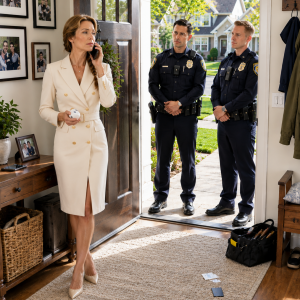
My attorney, Judith Hale, entered first.
Judith was in her mid-fifties, with short silver hair, a dark wool coat, and a habit of pausing before she spoke, as though every word had been weighed before it left her mouth. Behind her came two forensic accountants, a county sheriff’s deputy, and a records officer carrying a sealed navy folder.
Judith looked around the foyer, taking in the plastic bags, the boxes, and the papers on the kitchen island. Her eyes stopped briefly on Tessa’s robe.
“It appears they began earlier than expected,” she said.
Graham moved toward the doorway.
“This is a private family matter. You need to leave.”
Judith removed her glasses.
“It stopped being private when inaccurate financial documents were submitted to a commercial lender and a county records office.”
One of the accountants began photographing the boxes and bags without touching them. The second documented the papers on the island and the items Dennis had removed from my library.
Graham pointed toward me.
“My wife is upset about our separation. She’s trying to make this look like something it isn’t.”
“I know exactly what it is,” I said.
Judith opened the navy folder.
“Mr. Hadley, last night you told Nora that her authorization would satisfy a $2.7 million obligation owed by Northline Brandworks to Harborpoint Capital. Is that correct?”
Graham hesitated.
“Commercial obligations are transferred all the time.”
“That is correct,” Judith replied. “Which is why the Hawthorne Family Trust purchased yours twenty-four days ago.”
No one moved.
Even Tessa stopped adjusting the sleeve of my robe.
Judith placed a certified notice on the island.
The Hawthorne Family Trust had been created by my father after he sold the packaging company he had spent thirty years building. When Harborpoint Capital discovered irregularities in Northline’s records, the lender became willing to sell the company’s obligation at a discount.
The trust purchased that obligation through outside counsel.
Graham had never been told the buyer’s identity.
The money I authorized the night before had not released him from what he owed. It had completed the transfer, giving the trust control over the commercial note and its supporting guarantees.
Marjorie stared at Judith.
“What does that mean?”
I answered without taking my eyes off Graham.
“It means the obligation still exists. It now belongs to a trust established for Miles and me.”
Graham’s face tightened.
“You planned this.”
“No,” Judith said. “Your own records created this outcome. Nora simply refused to authorize a major transaction without understanding where the money was going.”
Dennis lowered the box to the floor.
One of the accountants, Paul Barlow, opened another file.
“We are also reviewing guarantee forms connected to the original financing. Several signatures and dates require explanation.”
The box slipped from Dennis’s hands. Papers scattered across the hardwood floor.
Graham turned toward his father.
“Dad handled the filings.”
Dennis stared at his son as though he could not believe how quickly Graham had offered him up.
Tessa began edging toward the hallway.
“I don’t know anything about his financing.”
Judith lifted a document.
“Are you familiar with Juniper Strategy Group?”
Tessa stopped.
“No.”
“That is unfortunate, because the company is registered to your apartment.”
Over the previous ten months, Northline Brandworks had paid more than $640,000 to Juniper Strategy Group for consulting, production support, and client research. The forensic accountants had found invoices, but no employees, completed projects, or meaningful evidence of the services described.
The company’s financial trouble had not come from a few unsuccessful contracts, as Graham had claimed.
Money had been leaving Northline in carefully divided payments, and much of it had traveled to an entity connected to the woman standing in my kitchen.
The Provision My Father Insisted On

Marjorie grabbed one of the bags containing my clothes.
“We’re leaving.”
The deputy raised his hand.
“Ma’am, please put that down.”
“These are family possessions.”
“They are my possessions,” I said.
Graham stepped closer to me.
“You think your father’s money gives you the right to control everything?”
Judith closed the folder.
“Nora’s father anticipated that someone might attempt to obtain trust property through deception or improper pressure.”
Graham became very still.
When my father created the Hawthorne Family Trust, he included a provision I had once considered unnecessary. It allowed the trustees to review and challenge transfers involving falsified permission, misleading representations, unauthorized access, or efforts by a spouse to gain control of protected assets.
At twenty-nine, I had told my father the language sounded suspicious and cold.
He had only smiled.
“Good agreements are written while everyone still likes one another,” he had said. “That’s what makes them useful when circumstances change.”
Standing in my kitchen thirteen years later, I finally understood what he had tried to protect.
Paul turned on a recorder.
“Nora, did you agree to leave this property today?”
“No.”
“Did you give anyone permission to pack your belongings?”
“No.”
“Did you allow Ms. Vaughn to use your clothing or jewelry?”
Tessa rolled her eyes.
“It’s a robe.”
I kept looking at Paul.
“No, I did not.”
Graham suddenly reached toward the navy folder. The deputy stepped between him and Judith, directing him away from the island.
“Sir, remain where you are.”
Marjorie called Graham’s name. Dennis began insisting that the entire situation had been misunderstood.
Tessa moved quickly toward the stairs.
As she did, something slipped from the robe’s pocket and landed on the hardwood floor with a metallic sound.
It was my grandmother’s diamond bracelet.
Six months earlier, Graham had told me it must have disappeared during a conference trip to Nashville. He had watched me empty my luggage, call the hotel, and search through every drawer in our bedroom.
Tessa looked down at the bracelet.
For the first time that morning, she had nothing to say.
Then the doorbell rang again.
A second county employee entered with a sealed envelope. When Graham saw it, a trace of confidence returned to his face.
“You’re too late,” he said. “The deed was filed this morning.”
For one brief moment, the room seemed to tilt.
Graham noticed.
“You weren’t the only person who hired an attorney, Nora.”
Judith opened the envelope and studied the first page.
Then she looked at him with an expression that was not triumphant, only deeply tired.
“You attempted to file a deed.”
The county employee stepped forward.
“The submission was rejected and referred for formal review.”
Marjorie gripped the island.
“Rejected for what reason?”
Judith turned the document around.
“Because this house is owned by the Cedar Hollow Residence Trust. Nora has the protected right to live here, but the property is not personally titled in her name. It cannot be transferred through an ordinary marital deed.”
Dennis lowered himself into a chair.
Judith continued.
“There is also a problem with the notarization. The listed notary has not held an active commission for almost three years.”
I looked at Dennis.
“Did you prepare that document?”
He looked away.
Marjorie answered for him.
“He was only trying to help Graham. He didn’t understand.”
Judith removed another page.
“The filing contains Nora’s electronic signature. However, the trust’s security records show that Nora never accessed the signing system.”
Graham raised his voice.
“Plenty of people use our home internet connection.”
“That is true,” Judith said. “But the identity-verification photograph shows Ms. Vaughn holding Nora’s driver’s license in front of the camera.”
Tessa sat down on the bottom stair and covered her face.
A week earlier, I had been unable to find my license. Graham had teased me for being forgetful. Tessa, who had supposedly come to the house for a work meeting, had even pretended to help me search.
At last, I could see the full shape of their plan.
The Backpack Upstairs

As the deputy separated everyone for individual statements, Graham moved toward me.
“Nora, tell them this is a misunderstanding.”
I studied the man I had married.
I remembered helping him paint his first office because we could not afford a contractor. I remembered covering the company’s payroll during a difficult winter and defending him when friends suggested that I carried too much of the marriage alone.
Then I looked at the legal papers he had prepared before asking me to rescue his company.
“You brought another woman into my home. You used my identification. You tried to claim property you had no authority to transfer, and you planned to remove me before asking for my financial help.”
He shook his head.
“You don’t understand how much pressure I was under.”
My eyes went to the bracelet on the floor.
“That was my mistake, Graham. I spent years understanding your pressure and almost none understanding your choices.”
Then I noticed how quiet the second floor had remained.
Miles.
I hurried upstairs and found him sitting on the edge of his bed in red rocket-ship pajamas. He was clutching his stuffed fox, and a small backpack sat beside his feet.
I sat beside him.
“Who packed your bag?”
“Grandma did.”
“Did she tell you where you were going?”
He looked toward the open door.
“She said Dad and I might stay somewhere else for a while.”
“Did anyone ask what you wanted?”
He shook his head.
Then he looked up at me.
“Are you going away without me?”
That question came closer to breaking my composure than anything I had seen downstairs.
I pulled him against me.
“No, sweetheart. I am not leaving you.”
“Promise?”
“I promise.”
He asked me to carry him downstairs. He was getting too tall for it, and his knees pressed awkwardly against my side, but I lifted him anyway.
When we reached the foyer, the house became quiet.
Graham looked at us. Miles tucked his face against my shoulder.
I walked past the bags, past Dennis and Marjorie, and past Tessa, who had finally removed my robe and wrapped herself in an old guest-room coat.
At the front door, Graham called after me.
“Where are you taking him?”
“To my sister’s house for the afternoon, exactly as my attorney has documented.”
“He belongs here.”
I tightened my arms around Miles.
“He belongs with adults who do not pack his bag while he sleeps and make decisions without speaking to him.”
Judith opened the door.
“Any temporary parenting arrangement will be handled properly, not decided through an early-morning ambush.”
I carried Miles outside.
The morning air was cool, and sunlight had begun moving through the bare branches of the maple trees. Until that moment, I had felt as though I were breathing through a narrow opening. On the porch, with my son’s arms around my neck, I finally drew a full breath.
What Remained Ours
The months that followed were quieter than that morning, but they revealed far more.
Northline Brandworks entered court-supervised restructuring while investigators reviewed its vendor payments, guarantee forms, and internal records. The Hawthorne Family Trust enforced its rights under the commercial note. Several transfers to Juniper Strategy Group were challenged, and funds were eventually returned.
Dennis accepted responsibility for his involvement in the rejected property filing. Tessa returned jewelry through her attorney, including several pieces I had not yet realized were missing.
Marjorie sent me a long letter accusing me of dividing the family. I placed it, unopened, in the same envelope in which it arrived.
Our legal separation lasted almost a year. During one hearing, Graham requested continuing financial support, claiming the decline of his company had changed his way of life.
The judge reviewed the attempted property transfer, the financial records, the photographs from my kitchen, and the statements showing that my belongings had been packed before I was even shown the papers.
Then she looked at Graham.
“The court will not reward an effort to remove a spouse from protections that were legally established for her benefit.”
His request was denied.
I did not redecorate the house immediately. For weeks, several rooms remained nearly empty. I needed the silence. I needed to walk through the hallway without remembering the black bags lined along the wall.
Little by little, Miles and I put the house back together.
My mother’s silver picture frames returned to the mantel. My grandmother’s quilt went back into the cedar chest. Miles selected a bright orange rug for his room because he said the previous one looked like something chosen by a person who disliked fun.
In early spring, we planted white hydrangeas beside the porch.
A year after the morning everything changed, Judith came by with two coffees and a box of cinnamon rolls. Miles was outside practicing baseball against the garage wall and missing his target with remarkable consistency.
Judith stood in the foyer and looked around.
“It still feels like a victory.”
I considered her words.
Morning light stretched across the hardwood floor. Miles laughed outside after another terrible throw. The coffeemaker clicked softly in the kitchen.
Graham had believed I would leave with one suitcase because he had already packed the rest of my life into plastic bags. He had believed humiliation would keep me quiet. He had believed the money I authorized would release him from every obligation, when it had actually placed his company’s future beneath the protections he had resented for years.
Most of all, he had believed I would walk away from my son simply because he told me to.
I looked toward the open door, where Miles was running after the baseball.
“No,” I said.
Judith raised an eyebrow.
I smiled.
“A victory is something you take from someone else. This feels like something I finally refused to let anyone take from me.”