Part 1: The Empty Chairs Beside My Bed
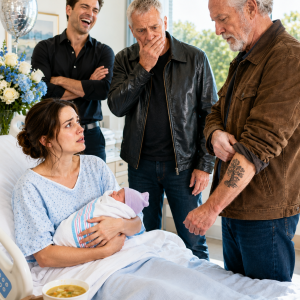
The first sound I remembered after nearly dying was the steady pulse of a cardiac monitor beside my hospital bed. The machine counted each second with mechanical patience, while fluorescent lights glowed above me and the room smelled of antiseptic, cold plastic, and the citrus lotion used by nurses after endless handwashing. My throat burned when I tried to swallow, and every breath felt as though my ribs had been wrapped in wire.
A man’s voice came from the chair beside me.
“Take it slowly, sweetheart. You have been through more than you realize.”
I turned my head and found my husband, Daniel Cross, folded awkwardly into a narrow hospital chair. His shirt was wrinkled, his beard had grown unevenly, and purple shadows darkened the skin beneath his eyes. One hand enclosed mine while the other held a paper coffee cup that had clearly been forgotten hours earlier.
When he realized I was awake, relief broke across his face with such force that he nearly stumbled while standing.
“Thank God, Rebecca. Thank God you came back.”
My name is Rebecca Sloan, and at thirty-five I managed payroll compliance for a regional healthcare company in Minneapolis, Minnesota. At work, people called me when paychecks were missing, tax records were wrong, or employees believed the company had failed them. In my family, people called me whenever they needed money, transportation, paperwork, emergency childcare, or someone patient enough to fix whatever they had ignored until it became urgent.
For years, I believed usefulness was the clearest form of love.
My parents encouraged that belief without ever naming it. My mother called me dependable, my father called me practical, and my younger brother, Luke, called me dramatic whenever I asked whether he intended to repay what he borrowed. Daniel used a different word.
“They are training you to confuse obligation with affection,” he told me more than once.
I always defended them because they were family, and that sentence had excused nearly everything. It excused the property-tax payment I made after my father missed the deadline, the late-night drive to repair my mother’s internet because she refused to call customer service, and the emergency transfer Luke requested after spending his rent money on a weekend trip.
My final memory before the hospital was standing beside the copy machine at work with a stack of payroll reports against my chest. My coworker Hannah called my name from the hallway, the carpet tilted beneath my feet, and the ceiling collapsed into darkness before I could answer.
“How long have I been here?” I whispered.
Daniel tightened his hand around mine.
“Eleven days since you collapsed, and you were unconscious for most of them.”
A nurse named Marisol entered after Daniel pressed the call button. She had silver-streaked hair pulled into a braid and the calm expression of someone who had learned how to enter frightened rooms without increasing the fear inside them. She checked the monitors, examined my pupils, and adjusted the blanket across my legs.
“You gave everyone a serious scare,” she said.
Everyone.
I looked toward the window, where two visitor chairs stood empty. There were no flowers from my mother, no card from my father, and no ridiculous balloon from Luke. The only personal things in the room were Daniel’s jacket, Hannah’s paperback novel, and a small bouquet from the hospital gift shop beginning to wilt inside a plastic pitcher.
“Where are they?” I asked.
Daniel glanced at Marisol, and that brief exchange told me more than either of them wanted to say.
“My parents,” I continued. “Did anyone contact them?”
Marisol lowered her clipboard.
“We called every emergency number in your records. Your mother answered twice, and your father returned one call.”
“What did they say?”
Her expression tightened with professional restraint.
“They said they were dealing with several personal matters and would visit when they could arrange the time.”
My parents lived forty-five minutes away. Luke lived less than thirty minutes from the medical center. I had been unconscious for eleven days while doctors, nurses, Daniel, and machines worked to keep me alive, yet not one member of my birth family had walked through the door.
Part 2: The Evidence That Could Not Be Rewritten
During the first several days after waking, I invented explanations because the truth felt too humiliating to accept. Perhaps visitors had been restricted, perhaps my parents misunderstood the severity, or perhaps someone at the hospital had written down the wrong room number.
Daniel never argued with those possibilities. Instead, he opened a folder he had built while I was unconscious.
Inside were admission records, emergency-contact logs, and notes from the patient advocate showing that my family had been informed repeatedly that my condition was critical. There was also the workplace incident report Hannah filed at 3:42 p.m., the ambulance dispatch record, and copies of the emails she sent to every number listed in my personnel file.
Dates, times, names, and signatures filled each page.
Evidence has a particular sharpness when affection collapses. A feeling can be challenged, minimized, or explained away, but a timestamp refuses to become kinder simply because the truth is painful.
On the thirteenth day, Luke sent a message asking whether I remembered the password to my streaming account. He did not ask whether I was awake, recovering, frightened, or even alive enough to answer.
On the fifteenth day, my mother wrote, “Hope you are improving.” There was no question mark, no apology, and no offer to visit.
Two days later, my father forwarded a joke about hospital food.
I did not respond to any of them.
My body recovered more slowly than my mind demanded. Standing made me dizzy, walking to the bathroom felt like crossing a field, and my muscles trembled after simple tasks. At night, I woke expecting the monitor to continue counting beside me.
Daniel remained present through every humiliating stage. Hannah brought clean socks, dry shampoo, and a paperback I never finished. Marisol checked on me even when another nurse handled the shift.
I learned that care had a physical weight. It looked like a husband sleeping badly in a plastic chair, a coworker bringing a hairbrush, and a nurse warming a blanket so a frightened patient could keep some dignity.
It did not look like silence from people who claimed blood made their love permanent.
When I finally returned to our townhouse in St. Paul, the rooms felt familiar and strangely temporary. Daniel walked behind me on the stairs because my balance remained unreliable. I hated needing him to do that, but he never made my weakness feel like a debt.
For the first week, I slept in short intervals and woke whenever the furnace clicked on. Somewhere inside me, I was still listening for footsteps that never came.
Five weeks after discharge, I sat at the kitchen table while Daniel prepared toast I intended to eat only halfway. My phone vibrated beside a glass of water.
The message came from my father.
“Your mother needs $14,500 for urgent surgery. Transfer it today.”
There was no greeting, no question about my health, and no mention of the month I had spent learning how to walk across a room without assistance. There was only a demand and a dollar amount.
Daniel watched my expression change.
“What happened?”
I turned the phone toward him.
His face hardened.
“Please do not let them drag you back into this.”
I understood exactly what he meant. Do not explain. Do not plead for understanding. Do not build another bridge for people who stood safely on one side while the previous bridge burned.
I opened my banking application, entered one dollar, and transferred it to my father with a brief note.
“Good luck.”
His answer arrived almost immediately.
“You selfish little witch. Your mother is sick, and you owe this family.”
The sentence burned through the last fragile excuse I had been protecting.
You owe this family.
I thought about the tax bills, emergency transfers, late-night drives, unpaid loans, and empty chairs beside my hospital bed. I thought about Marisol saying the hospital had explained my condition clearly.
I did not answer. Instead, I captured screenshots of the demand, the transfer receipt, and every insult that followed. Then I forwarded them to Daniel and Hannah.
I had spent years working in payroll compliance, where anything undocumented could be reshaped into a story benefiting whoever spoke first. My family had always depended upon my shame to keep their version intact.
This time, I created a record.
Part 3: The Police Report My Father Weaponized

Three hours later, someone pounded on our front door with enough force to shake the framed photograph in the hallway.
Daniel checked the peephole, then turned toward me as blue and red light moved across the living-room wall.
“Rebecca, there are two police officers outside.”
I rose carefully, one hand on the chair until the room stopped shifting. My body was not prepared for confrontation, but my mind had become very clear.
The older officer held a printed complaint. The younger officer watched the room with the cautious focus of someone entering a family accusation without knowing which person had created the danger.
“Are you Rebecca Sloan?” the older officer asked.
“Yes, I am.”
“Your father reported that funds intended for your mother’s surgery were transferred into an account you control. He also alleged ongoing financial exploitation.”
Daniel stepped forward, but I raised one hand.
I wanted the conversation to remain calm, factual, and impossible to misrepresent.
“Officer, may I show you the messages connected to that complaint?”
He nodded.
I opened the thread, beginning with my father’s demand for $14,500, followed by the one-dollar transfer and his accusation that I owed the family. Daniel brought the hospital folder from the side table and handed over the emergency-contact logs, admission records, and patient-advocate note confirming that my parents knew I had been critically ill.
The officer read the note twice.
His expression changed, not dramatically, but professionally, which somehow felt more serious.
“Your father also requested a welfare check on your mother,” he said. “He claims she could be endangered without immediate surgery.”
A new voicemail appeared while he was speaking.
It came from my father.
I pressed play.
His voice filled the living room, sharp and careless in the way he always sounded when he believed no outsider would hear him.
“You think sending one dollar makes you clever? If the money is not transferred tonight, I will tell everyone you have been stealing from this family for years. I will make sure your employer hears what kind of daughter you are.”
The message ended.
Nobody spoke for several seconds.
The younger officer shifted his weight. Daniel placed one hand gently against my back.
The older officer folded the complaint.
“Ms. Sloan, preserve that voicemail and every related message. Do not delete anything.”
“I will not.”
“Do you have evidence that your mother is actually scheduled for emergency surgery?”
“No. I have evidence that my father needs money and uses my mother’s health whenever he believes guilt will work faster than honesty.”
The officer gave me an incident number and explained how to request a copy of the report. He also advised me to document unwanted contact and call again if anyone came to the property.
Document unwanted contact.
For most people, the phrase meant harassment. For me, it meant learning how to describe my family without protecting them from the truth.
The following morning, I requested certified copies of the hospital call logs, the patient-advocate notes, and the emergency admission records. Hannah sent me the original workplace incident report, while I downloaded eight years of bank statements showing repeated transfers to my parents and brother.
I did not assemble the evidence to punish them.
I assembled it because the people who abandoned me were trying to rewrite themselves as victims.
By noon, my father had called nine times. My mother sent a message saying, “Your father is extremely upset.”
I stared at the screen and nearly laughed.
My father was upset, not the daughter who woke after eleven unconscious days beside two empty chairs. Not Daniel, whose back cramped from sleeping in a hospital chair. Not Hannah, who watched me collapse onto office carpet.
The center of the family universe remained wherever my father experienced discomfort.
I wrote one sentence to my mother.
“Do not contact me for money again.”
Her answer arrived fifteen minutes later.
“After everything we have done for you?”
I did not respond because some questions are not questions. They are traps wearing punctuation.
Part 4: The Family Meeting They Did Not Control
Luke began sending long messages that alternated between panic and insult. He claimed our father had overreacted, suggested our mother might need testing, accused me of destroying the family, and insisted I always believed I was better than everyone else.
I saved every message inside a folder titled FAMILY FINANCIAL CONTACT and backed it up twice.
Daniel watched me organize bank records at the dining table one evening while a blanket remained wrapped around my shoulders.
“You do not have to prove anything to me,” he said.
“I know, but I need to prove it to myself.”
That realization became the quiet turning point. Protecting myself did not make me cruel. It only meant I had finally stopped volunteering to be harmed.
A week later, my parents and Luke arrived without warning.
They stood on our porch carrying a folder, a casserole dish, and the kind of outrage people manufacture when they expect an apology before entering the room. Daniel kept the chain locked while I activated the doorbell camera.
My father spoke first.
“Open the door, Rebecca. We need to settle this before you make the family look worse.”
“You filed a false report accusing me of stealing money.”
“I was frightened about your mother.”
My mother pressed one hand against her stomach and looked toward the camera.
“I may need a procedure eventually, and your father became emotional.”
“Are you scheduled for surgery?”
She glanced at him.
“Not yet.”
The supposed emergency had disappeared as soon as police documentation existed.
Luke lifted the folder.
“We made a list of what everyone owes. You have received more help from Mom and Dad than you remember.”
“Send it to my attorney.”
My father stepped closer to the door.
“You do not need an attorney against your own parents.”
“You involved the police against your own daughter.”
His expression hardened.
“We raised you, paid for your childhood, and supported your education. You cannot pretend that history has no value.”
For most of my life, those words would have sent me searching for a checkbook. This time, I heard what he was actually saying: parenting had been an investment, and he believed adulthood was the repayment period.
“Children do not incur financial debt because their parents fed and housed them,” I said. “That was your responsibility, not a loan agreement.”
My mother began crying with remarkable speed.
“You have become cold since leaving the hospital.”
“I became clear after waking up and discovering none of you had visited.”
Luke looked uncomfortable, but my father remained angry.
“The hospital made everything sound uncertain. We did not want to drive there and sit around for nothing.”
Daniel’s hand tightened against the doorframe.
“She was unconscious and close to death,” he said. “You were informed repeatedly.”
My father pointed toward him.
“This is your influence. She never spoke to us like this before marrying you.”
That accusation finally made me understand why Daniel had always seemed threatening to them. He had not separated me from my family. He had simply been the first person close enough to identify the price of belonging.
“Daniel did not create these boundaries,” I said. “He only stood beside me while I finally enforced them.”
My father demanded the door be opened. When I refused, he struck the wood with his palm and threatened to contact my employer.
I called the police using the incident number from the earlier report.
The same older officer arrived with another patrol unit. After reviewing the doorbell recording, he issued a formal trespass warning and instructed my family to leave.
My mother looked at me from the driveway.
“You will regret treating us like strangers.”
“Strangers would have shown more concern while I was in intensive care.”
They left without the casserole dish, which remained on the porch until Daniel threw it away.
Part 5: The Story Behind The Money

The confrontation should have ended there, but two days later, Luke contacted me from a new number.
His message was different from the others.
“I need to tell you what the money was really for.”
I agreed to meet him in a public café with Daniel sitting nearby and my phone recording openly on the table.
Luke arrived wearing yesterday’s clothes and carrying the folder from our porch. He looked exhausted rather than angry.
“Mom does not need surgery,” he said before sitting down. “Dad owes money to a private lender.”
The debt came from an investment scheme involving renovated rental properties in Duluth. My father had convinced several relatives to contribute, promising guaranteed returns. The properties did not exist, and the man managing the supposed investment had disappeared with most of the funds.
My father had covered early repayments using money borrowed from other people. When the arrangement began collapsing, he decided I could rescue everyone quietly.
The requested $14,500 represented the first urgent payment, not the entire debt.
“Why use Mom’s surgery?” I asked.
Luke looked down.
“Because he said you would never refuse if you thought she might die.”
The cruelty of that calculation silenced me for several seconds.
My father had watched me nearly die, refused to visit, and then used the possibility of my mother’s death as leverage because he understood exactly which wound remained open.
Luke pushed the folder toward me. Inside were messages between him and my father, payment schedules, and a handwritten list of relatives who believed their money remained invested.
“Why are you giving me this?”
His eyes filled with shame.
“Because he wants me to tell everyone you took the money. He said your job in payroll would make the accusation believable.”
The false police report had not been an emotional outburst. It had been the beginning of a cover story.
I contacted my attorney and provided the documents to investigators. The case quickly expanded from a family dispute into a fraud inquiry involving multiple victims. My father had not created the original scheme, but he had knowingly repeated false claims and redirected funds to conceal losses.
My mother admitted that she knew there was no scheduled surgery. She insisted she participated because she feared losing the house.
Luke cooperated with investigators and avoided charges after proving he had been misled about several transactions, although our relationship did not repair simply because he finally told the truth.
Honesty delivered late can still matter, but it does not erase everything that came before it.
Part 6: The Difference Between Need And Love
My father eventually accepted a plea agreement involving fraud, false reporting, and attempted financial coercion. The court ordered restitution to several relatives, and my parents sold their house to satisfy part of the judgment.
He never offered an apology without attaching an explanation. According to him, pressure had made him desperate, fear had confused his judgment, and my refusal to help had forced him to act quickly.
Responsibility always remained nearby, but never close enough for him to hold.
My mother moved into a small apartment and continued sending messages through relatives about reconciliation. Every request began with the language of healing and ended with something she needed.
I maintained no contact.
Luke attended counseling and began repaying money he had borrowed from me over the years. I did not restore the relationship we once pretended to have, but I allowed brief communication because he respected the conditions I established.
Recovery continued in quieter ways.
I returned to work part-time, then gradually resumed full responsibility. Hannah decorated my desk with a banner reading, “WELCOME BACK, PAYROLL EMPRESS,” and I laughed hard enough to become dizzy.
Marisol sent a card through the hospital’s patient-services department after I wrote to thank her. Her message said that survival was sometimes measured less by the body’s strength than by the willingness to believe care should not have to be earned.
Daniel and I spent our first holiday without my family making pancakes, watching old movies, and ignoring our phones. I expected guilt to suffocate me, but peace arrived instead.
At first, peace felt suspicious because I had mistaken chaos for belonging for so many years.
By spring, I could discuss the hospital without hearing the monitor in my dreams. By summer, I drove past the medical center without gripping the steering wheel. By autumn, I could say no without providing three explanations and a carefully worded apology.
The police reports remained inside a locked file. So did the hospital call logs, bank statements, voicemails, and doorbell recordings. I rarely opened them because I no longer needed evidence to convince myself.
I remembered the truth.
My family left the chairs empty.
Daniel filled the room.
Hannah brought clean clothes and patience. Marisol documented what others hoped could be forgotten. The police officers listened when evidence replaced accusation.
I finally stopped confusing someone’s need for me with their love for me.
Part 7: The Life I No Longer Owed Anyone
Two years after my collapse, I volunteered with a financial-literacy program supporting patients recovering from serious illness. Many participants had discovered that medical crises attracted relatives who treated insurance payments, disability benefits, or savings as shared family property.
During one workshop, a woman asked how I stopped feeling guilty for refusing money to people who raised me.
I considered the question carefully.
“I learned that gratitude and surrender are not the same thing,” I told her. “You can appreciate what someone once gave you without allowing them to take whatever they want forever.”
After the workshop, Daniel and I walked along the Mississippi River beneath trees beginning to turn gold.
“Do you ever miss them?” he asked.
“I miss the family I kept expecting them to become.”
He nodded because he understood the difference.
I did not miss the demands, accusations, or emergency messages. I mourned the imagined mother who would sit beside my hospital bed, the father who would protect my name instead of using it, and the brother who would call because he cared rather than because an account was empty.
Grief became easier when I stopped directing it toward people who still believed they had done nothing wrong.
The last message my father sent arrived through a distant cousin. It contained no apology, only a statement that families should not keep score.
I deleted it after saving one final screenshot.
For years, I had not kept score at all, which was why they continued taking.
Boundaries were not revenge. Documentation was not cruelty. Refusing manipulation was not abandonment.
The night the police first appeared, I stood in our living room with weak legs, flashing lights moving across the wall, and my hospital folder open on the table. I remember pressing play on my father’s voicemail and hearing his own voice reveal what years of arguments could never prove.
For once, I allowed the truth to speak without translating it into forgiveness.
Nearly dying taught me that a person can owe honesty, kindness, gratitude, and accountability. Nobody owes their future to people who notice them only when money is missing.
I did not become heartless after the hospital.
I became unavailable for exploitation.
Those are not the same thing.
The monitor beside my bed once counted every second as though my survival were uncertain. My family treated those seconds as less important than their convenience.
Now I measure life differently.
I measure it by the people who arrive, the peace inside my home, and the freedom to answer a demand without fear.
The empty chairs taught me who they were.
The life afterward taught me who I could become.
THE END