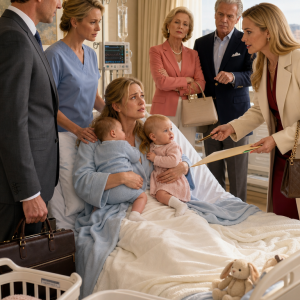
The Morning They Expected Me to Surrender

I entered the family courthouse in Cleveland on a pale February morning with my six-day-old daughter tucked beneath my coat, her warm cheek resting against my chest while the wind rattled the tall windows behind me. I was still recovering from an emergency delivery, every step pulling at the healing muscles in my abdomen, yet the discomfort in my body was nothing compared with the expression on my husband’s face when he saw me walk through the courtroom doors.
Richard Calloway had expected me to stay away.
He sat at the petitioner’s table in a charcoal suit, surrounded by people who had spent years assuring him that his family name could solve almost any problem. Beside him was his mother, Margaret, perfectly composed in a cream wool coat with pearl buttons. His attorney, Thomas Weller, arranged several folders in front of him as though the hearing had already been decided.
On Richard’s other side sat a woman named Sloane Avery.
She was wearing my gold bracelet.
The bracelet had belonged to Richard’s grandmother and had been given to me at our wedding, not because Margaret welcomed me into the family, but because the Calloways enjoyed ceremonies that made them appear generous. I had worn it only a handful of times. Two months earlier, it had disappeared from the jewelry drawer in our bedroom.
Now it gleamed beneath the courtroom lights on Sloane’s wrist.
I adjusted the blanket around my daughter and asked, “Is that the bracelet from our bedroom?”
Richard looked at me as though I were an inconvenient employee interrupting an important meeting.
“Family jewelry belongs with the family,” he said. “You made it clear you no longer wanted to be part of ours.”
A quiet laugh moved through the people sitting behind him.
Thomas rose and offered me a smile polished by decades of expensive litigation.
“Mrs. Calloway, you have just left the hospital,” he said. “There is no shame in admitting that you are overwhelmed. You could have allowed counsel to handle this privately.”
What he meant was that I should have signed the papers placed beside my hospital bed.
Three days after my daughter was born, Thomas had arrived while I was still weak, sleep-deprived, and trying to learn how to feed a newborn without assistance. Richard had not visited. He had not called to ask about the baby. Instead, he sent his attorney with a proposed temporary custody arrangement and a list of conditions I would have to meet before Richard would “consider” allowing me regular contact with my own child.
The arrangement gave Richard physical custody and placed our daughter in the Calloway estate under Margaret’s supervision. I was expected to undergo an evaluation with a specialist selected by the family, surrender access to our shared accounts, and move into a furnished apartment owned by one of Richard’s companies.
Thomas had placed a pen beside the papers.
“Signing now would show cooperation,” he told me.
“And refusing?” I had asked.
His expression had remained pleasant.
“Refusing may suggest that you are not making rational decisions.”
I refused.
By the following afternoon, Richard had filed an emergency petition claiming I had become emotionally unstable, removed the baby without his permission, and lacked the income or permanent residence necessary to provide a secure home.
He knew those statements were misleading.
He also believed I would be too frightened to prove it.
Judge Rebecca Larkin entered the courtroom, reviewed the petition, and then looked toward the empty chair beside me.
“Mrs. Calloway, is an attorney joining you?”
“No, Your Honor.”
Thomas glanced at Richard, and the corner of Richard’s mouth lifted.
“She intends to handle this herself?” Thomas asked.
I did not answer him. I set the diaper bag on the table and removed a thick cobalt-blue binder divided by labeled sections.
Richard leaned back in his chair.
“What is that supposed to be?”
I placed the binder before me and rested one hand on its cover.
“The reason your petition will not survive this morning.”
The Life He Thought I Had Forgotten
Before I married Richard, I had worked as a senior compliance examiner for the Ohio Bureau of Banking Oversight. My job was to follow money through complicated places: holding companies that existed only on paper, loans opened under borrowed identities, payments disguised as consulting fees, and financial records prepared to confuse anyone who lacked the patience to read every page.
Richard knew my job title, but he never understood my work.
To him, I was a woman who sat in an office reviewing spreadsheets. He never realized that my career had trained me to notice patterns, preserve records, compare signatures, and recognize the moment a person’s story stopped matching the numbers.
After our wedding, he encouraged me to leave the bureau.
At first, he presented the idea as a gift.
“You have worked hard long enough,” he said. “Let me take care of you.”
Later, it became an expectation.
When I became pregnant, Richard transferred most of our household funds into accounts I could not access. He canceled my personal credit card and told the staff at the estate that I was not to drive without informing him. He described each restriction as concern for the baby.
“You should not be dealing with traffic in your condition.”
“You should not upset yourself with financial matters.”
“You should let me make the difficult decisions.”
The sentences sounded protective when heard one at a time. Together, they formed a locked door.
Margaret visited almost daily, rearranging the nursery and speaking about the baby as though I were only temporarily involved.
When the doctor confirmed we were expecting a girl, Margaret studied the ultrasound screen and said, “A granddaughter can still carry the family traditions, provided she is raised correctly.”
She did not look at me when she said it.
During the final year of my marriage, I began saving documents. I photographed account statements before Richard removed them from the house. I forwarded messages to a secure address. I copied company records onto an encrypted drive and kept it inside the lining of an old travel bag.
I also began documenting the moments when Richard’s temper left visible evidence.
The injuries were never described honestly in our home. A painful wrist became a fall on the stairs. A shoulder injury became an accident with a cabinet door. A visit to urgent care became proof that I was nervous and careless.
When I met privately with a counselor, Richard found out and treated those appointments as ammunition.
“A judge will hear that you needed therapy,” he told me one evening. “Do you understand what that will sound like?”
I understood perfectly.
Seeking help would be presented as weakness, while the behavior that made help necessary would remain hidden.
That was why the blue binder existed.
When the Binder Opened

Judge Larkin turned to the first section.
I explained that Richard’s petition claimed we had lived separately for nearly a year and that he questioned whether he was the baby’s father. The binder contained a certified parentage report, clinic records, security entries from the estate, and photographs showing that Richard and I had continued living under the same roof throughout the pregnancy.
Thomas stood.
“My client filed according to the information available to him.”
“The information came from his own house,” I replied. “He knew exactly where I lived.”
Judge Larkin raised a hand before Thomas could interrupt again.
“Continue, Mrs. Calloway.”
The second section contained medical records and notes from a nurse named Allison Price, who had quietly documented my repeated visits for injuries that did not match the explanations Richard provided.
Thomas argued that the records proved nothing beyond household mishaps.
Judge Larkin read one of Allison’s notes twice before looking at him.
“The nurse wrote that Mrs. Calloway appeared frightened whenever her husband entered the room.”
Thomas adjusted his glasses.
“That is a subjective observation.”
“It is one observation among many,” I said.
The next section contained messages.
Richard’s confidence began to fade when the judge read them aloud.
One message from him said, “Sign the custody agreement before the baby arrives, or I will make sure the court sees you as incapable.”
Another came from Margaret.
“Dr. Keller is ready to explain that she is irrational. Once the child is at the estate, we can manage everything quietly.”
Margaret rose halfway from her chair.
“Those were private family conversations.”
Judge Larkin looked directly at her.
“Sit down, Mrs. Calloway. Another interruption and you will be escorted outside.”
The fourth section contained audio captured by the nursery monitor. Richard had known the monitor recorded sound; he had purchased the system himself. On one recording, he told Margaret that wealth mattered more than truth in family court and that once the baby was living at the estate, I would no longer have leverage.
Richard struck the table with his palm.
“You saved conversations from my house?”
I looked at him across the room.
“I preserved statements concerning my child.”
For the first time that morning, nobody behind him laughed.
The Numbers Beneath the Family Name
Thomas attempted to steer the hearing back toward parenting, but Richard had made his financial position central to the petition. He had portrayed himself as the stable provider and me as a dependent woman without resources.
That allowed me to open the fifth section.
For nearly four months, I had reviewed the accounts connected to Calloway Hospitality Group, Richard’s luxury resort business. Payments labeled as management fees had been routed to companies registered at empty storefronts and abandoned rural properties. Two large credit accounts had been opened using my name and personal information.
The signatures appeared convincing at first glance.
They were not mine.
“The pressure changes halfway through each signature,” I explained. “The writer copied the shape but not the movement.”
Richard stood so quickly that his chair scraped the floor.
“She has no authority to examine company accounts.”
Judge Larkin’s voice remained calm.
“Sit down.”
He did not move.
“Mr. Calloway, sit down now.”
He obeyed.
I showed the judge that several companies receiving funds were registered under the names of Richard’s former chauffeur and Margaret’s longtime housekeeper. The housekeeper had signed a sworn statement confirming she had never created a business and knew nothing about the account opened in her name.
My own identity had been used to guarantee loans connected to the same network.
The plan gradually became clear. If regulators discovered the transactions, Richard could point toward documents carrying my name. At the same time, his family was building a record suggesting I could not be trusted to manage money or care for a child.
Thomas leaned close to Richard.
“Is any of this accurate?”
Richard whispered something I could not hear.
Judge Larkin turned another page.
“According to this filing, a federal financial inquiry was opened earlier this week.”
“That inquiry is preliminary,” Thomas said quickly.
“Several business accounts have already been restricted by court order,” I replied.
Margaret reached for her pearl necklace, tugging the clasp until it broke. Pearls scattered across the floor, rolling beneath chairs and bouncing against the wooden railing.
Beside her, Sloane stared at Richard.
“You told me the review was routine.”
“Not now,” he said sharply.
Her face changed.
Until that moment, she had believed she was sitting beside a powerful man whose unfortunate wife had become unstable. She had apparently been shown nursery plans, photographs of the estate, and documents suggesting she would soon help raise my daughter.
She looked down at the bracelet on her wrist.
“You said she left the hospital without the baby.”
Richard’s attorney closed his eyes briefly.
Margaret reached for Sloane’s sleeve.
“Please be quiet.”
Sloane pulled away.
“You told me she did not want the child.”
I watched her realize that she had not been chosen because she was special. She had been selected because Richard believed she would accept his version of events without examining it.
She unfastened the bracelet and placed it on top of his legal papers.
“I do not want this.”
Then she picked up her purse and walked out of the courtroom.
The Ruling
Thomas requested a recess, arguing that he needed time to review the evidence.
Judge Larkin denied it.
She noted that Richard had sworn to statements contradicted by medical records, financial documents, messages, security logs, and audio evidence. She also noted that his petition appeared designed not to protect a newborn, but to remove the child from her mother before the mother could regain financial independence.
Richard lowered his head.
A few minutes earlier, he had looked like the owner of the room. Now he looked like a man who had finally discovered that reputation could not rewrite a document.
Judge Larkin granted me temporary legal and physical custody, ordered that my location remain confidential, and prohibited Richard and Margaret from contacting me outside approved legal channels.
Richard stood again.
“You cannot keep my daughter from me.”
Two court officers stepped between us.
The judge looked at him with an expression that allowed no argument.
“Your own conduct brought you here, Mr. Calloway.”
When the hearing ended, I closed the blue binder and lifted my daughter from the carrier. Her eyes opened briefly, calm and unfocused, and one tiny hand pressed against my collarbone.
Behind me, Richard called my name.
“Megan, wait. We can repair this.”
I paused at the end of the aisle.
“You believed that because I was quiet, I had nothing to say,” I told him. “I was quiet because I was collecting the truth.”
Then I carried Lucy out of the courtroom.
Learning What Safety Felt Like
The ruling protected us, but it did not immediately make me feel safe.
For the first several weeks in our secured apartment, ordinary sounds startled me. A car door closing outside made my stomach tighten. A branch brushing the window could keep me awake for an hour. When I spilled formula across the kitchen floor, I sat beside the cabinet and wept because some part of me still believed every mistake could be used as proof that I was failing.
Allison, the nurse who had documented my injuries, visited often.
One evening, she found me staring at the broken bottle on the floor while Lucy slept in her bassinet.
“I should be doing better than this,” I whispered.
Allison handed me a towel.
“You gave birth, protected your daughter, prepared your own case, and walked into court without anyone beside you,” she said. “You are allowed to spill formula.”
The financial inquiry widened over the following months. Investigators recovered altered ledgers, false loan applications, and payments made to Dr. Keller, the specialist Margaret had planned to use against me. Sloane later provided messages proving she had been told I abandoned my daughter and had no interest in raising her.
When we met at a small café, she slid a flash drive across the table.
“I believed everything he said,” she admitted. “I thought I was helping a child. I did not understand that he was using me.”
“Why come forward now?”
She looked toward the window.
“Because I finally understood that the moment I became inconvenient, he would create a story about me too.”
Before leaving, she apologized for wearing the bracelet.
I believed she was sorry, although forgiveness did not require me to make room for her in my life.
Richard’s supervised visits became irregular and then stopped. It took me a long time to accept what that meant. He had fought fiercely for possession of Lucy, yet he showed little interest in knowing her once he could no longer use her to control me.
One night, after she fell asleep, I opened a journal and began a letter she could read when she was older.
“My dear Lucy, you entered the world at a moment when I had almost forgotten my own strength. You never had to rescue me, because that was never your responsibility, but loving you reminded me that I was still capable of standing up. You will never have to prove that you deserve care, respect, or a place where you feel safe.”
What the Blue Binder Became
Four years later, I stood in an auditorium at the Cuyahoga Family Advocacy Center while attorneys, social workers, nurses, and financial counselors gathered for the launch of a new program.
We called it the Blue Binder Project.
The program helped parents document financial control, preserve electronic records, understand shared accounts, and respond to misleading custody claims. It also trained professionals to recognize that financial restriction and emotional pressure often hide behind respectable homes, polished manners, and claims of family concern.
Lucy sat in the front row beside Allison, swinging her small shoes beneath the chair.
When I approached the microphone, she waved both hands at me.
I smiled before addressing the room.
“Four years ago, I entered a courtroom believing I had to prove I deserved to remain my daughter’s mother,” I said. “I carried a blue binder because I knew my word alone would be weighed against wealth, influence, and a carefully prepared story.”
I looked around the auditorium.
“No parent should need professional investigative training simply to be heard. This project exists so that records can be preserved earlier, questions can be asked sooner, and vulnerable families do not have to face powerful systems alone.”
After the presentation, a young mother approached me carrying a sleeping infant. Her eyes were tired, and her hands trembled as she adjusted the child’s blanket.
“My partner says his family will take my son if I leave,” she whispered. “He says everyone will believe I am unstable.”
I recognized the sentence immediately.
I pulled out a chair beside mine.
“Sit with me,” I said. “Tell me what has been happening, and we will begin with the facts.”
Life after Richard was not dramatic most days, and I became grateful for that. Lucy went to preschool, collected smooth stones at the park, and insisted on wearing rain boots even when the sun was shining. I returned to public service and trained advocates throughout Ohio, yet the most meaningful part of my life often happened in the quiet hour before bedtime.
One evening, Lucy noticed the old blue binder on the top shelf of my office closet.
“What is that big book?” she asked.
I lifted her into my arms.
“It helped us reach a safe place when you were a baby.”
She considered this carefully.
“Was I strong?”
I kissed the top of her head.
“You were tiny.”
“But was I brave?”
I held her closer, remembering the cold courthouse, the gold bracelet, the scattered pearls, and the silence that fell when the truth finally entered the room.
“You were brave just by being here,” I told her. “And loving you helped me remember that I was brave too.”