Part 1: A Toast Written to Make Me Smaller
My marriage lasted forty-three minutes before my husband raised a champagne glass and explained to two hundred guests why marrying me had been his greatest act of generosity.
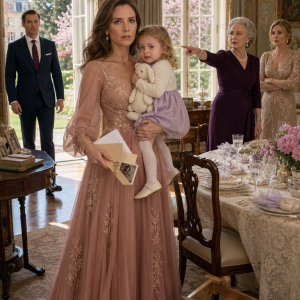
The reception occupied a restored apple orchard outside Asheville, North Carolina, where white pavilions stretched between old trees beneath an early autumn sky. Every expensive detail satisfied the Hollis family’s idea of permanence, although I had requested wildflowers and a small ceremony.
Colton Hollis stood beneath a chandelier suspended from an oak branch, handsome in the effortless way that expensive tailoring often makes cruelty appear disciplined. His father, Warren, watched from the family table, while his mother, Diane, smiled approvingly.
Colton rested one hand against my waist and began his toast.
“Most of you know that Evelyn did not grow up with the advantages surrounding us tonight,” he said. “She moved through several foster homes, arrived in Asheville with two suitcases, and supported herself by restoring damaged books.”
The first laughter was uncertain because nobody understood whether they should admire or pity me.
“When we met, she did not know which fork belonged to the first course, and she believed a weekend in Charleston counted as extravagant travel.”
The laughter became easier. Diane lifted her glass encouragingly, while three of Colton’s college friends exchanged the satisfied looks of men recognizing a familiar performance.
“Fortunately,” Colton continued, “the Hollis family has always believed that worthy projects deserve patient investment.”
This time, everyone understood the joke.
I was the project, and Colton expected gratitude for the renovation.
Across the pavilion, my closest friend, June Park, lowered her glass. She had warned me that Colton told stories about our relationship as case studies in which his money always produced the happy ending.
Colton reached beneath the table and lifted a small canvas tote bag.
“Since Evelyn came to our first dinner carrying something much like this, I thought we should preserve it as a reminder of how far she has traveled.”
He emptied the bag beside the wedding cake. A thrift-store sweater, a bus pass, a dented tin of watercolor pencils, and photocopies from my childhood case file scattered across the linen.
The guests stopped laughing. The papers contained placement dates, social-worker notes, and a psychiatric evaluation written when I was eleven, all taken from records Colton’s family office had promised to secure.
“Where did you get those?” I asked.
He mistook the quietness of my voice for embarrassment.
“You gave them to our records manager, sweetheart. Nobody here is judging you.”
June rose from her chair.
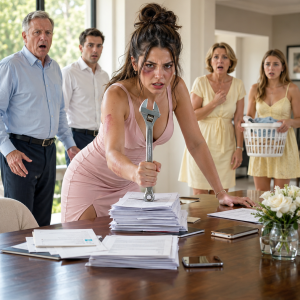
“You displayed her sealed childhood records during your wedding toast, and you think judgment is the problem?”
Diane gave her a warning look.
“This is affectionate humor between newlyweds, and Evelyn understands Colton’s personality.”
I finally looked at my husband.
“Did you write this speech before asking whether I wanted my childhood discussed publicly?”
His smile tightened around the edges.
“Please do not make everyone uncomfortable because you are feeling sensitive.”
Before I could answer, the orchard’s iron service gate opened behind the pavilion. A dark green vintage station wagon rolled slowly between the trees, followed by a state investigator’s sedan and a delivery truck bearing the crest of the North Carolina Historical Archives.
The station wagon stopped near the lawn. A silver-haired woman wearing a navy suit stepped out, holding a cedar box carved with climbing swallows. She resembled my mother as age might have reshaped her, sharing the same gray-green eyes and narrow chin.
The woman looked at the papers scattered beside my wedding cake, then turned toward Colton.
“You must be the man who intercepted my letters.”
Part 2: The Name My Mother Never Erased
Colton moved in front of me, although his gesture felt less protective than territorial.
“This is a private event, and you cannot drive onto family property without authorization.”
Warren Hollis stood so abruptly that his chair struck the table behind him.
“Marian Vale,” he said.
The name reached me through twenty years of incomplete memories. My mother had once spoken about an older sister who repaired antique maps, argued with professors, and disappeared after a family dispute nobody would explain.
Marian approached carefully, stopping several feet away.
“My name is Marian Vale, and your mother, Laurel Bennett, was my younger sister.”
“You are my aunt.”
“I have been trying to prove that to you for nearly three years.”
She opened the cedar box and removed a bundle of envelopes bound with blue ribbon. Each one carried my name, a different address, and a postal mark showing that it had been redirected through Hollis Family Management.
Colton’s complexion changed.
After our engagement, he persuaded me to let his office manage gallery inquiries and licensing requests, placing every invitation and payment behind employees loyal to him.
“Those letters never reached me,” I said.
Marian looked toward Colton.
“The first two were returned, while the next four were signed for by his family office. My attorneys then sent a notice requesting direct contact, but their response claimed Evelyn had declined all communication.”
“I never declined anything.”
Colton adjusted his cuff as though the gesture could restore control.
“My office filters unsolicited correspondence because wealthy families attract opportunists. Nobody knew whether this woman was legitimate.”
Marian’s expression remained calm.
“Your office received certified genealogical records, photographs, your fiancée’s original birth announcement, and a proposed independent DNA test. You knew exactly who I claimed to be.”
Diane stepped forward.
“Even if some administrative error occurred, interrupting a wedding remains outrageous.”
“What happened beside that cake was outrageous,” Marian replied. “Arriving with evidence was merely inconvenient.”
She handed me a photograph showing my mother at nineteen, standing beside Marian in a university conservation laboratory. Between them rested the same cedar box.
Inside were letters my mother had written during my childhood, along with sketches and a manuscript describing my grandfather’s bookbinding technique. I touched her handwriting without trusting myself to speak.
Colton reached for my elbow.
“Evelyn, we can verify everything tomorrow, after we finish the reception privately.”
I stepped away before his fingers reached me.
“Did you instruct your office to withhold Marian’s letters?”
“I authorized enhanced screening because you were overwhelmed by wedding arrangements.”
“That was not my question.”
His eyes shifted toward the guests.
“I made a reasonable decision for our future, and I will not apologize for protecting you from emotional disruption.”
Marian gave me room to decide what happened next.
“A car is waiting if you wish to leave, although I will respect whatever choice you make.”
Warren finally recovered his voice.
“Nobody is leaving until you explain why a state investigator accompanied you.”
Marian turned toward him.
“That matter concerns the preservation contracts your company obtained through the Appalachian Renewal Program.”
Hollis Heritage Development converted historic buildings into luxury hotels, while Colton supervised a federal restoration program operating across three states.
The investigator removed a sealed evidence envelope from her briefcase.
Warren’s confidence cracked before anyone explained its contents.
Part 3: The Buildings That Existed Only on Paper

Marian asked whether I wanted the discussion moved away from the guests. I considered how frequently the Hollis family demanded privacy only after their own conduct became visible.
“The orchestra can take a break,” I said. “Everything else may continue exactly where Colton started it.”
The investigator introduced herself as Special Agent Lena Ortiz, who had spent eleven months examining grant reimbursements submitted by Hollis Heritage.
Marian’s involvement began through the Vale Center for Architectural Conservation, which reviewed endangered landmarks and maintained original plans for public buildings. Her staff noticed reimbursement requests for restoration work that contradicted photographs, permits, and archive records.
One project claimed six million dollars for stabilizing a textile mill demolished eighteen months earlier, while another charged taxpayers for slate roofing never installed. The most dangerous discrepancy involved the Red Hollow Children’s Library, where Hollis Heritage reported replacing fire barriers, electrical systems, and structural beams that remained untouched.
“The library opened three months ago,” I said.
Agent Ortiz nodded.
“It was closed this morning after an independent engineer identified overloaded wiring, unsupported flooring, and fraudulent inspection certificates.”
Warren pointed toward the investigator.
“Any discrepancies were created by subcontractors, and discussing an active inquiry at a social gathering is professionally irresponsible.”
“We did not come to announce charges,” Ortiz replied. “We came to preserve records scheduled for destruction tonight.”
Colton’s face turned rigid.
Marian opened a leather portfolio containing internal emails, demolition schedules, payment approvals, and mirrored copies of accounting ledgers. A whistleblower within Hollis Heritage had provided evidence that servers storing original invoices would be erased during a planned cybersecurity migration at midnight.
The authorization carried Colton’s electronic signature.
“Routine migration requests are approved in batches,” he said. “My signature proves nothing about individual files.”
Agent Ortiz removed a printed message.
“This instruction asks the technology director to ensure that legacy materials connected to Appalachian Renewal become permanently unrecoverable before Monday’s audit.”
Colton looked at Warren, and that single glance revealed an alliance neither man could explain away.
Warren lowered his voice.
“How did your organization obtain privileged corporate communications?”
Marian indicated the delivery truck near the gate.
“We did not obtain them from your company. Your executives donated forty-seven archival boxes to my conservation center after claiming the contents possessed no continuing business value.”
Hollis Heritage had discarded its own evidence through a charitable donation, and archive employees discovered carbon copies of invoices that no longer matched the digital records.
Shell contractors controlled by Colton’s former fraternity partner received nearly fourteen million dollars, then transferred money into ventures benefiting Colton and Warren. One transfer paid for the orchard wedding.
“Did public restoration money pay for this reception?”
Colton stepped toward me.
“The wedding was paid through a family events account, and you should not repeat accusations you do not understand.”
Marian placed another ledger on the table.
“The family events account received three transfers from Blue Ridge Materials Consulting, which billed the Red Hollow library for fireproofing that was never installed.”
For the first time that afternoon, Diane stopped defending her son.
“Colton, tell me that is not true.”
He did not answer her.
Instead, he turned his anger toward me.
“None of this would be happening here if you had respected my request to stop digging into those returned letters.”
I had not known about the investigation, but Colton’s accusation told Agent Ortiz that he believed I had.
Marian studied him carefully.
“What did you think Evelyn discovered?”
Colton realized his mistake too late.
Part 4: What He Hid Inside My Work
Three months earlier, Colton asked me to restore nineteenth-century municipal ledgers for an exhibition. I noticed modern pages sewn into old bindings, but he dismissed them as scrap paper reused during cataloging.
Agent Ortiz now showed me photographs of those pages.
The codes matched shell-company transfers, false certificates, and private property purchases. Colton had hidden transaction schedules inside artifacts delivered to my studio, intending to claim I inserted them if investigators discovered the evidence.
“You placed evidence in my studio,” I said.
His silence confirmed everything.
“You insured the ledgers under my business name and repeatedly insisted that nobody else enter the conservation room.”
“I was trying to protect valuable materials.”
“You were preparing to blame me if the scheme collapsed.”
June stepped beside me.
“He asked me whether Evelyn ever worked alone after drinking wine,” she told Ortiz. “I assumed he was worried about insurance liability.”
Colton shook his head.
“This interpretation is absurd, and Evelyn is allowing an emotional reunion to distort obvious facts.”
Marian removed the final document from her portfolio.
It was a draft statement written by the Hollis family’s crisis consultant two weeks before the wedding. The statement blamed financial irregularities on an unnamed independent conservator who had allegedly falsified archive materials while suffering from unresolved childhood trauma.
The language quoted directly from the psychological evaluation displayed beside our wedding cake. His toast had not merely humiliated me; it began establishing a public story in which my history made me unreliable.
“You planned to describe me as unstable before anyone accused me.”
“That statement was one of several hypothetical scenarios prepared by consultants. Every responsible company anticipates reputational threats.”
“I was not your wife in those documents. I was an available explanation.”
“You told me the conservator accepted responsibility for the archive irregularities.”
Colton’s composure finally shattered.
“I told you I had a containment strategy because you demanded one.”
Agent Ortiz asked both men to surrender their phones and remain available while search warrants were executed at the company’s headquarters. Neither had been arrested, although leaving could be interpreted as an attempt to interfere with evidence preservation.
Diane sank into her chair.
“What happens to the company?”
Marian answered without satisfaction.
“Independent directors will decide whether Hollis Heritage deserves to survive without the Hollis family controlling it.”
Warren studied her.
Her conservation foundation and two pension funds had acquired a majority of the company’s distressed municipal bonds. The bond agreements allowed creditors to demand independent oversight when fraud threatened public safety, and Marian discovered my name while examining the company’s insurance records.
Colton reached for my hand.
“Evelyn, we can still separate our marriage from the company’s problems.”
I looked at the man who had used my childhood, profession, sealed records, and trust as parts of a contingency plan.
“There is no marriage separate from what you did, because what you did reveals the person I married.”
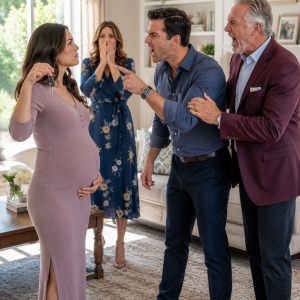
I placed the ring inside the empty champagne glass from his toast.
“Your family financed an elaborate celebration with money taken from unsafe public buildings, but you still believed I was the embarrassing person under this pavilion.”
His eyes hardened.
“If you leave now, the prenuptial agreement gives you nothing.”
“Then it finally gives me exactly what I want.”
Part 5: The House Where My Mother Was Waiting

I left through the orchard beside Marian, carrying the cedar box while June followed with my shoes and overnight bag. Nobody applauded, because liberation did not need another performance for wealthy strangers.
During the journey toward Winston-Salem, Marian explained that my mother had separated from the Vale family after marrying my father. When my parents died, Marian was completing a fellowship overseas, and by her return, sealed proceedings and repeated placements had scattered my records across three counties. A private investigator eventually found my studio, whereupon Colton’s office intercepted her attempts at contact.
“I should have appeared at your door immediately,” she said. “I allowed lawyers to persuade me that careful contact would feel safer for you.”
“You kept trying after the letters disappeared.”
“Trying does not return the missing years.”
“No, but it tells me they were missing for both of us.”
Her home occupied a former schoolhouse filled with atlases, carved boxes, family photographs, and books repaired with stitching my hands somehow recognized. One photograph showed my mother teaching me to thread bright yarn through cardboard, proving my profession had roots extending beyond my conscious memory.
The investigation expanded during the following months. Warren resigned, Colton was indicted for conspiracy, wire fraud, obstruction, and falsifying safety certifications, while independent engineers inspected every public project. Hollis Heritage survived under court-monitored leadership because closing it would have punished employees and communities more than the executives responsible.
My marriage was annulled after forty-three legal minutes. The prenuptial agreement protected Hollis assets, while the investigation protected me from debts created before the ceremony.
Colton wrote three letters from detention, eventually admitting that my missing family had made isolation easier. I kept none of them.
Part 6: The Pages We Chose to Repair
Eighteen months after the orchard wedding, the Red Hollow Children’s Library reopened beneath a new name chosen by local residents. Its rebuilt floors could support crowded reading rooms, its wiring passed independent inspections, and the restored brick walls contained plaques naming workers rather than donors.
Marian and I established the Laurel Bennett Book Arts Workshop upstairs, providing free conservation, illustration, and printmaking classes for foster children and young adults leaving residential care.
On opening day, June found me repairing a torn atlas beside a twelve-year-old student named Tessa. The girl had selected golden thread even though traditional restoration called for something less visible.
“People usually try to hide the repair,” Tessa explained. “I want anyone opening the book to know somebody cared enough to fix it.”
Marian stood in the doorway listening. Her eyes met mine across the room.
I once believed a repaired object became valuable by looking untouched, which matched the marriage Colton wanted: every fracture hidden and every history edited. Tessa understood that a careful repair did not deny damage; it made survival legible.
After the ceremony, reporters waited outside, hoping I would discuss Colton’s sentencing or the wedding video. I spoke about the workshop, public accountability, and the craftspeople who rebuilt the library correctly, because my new life deserved more attention than the spectacle that forced me to leave.
That evening, Marian placed the cedar box on a table inside the workshop.
“Your mother intended these letters for you, although keeping them together no longer requires keeping them hidden.”
We arranged several beneath protective glass, including a note Laurel had written shortly before her death.
Her final sentence read: A person who loves you will never require your smallness as proof of their importance.
For years, Colton had presented my loneliness as evidence that he rescued me. Marian taught me that being found did not mean becoming indebted to the person who arrived. Real family opened a door without deciding how grateful I must appear while walking through it.
Before locking the workshop, I noticed Tessa’s atlas drying beneath a linen weight. Golden thread crossed the repaired spine in bright, deliberate lines.
The damage remained part of the book, although it no longer controlled how the story ended.
Neither did mine.
THE END