Part 1: Forty-Eight Dollars in the Rain
The first thing my mother did after helping my husband take my home was hand him a bottle of champagne.
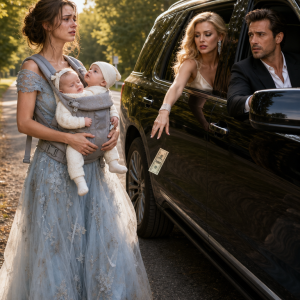
Rain swept across the hills outside Asheville, North Carolina, while everything I possessed lay inside six soaked boxes beside the road. My shoes had disappeared, and one palm was scraped from falling against the stone steps.
Harrison Vale stood beneath the entrance of the house I had restored. My sister, Brooke, wore my burgundy coat while my mother, Vivian, presented Harrison with a ribboned bottle.
“Tell me you did not know they planned this,” I called toward Brooke.
She examined the sleeve of my coat before answering.
“I knew Harrison was protecting the company from someone who had become unpredictable.”
Six hours earlier, I had entered Buncombe County Superior Court believing our divorce hearing concerned temporary access to bank accounts. Harrison’s attorneys instead requested emergency control of Holloway Heritage Design, the architectural-preservation firm I had founded ten years earlier. They claimed I had become incapable of managing client funds after developing paranoid beliefs about forged surveys and corrupted building records.
Vivian and Brooke supported every allegation, while Harrison produced edited recordings and emails stripped of their attachments. The judge issued only temporary financial restrictions, but Harrison treated them as permission to lock me out, dismiss my staff, and discard my belongings.
“You lied under oath,” I told my mother. “You know I never imagined those altered surveys.”
Vivian descended one step, remaining safely beneath the roof.
“Your obsession with old buildings has embarrassed this family long enough. Harrison develops entire communities while you argue over bricks, gardens, and forgotten deeds.”
“My company earned six million dollars last year preserving properties your friends use for charity galas.”
“Yet you could not preserve your marriage,” she replied.
Harrison raised his glass with a satisfied smile.
“Your client relationships belong somewhere capable of turning them into real development opportunities. I will make Holloway useful.”
His purpose was finally unmistakable. Harrison had manufactured a crisis to capture my firm’s historical research, municipal contacts, and land records.
I asked Vivian for one night in her guesthouse because my accounts were inaccessible and Harrison had kept the car registered jointly. My mother refused before I finished explaining.
“You will not bring another spectacle to my property. Find a shelter or ask one of those preservation activists you value more than family.”
Brooke laughed softly, and Harrison told security that their responsibility had ended. The entrance doors closed while the champagne remained visible through the glass.
My available checking balance was $48.19.
As I considered sleeping beneath a motel awning, a black sedan stopped beside my boxes. A silver-haired woman approached beneath a wide umbrella.
“Amelia Holloway?”
“If Harrison sent you, please tell him the rain has already destroyed anything worth taking.”
“I represent no member of the Vale family. My name is Rebecca Sloan, and I served as counsel to Samuel Holloway.”
Samuel was my grandfather’s estranged brother, whom Vivian described as a reckless drifter who had squandered his inheritance decades earlier. According to every family story, he had died penniless somewhere in Arizona.
Rebecca held out a sealed envelope.
“Samuel died four days ago at his home in Santa Fe. Contrary to your mother’s account, he built a private investment company holding commercial property, water infrastructure, and agricultural technology interests.”
I struggled to understand why she was telling me while rainwater ran down my face.
“His estate currently holds approximately seventy-six million dollars in liquid and marketable assets. After specific charitable gifts, he left the controlling remainder to you.”
The entrance behind us remained dark, and the celebration had moved deeper into the house. Rebecca glanced toward it before lowering her voice.
“Samuel did not leave you this inheritance to finance another rescue for the relatives who abandoned you. Before you can receive unrestricted control, he requires you to recover something they helped steal.”
Part 2: Samuel Holloway’s Condition
Rebecca brought me to Samuel’s brick residence overlooking downtown Asheville, where dry clothing, food, and a guest room had already been prepared. Once I stopped shaking, she opened three archival boxes in the library.
Forty years earlier, Samuel and my grandfather had jointly controlled Holloway Springs, a 900-acre mountain property containing forests, historic farm buildings, and the headwaters of a regional river. Samuel wanted the land protected through a conservation trust, while my grandfather favored limited development.
Harrison’s father, Charles Vale, wanted considerably more. With Vivian’s assistance, Charles obtained a questionable amendment indicating that Samuel had surrendered his voting rights after abandoning the family. The Vales later acquired several parcels cheaply, while Vivian gained social connections and an undisclosed interest in one development partnership.
“My mother helped the Vale family take land from her own uncle, then encouraged me to marry Harrison,” I said.
“Samuel believed the marriage was not accidental. Harrison’s recent resort project occupies the most valuable portion of the original property, and Holloway Heritage Design possesses records capable of challenging his permits.”
The pattern became painfully clear. Vivian had helped one generation of Vales neutralize Samuel, then helped the next generation neutralize me.
Samuel’s trust required me to establish a legal path for recovering the transferred parcels and protecting the headwaters. Rebecca could deploy resources through independent entities, but revealing my inheritance prematurely would redirect most liquid assets to conservation charities.
“He expects me to fight Harrison while everyone believes I have forty-eight dollars?”
“Samuel believed arrogance would make the Vales careless. He also believed your expertise, rather than his money, would determine whether this succeeded.”
Samuel’s library contained every preservation award and study my mother had dismissed. With Rebecca’s help, complete recordings and medical records defeated Harrison’s temporary order within three weeks, although a neutral custodian retained disputed company files. Publicly, I moved into a modest apartment and cataloged records for the regional archive. Privately, Blue Ridge Stewardship Partners began purchasing Harrison’s distressed resort loans through ordinary commercial transactions.
My archival work produced the first significant breakthrough. Harrison’s resort permits described the headwater parcels as previously disturbed pasture lacking notable historical resources. A 1981 survey instead identified intact wetlands, Cherokee trade-route remnants, and two nineteenth-century structures eligible for protection.
The later report removing those findings contained measurements inconsistent with the mountain watershed. More importantly, its notarized amendment carried Samuel’s signature on a date when immigration records proved he was attending an agricultural conference in Brazil.
I needed access to Holloway Heritage Design’s original project archive, but the neutral custodian would release materials only through documented discovery. Harrison controlled the copies held by his development company, and he remained convinced that I was too frightened to challenge him.
Thanksgiving provided the opportunity to reinforce that belief.
Uninvited at Thanksgiving, I arrived wearing a worn coat and asked Vivian for money to repair my apartment heater while nearly thirty guests watched.
“You interrupt Thanksgiving after everything you have done to us, and now you expect charity?” Vivian asked loudly.
“I only need enough to survive until my next paycheck.”
She sent me to the kitchen for leftovers, where Harrison found me eating cold turkey.
“I heard preservation work was not paying your bills anymore,” he said. “Perhaps reality has finally corrected your opinion of yourself.”
I lowered my eyes and asked whether he knew of any available work.
He smiled before offering me a temporary overnight records position at Vale Development. The job involved scanning old project files ahead of an office relocation, paid barely above minimum wage, and required signing strict confidentiality rules.
“You will work under supervision, and you will not touch anything outside the assigned boxes.”
“I understand, and I appreciate the opportunity.”
He believed he had reduced his former wife to organizing the records he intended to exploit. He did not understand that the position provided lawful access to the precise documents I needed.
Part 3: The Records He Ordered Me to Scan

For ten nights, I cataloged routine files while surveillance cameras recorded careful work. Harrison smiled whenever he saw my identification badge marked TEMPORARY.
On the eleventh night, my assignment list included six boxes from the original Holloway Springs acquisition. Harrison wanted them digitized before a scheduled audit by his resort lenders, apparently assuming the documents supported his ownership.
They did not.
Inside the fourth box, I found correspondence between Charles Vale and Vivian discussing how to characterize Samuel as unreachable. Another folder contained draft survey amendments created before the environmental consultant supposedly inspected the land. The most important document was a side agreement granting Vivian a three-percent interest in future development revenue in exchange for securing family approval.
I scanned every page directly into Vale Development’s official document system, exactly as my instructions required. That decision created preserved business records with verifiable metadata rather than stolen photographs obtained from a private safe.
Harrison discovered the implications two days later. He ordered the boxes removed, but the audit protocol prevented deletion after upload. He then sued me for violating confidentiality and claimed I had deliberately misclassified privileged material.
The lawsuit allowed my attorneys to request the complete archive. Meanwhile, Blue Ridge purchased additional obligations as preliminary environmental reviews delayed construction and frightened Harrison’s lenders.
Brooke telephoned after Harrison filed his lawsuit.
“Mother and I can persuade him to settle, but you must help with my engagement gala at the resort hotel.”
Before the divorce, my company had designed historical exhibitions and botanical installations for prestigious events. Brooke wanted an elaborate Appalachian garden theme for six hundred guests, but her original designer had withdrawn after invoices went unpaid.
“What budget would I receive?”
“You should consider the exposure your payment. Harrison might forgive your legal violations if you prove you can still be useful.”
I agreed because the vendor credential offered legitimate hotel access, while the gala would gather Harrison’s directors, lenders, and investors after regulators completed their preliminary findings.
While I built an installation of rhododendrons, mountain laurel, and ferns, Rebecca negotiated with shareholders concerned about Harrison’s liabilities. Enough owners agreed to support leadership changes if regulators confirmed the false filings.
On the gala afternoon, I finished the final arch above the stage while Brooke criticized my secondhand work clothes.
“You may leave through the service corridor before guests arrive. Mother does not want anyone assuming you were invited.”
I pushed my equipment cart toward the freight elevator, then entered a private suite rented in Rebecca’s name. Inside waited a tailored midnight-blue gown, my grandmother’s diamond earrings, and a folder containing the court filings scheduled for release that evening.
When Harrison announced that final construction financing had been secured, Rebecca sent a message confirming that the last shareholder consent had been signed.
I entered through the ballroom’s main doors and walked beneath the botanical arch my family had expected me to build invisibly. Conversations faded as guests recognized me. Harrison lowered his champagne glass, while Vivian stared as though the woman she had abandoned in the rain had returned from another life.
I stopped beside the stage rather than taking his microphone.
“You should leave before security removes you,” Harrison said.
Rebecca entered behind me with Blue Ridge’s general counsel and two independent directors.
“Security will remain neutral tonight,” she replied. “The hotel’s mortgage holder amended the property-management agreement this afternoon.”
Harrison looked toward his directors, but none offered reassurance.
“What exactly do you think you are doing, Amelia?”
“Correcting the record you ordered me to preserve.”
Part 4: The Empire Beneath the Ballroom
The screens behind Harrison displayed a notice from state regulators announcing a formal review of the resort’s land-use approvals. A second document showed the 1981 wetlands and historical-resource survey, followed by the amended report that had erased every protected feature.
I explained the impossible measurements, Samuel’s presence in Brazil, and proof that the amendment predated the alleged inspection. Attorneys had already filed everything with appropriate authorities.
Vivian rose from her table.
“Amelia has spent months inventing this fantasy because she cannot accept her divorce.”
The side agreement appeared on the screen with her signature and revenue percentage clearly highlighted.
“Then perhaps you can explain why Charles Vale promised you a private interest in the development three weeks before Samuel supposedly surrendered his rights.”
My mother gripped the table, and Brooke began whispering urgently to Mason. Harrison accused me of stealing corporate files until his own audit director confirmed that I had scanned assigned records into the official system under written instructions.
Rebecca disclosed that Blue Ridge controlled much of the resort’s secured debt and had gained voting support from shareholders representing fifty-four percent of Vale Development.
“Owning loans does not make Amelia the chief executive,” Harrison insisted. “This company still answers to its board.”
One director read a resolution placing Harrison on administrative leave pending independent investigations and appointing an interim management committee.
Harrison stared around the ballroom as supporters quietly avoided his eyes.
“She could never finance an operation of this size. I froze every account she possessed.”
Samuel’s confidentiality condition now allowed disclosure because the recovery petition had been accepted and Blue Ridge could prevent further development.
“Samuel Holloway died four days before you threw me into the rain,” I said. “He left me a trust valued at approximately seventy-six million dollars because he knew your family had built this resort upon property taken through deception.”
Vivian whispered that Samuel had been penniless, repeating the lie she had protected for most of her adult life.
“He rebuilt his fortune without you, Mother. He also preserved every letter proving why you helped remove him from the family.”
Harrison’s expression shifted from disbelief to panic.
“Vale Development is my life, and you cannot dismantle it because your uncle left you money.”
“Your employees and legitimate projects will be protected. The headwater property will be removed from commercial development, while the court and regulators determine which transfers remain valid. Your life is not being dismantled; your decisions are finally being examined.”
Brooke claimed she had trusted Harrison, while Vivian insisted families could survive terrible mistakes.
“A mistake is made without understanding,” I answered. “You knew what your testimony would do because you had already done the same thing to Samuel.”
Rebecca handed them notices concerning distressed loans secured by their homes. Nobody was evicted that night, but Harrison’s subsidies had ended, and both properties faced sale unless refinanced independently.
“Where are we supposed to live?” Vivian asked.
The question returned me instantly to the driveway, where I had possessed forty-eight dollars and no shoes.
“You have attorneys, vehicles, and legally required notice. That is considerably more consideration than you gave your daughter.”
I left the ballroom while Harrison argued with directors, Brooke cried beside an abandoned engagement table, and Vivian called my name. Their regret had arrived only after discovering that cruelty carried an invoice, which made it unsuitable as the foundation for reconciliation.
Part 5: What the Inheritance Restored
Regulators suspended construction, investigators examined the records, and Vale Development entered court-supervised restructuring. Legitimate projects and ordinary employees were protected, while my firm recovered its contracts. Harrison later faced civil penalties and criminal charges involving false certifications. Brooke lost her engagement, and Vivian sold jewelry before moving into a modest condominium. I released my anger eventually, but forgiveness never required restoring their access to my life.
I reestablished Holloway Heritage Design as an independent preservation and environmental-planning firm. With the recovered land and a portion of Samuel’s trust, we created the Mountain Headwaters Conservancy, which restored wetlands, protected historical structures, and digitized vulnerable property records for rural communities.
One year after the rainy night, schoolchildren helped plant native wildflowers along a restored stream on the former resort property. A young girl pressed soil around a mountain aster before asking why one small flower required so many adults to protect it.
“Because valuable things do not become unimportant merely because powerful people overlook them,” I told her.
Rebecca joined me later on a wooden observation platform overlooking the restored headwaters. She carried two paper cups of cider rather than champagne, which made both of us laugh.
“Samuel’s final restriction expired this morning,” she said. “The remaining trust assets are now under your unrestricted control.”
Seventy-six million dollars sounded enormous, although money was no longer the most significant part of my inheritance. Samuel had left evidence that my mother’s story was false, resources to challenge an entrenched company, and proof that the profession my family mocked possessed genuine power.
Most importantly, he had given me the opportunity to stop confusing biological connection with love.
Vivian once believed legacy meant a respected surname, an impressive estate, and invitations from wealthy people. Harrison believed legacy meant placing the Vale name on buildings constructed through debt and concealed history. Brooke believed she could acquire it by marrying into the correct family.
Samuel understood that legacy was whatever remained useful after admiration disappeared.
I had begun that year barefoot beside broken boxes, watching my mother celebrate the man who had taken everything she believed defined me. They thought the temporary loss of my house, accounts, and company had reduced me to nothing.
They never understood that my value had not been stored inside anything they controlled.
The inheritance did not create that value, and revenge did not restore it. I recovered because I stopped asking cruel people to confirm who I was, then used the truth they dismissed to protect something larger than myself.
The night Harrison threw me into the rain was not the end of my life. It was merely the final evening when my family possessed the authority to tell me what my life was worth.
THE END