The Dinner She Tossed Aside
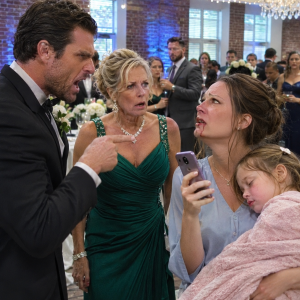
At my family’s Fourth of July cookout in Annapolis, my daughter-in-law scraped the dinner I had prepared into the dog’s bowl.
She did not do it quietly.
She lifted my plate high enough for everyone on the patio to see, tilted it over the stainless-steel bowl beside the deck, and watched as grilled chicken, potato salad, and roasted vegetables fell in a messy pile.
Then she laughed.
“The hired help always eats last,” she announced. “You can wait by the kitchen until everyone else is finished.”
A few guests lowered their eyes. Others stared at their drinks, pretending they had not heard her.
My son stood only a few feet away.
He saw everything.
He said nothing.
I looked at the woman who had married my only child, then at the navy-blue coat folded over the back of my chair. I picked it up, slipped my arms into the sleeves, and fastened the buttons slowly.
“Now they will learn who owns this land,” I said.
The laughter stopped.
Less than an hour later, my daughter-in-law’s face had lost all its confidence, my son was asking me to reconsider, and everyone at the party finally understood that the quiet older woman they had treated like an employee was the reason their comfortable lives existed at all.
But that afternoon did not begin with anger.
It began with hope.
The Celebration I Prepared Alone
For nearly a month, I had been planning the cookout at our waterfront property on the Chesapeake Bay.
I ordered fresh flowers from a local farm, arranged lanterns along the dock, and asked the caterer to prepare a menu that honored the recipes my late husband, Everett, had loved. There were smoked ribs, grilled corn, lemon chicken, homemade rolls, and a blueberry pie made from his mother’s recipe.
I wanted the gathering to feel warm.
Everett had been gone for almost four years, and holidays still carried an emptiness I could not explain. My son, Travis, had promised that the cookout would bring the family closer together.
“Kelsey has invited a few friends,” he told me over the phone. “It will be good for you to have people around.”
A few friends became almost forty guests.
By noon, expensive cars lined the circular driveway. Kelsey’s friends arrived in bright summer clothes, carrying bottles of sparkling water and talking loudly about vacations, investment properties, and private schools.
Most of them barely acknowledged me.
Kelsey introduced me to one couple by saying, “This is Helena. She helps us keep everything running.”
She did not say I was Travis’s mother.
She did not say the property belonged to me.
I watched her turn away before I could correct her.
For several minutes, I told myself it did not matter. Maybe she had spoken carelessly. Maybe the music was too loud. Maybe I was being overly sensitive.
I had spent years making excuses for both of them.
That afternoon, however, my excuses finally ran out.
The Woman They Called the Caretaker
Everett and I had bought the waterfront land more than thirty years earlier, when it held nothing but an aging cottage and a broken wooden pier.
We built the main house slowly.
We worked weekends, saved every extra dollar, and lived in two unfinished rooms while the rest of the home was being completed. Everett handled construction contracts while I managed the finances and helped expand his small marine-repair business.
Over time, that little business became Frost Harbor Group, a successful company that maintained docks, managed waterfront properties, and supplied equipment to marinas across three states.
When Everett passed away, his ownership interests transferred to me.
The house, land, dock, boats, company shares, and investment accounts were all legally mine.
Travis knew this.
Kelsey knew it too, although she preferred telling people that Travis had inherited everything from his father.
I had allowed them to live in the guesthouse after they married because their first apartment had become too expensive. Later, when they wanted a larger place, I let them move into the main residence while I relocated to the smaller cottage near the garden.
It was supposed to be temporary.
Three years later, Kelsey behaved as if I were fortunate to be allowed on the property.
She began giving instructions to the housekeeper in my name. She replaced family photographs with framed pictures of herself and Travis. She even changed the lock on the wine room without telling me.
Whenever I asked about it, Travis tried to calm me.
“Mom, Kelsey is just trying to make the house feel like home,” he would say.
I wanted my son to be happy, so I remained quiet.
My silence became their permission.
The Seat at the End of the Table

At the cookout, Kelsey placed name cards at every table.
Mine was not among them.
When I asked where I should sit, she pointed to a small folding chair near the outdoor kitchen.
“That area is better for people helping with food,” she said.
“I am not helping the caterer,” I replied. “I am part of the family.”
She smiled without warmth.
“Of course. But someone needs to make sure the serving trays stay full.”
Travis heard the conversation but walked away when one of his friends called his name.
I stood beside the buffet for nearly an hour, answering questions from the catering team and directing guests toward the drinks. Most assumed I had been hired to oversee the event.
One man handed me his empty glass without even looking at me.
I placed it on a tray and continued smiling.
It was not because I lacked courage.
It was because I was still waiting for my son to notice what was happening and defend me.
He never did.
When the food was served, I finally prepared a plate and carried it toward the empty seat beside Travis.
Kelsey stepped in front of me.
“That chair is reserved,” she said.
“For whom?”
“One of our investors may arrive later.”
I glanced around. Every other seat was occupied.
“Then I will sit here until he comes.”
Her expression tightened.
“Helena, please do not make this awkward.”
“I am not the person making it awkward.”
That was when she reached for my plate.
The Moment Everyone Saw

At first, I thought Kelsey planned to place the plate somewhere else.
Instead, she walked to the dog’s bowl near the deck steps and emptied my food into it.
Our old golden retriever, Maple, lifted her head in confusion.
Kelsey laughed and turned toward her friends.
“The hired help always eats last,” she said. “She can have something after the guests leave.”
No one laughed with her.
Travis looked down at his phone.
I waited several seconds, giving him one final chance.
“Travis,” I said quietly.
He did not meet my eyes.
“Mom, can we discuss this later?”
Those words hurt more than Kelsey’s behavior.
Later.
That was what he always said when something required courage.
Later, when Kelsey was calmer.
Later, when the guests were gone.
Related Posts

“Go Save Your Job, Son. Your Wife and Baby Are Safe With Us,” My Mother Promised as I Left My Wife and Our 7-Day-Old Newborn in Her Care. Four Days Later, I Returned Home at 4 A.M. and Found Their Bedroom Locked From the Outside. My Wife Was Unconscious, and Our Baby Barely Responded. At the Hospital, the Doctor Took One Look at My Son and Ordered, “Call the Police. Right Now.” Then She Asked Me a Question That Made Me Realize Something Terrible Had Happened While I Was Gone…
“Dad, What Have You Done? There Are People Outside Demanding to See You!” My Daughter Cried Over the Phone. I’m 71, and I’ve Run My Little Diner for Nearly 40 Years. Two Days Earlier, I’d Quietly Given a Hungry Young Delivery Driver a Free Breakfast, Even Though We Could Barely Afford It. My Daughter Had Warned Me, “One Day, Your Kindness Is Going to Cost You This Diner!” Now, a Photo of My Handwritten Receipt Was Spreading Across the Internet, and Strangers Were Gathering Outside My Door. I Stood Behind the Counter, Afraid to Find Out Why.

My Husband Pushed Me Out Of The House While I Was Holding Our Twelve-Day-Old Son In The Middle Of A Freezing Blizzard, Then Locked The Door Behind Us. With No Winter Coat Or Phone, I Struggled To Reach Our Elderly Neighbor’s Porch. He Brought Us Inside, Called Emergency Services, And Checked His Security Cameras. The Footage Showed My Husband Forcing Me Outside, Providing Crucial Evidence. But The Most Damning Evidence Came From His Own Mother…
“Mom, Please Don’t Ask Me to Walk Down the Aisle Without You,” My Daughter Begged the Night Before My Surgery. At 47, I Was About to Lose Part of My Jaw to C@ncer, and I Was Terrified My Husband Would Never Look at Me the Same Way Again. “Raymond, What If You Can’t Bear to Look at My Face?” I Asked. He Went Quiet, and That Silence Frightened Me More Than Anything. But Later That Night, I Found a Folded Note Hidden in Our Old Family Photo Album. It Was Dated Six Months Earlier—and I Wasn’t Prepared for What My Husband Had Written.