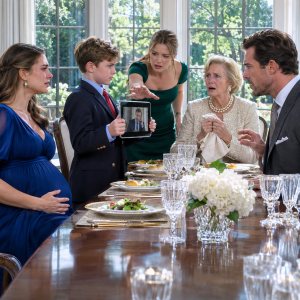
The Night the Doors Opened

Thirty minutes after my husband threw his wedding ring at me in front of nearly two hundred guests, I was sitting alone in the upstairs lounge of Boston’s most exclusive hotel, watching him celebrate through a wall of glass.
From where I sat, the ballroom looked almost beautiful. Crystal chandeliers cast soft light over ivory tablecloths, a string quartet played near the marble fireplace, and waiters moved among the guests carrying silver trays. The annual benefit hosted by Meridian Crest Group had attracted senior executives, judges, physicians, and several families whose names appeared on buildings throughout New England.
Downstairs, my husband, Graham Holloway, stood near the podium with one hand resting possessively on the waist of a young woman named Vanessa Price. His mother, Judith, remained at Vanessa’s other side, smiling as though the three of them had just won something.
Perhaps they believed they had.
A few minutes earlier, Graham had raised his glass and announced that Vanessa was expecting his child. Then, with the theatrical confidence he had acquired after becoming chief executive of Meridian Crest, he had removed his wedding ring and tossed it across the table.
It had landed beside my plate.
“I’m done carrying you,” he had said. “Get out, you barren leech.”
Vanessa had lifted an ultrasound photograph high enough for everyone to see, while Judith laughed and declared that the Holloway family was finally going to have the heir it deserved.
When I stood, someone near Graham bumped a glass. Red wine splashed across the front of my pale blue dress. No one offered me a napkin. No one asked whether I was all right.
They simply watched.
I wiped my face with the corner of the tablecloth, took out my phone, and called the only number Graham had never known existed.
“This is Eleanor Whitmore,” I said after the line connected. “Activate chairwoman authority. Remove Graham Holloway from every executive position, suspend his access to all corporate accounts, and reclaim the Wellesley residence and company vehicles tonight.”
The ballroom had fallen silent for half a second before Judith began laughing.
“Chairwoman authority?” she said. “Listen to her. The poor thing has finally lost her senses.”
Graham leaned close enough for me to smell the expensive wine on his breath.
“Go quietly, Eleanor. If you embarrass me any further, I’ll have security escort you out.”
I looked at the clock above the ballroom doors.
“You should enjoy the next thirty minutes,” I told him. “They are the last ones in which anyone here will call you CEO.”
Then I walked away.
Now, seated in the mezzanine lounge with a glass of sparkling water untouched beside me, I watched Graham take the stage as though nothing had happened.
He straightened his bow tie, thanked the sponsors, and spoke grandly about loyalty, vision, and family values. Vanessa stood below him, one hand placed carefully over her flat stomach. Judith whispered to the people around her, occasionally glancing toward the upper level as if she expected to find me weeping behind a curtain.
I was not weeping.
I was remembering.
The Man I Once Believed In
I met Graham eleven years earlier at a small professional conference in Providence. At the time, he was a regional sales supervisor for a struggling building-supply company, and I was using my mother’s maiden name while working as a project coordinator at one of Meridian Crest’s charitable foundations.
He spilled coffee on a stack of handouts I was carrying and spent the next twenty minutes helping me dry the pages beneath a hand dryer in the women’s restroom hallway.
He was embarrassed, funny, and unexpectedly kind.
When he learned that I had missed lunch, he brought me a turkey sandwich from a corner café. We sat on a stone bench outside the conference center, eating from paper wrappers while the afternoon traffic passed.
“I’m going to run a major company someday,” he said, smiling as if he knew how improbable it sounded. “Maybe then I can afford to buy you a proper lunch.”
“I liked this lunch,” I told him.
That was true. I liked him, too.
My grandfather, Walter Whitmore, had founded Meridian Crest Group nearly fifty years earlier. What began as a small chain of rehabilitation centers had grown into a national network of senior-living communities, medical offices, and charitable housing programs. By the time I reached adulthood, the company employed more than twelve thousand people.
My parents had separated when I was young, and I had spent most of my childhood with my mother in a modest town outside Portland, Maine. Grandfather entered my life more fully after I finished college. He taught me how to read contracts, question financial projections, and listen carefully when confident men spoke as though confidence were the same thing as competence.
When he retired, he transferred the controlling voting shares into a trust established in my name. Only the board, the company’s general counsel, and two trustees knew that I held final authority.
Grandfather believed anonymity would protect me while I learned.
“If people know what you own before they know who you are,” he once told me, “you will spend your life wondering which part of you they came to meet.”
So when Graham asked about my family, I told him only that my grandfather had worked in healthcare administration. It was not exactly false, though it was far from complete.
I wanted Graham to love the woman who ate sandwiches on park benches, wore ordinary shoes, and worried about paying too much for groceries. I did not want him to see a trust, a board seat, or a number printed on a financial statement.
For several years, he seemed to love me exactly that way.
We married in a white wooden church near the Maine coast, with fewer than sixty guests. Graham cried when I walked down the aisle. During our first dance, he pressed his forehead to mine and promised that no matter what happened, we would never become one of those couples who stopped being kind to each other.
I believed him so completely that remembering it later felt almost embarrassing.
A year into our marriage, Meridian Crest acquired the company where Graham worked. He told me that he feared losing his position. I quietly arranged for his performance to receive a fair review, and the board discovered that he was energetic, persuasive, and excellent with clients.
At first, I only opened a door.
Later, I pushed him through several more.
When a vice president retired, I recommended Graham for the role. When directors questioned his lack of experience, I supported a leadership program and gave him access to seasoned advisers. When he mishandled a regional expansion, I authorized a restructuring that prevented the failure from becoming public.
Graham believed each rescue proved his brilliance.
Within seven years, he had become chief executive.
The promotion changed the rhythm of our marriage. He began correcting the way I spoke in public, criticizing my clothes, and introducing me merely as “my wife, Eleanor,” in a tone that suggested I had no accomplishments of my own.
Judith changed as well. Before Graham’s success, she had treated me with guarded politeness. Afterward, she began speaking to me as though I were an inconvenient employee living in her son’s house.
The Wellesley estate had been purchased by a Meridian Crest property trust for visiting executives, but I had authorized Graham and me to use it as our family home. Judith assumed her son owned it. Before long, she was redecorating rooms, dismissing staff members, and hosting luncheons without asking me.
I said nothing because Graham always defended her.
“She sacrificed everything to raise me,” he would say. “Let her enjoy this.”
I understood sacrifice. What I did not understand then was how quickly gratitude could become permission.
The Quiet Cruelty at Home
Our struggle to start a family became Judith’s favorite weapon.
At first, Graham held my hand during appointments and told me that we would face every disappointment together. After his promotion, he attended less often. Eventually, he stopped asking what the doctors said.
Judith began bringing me bottles of supplements with handwritten labels.
“A woman from my club swears by these,” she told me. “You should be grateful I’m still trying to help you.”
The capsules often left me dizzy and unsettled, but when I said I wanted to stop taking them, she accused me of not wanting a family badly enough.
On weekends, she insisted on cooking meals she described as restorative. They had a faint metallic taste that she claimed came from mineral powders.
About a year before the gala, she served soup at our kitchen island. After tasting a spoonful from my bowl—not hers—she made a face and swept it onto the floor.
“Even the food in this house is disappointing,” she snapped. “Ten years, Eleanor. No career anyone can name, no social standing of your own, and no child. What exactly do you contribute?”
I knelt to gather the pieces of porcelain while Graham scrolled through messages on his phone.
“Are you going to let her speak to me like that?” I asked.
He did not look up.
“Don’t start another argument.”
That sentence stayed with me because it revealed the rule governing our household: Judith could injure, insult, and humiliate me, but my response was considered the real disruption.
Three months later, I became ill after another weekend dinner. A physician asked me to list every medication and supplement I had taken. I brought him the remaining capsules Judith had given me.
The laboratory report raised questions serious enough that I hired an independent investigator. She recovered copies of older medical records, arranged further testing, and traced the supplements to an unlicensed online seller. Certain ingredients could interfere with hormones and cause other long-term complications.
There was no single dramatic piece of evidence, but there was a pattern: unexplained symptoms, altered bottles, missing medical documents, and purchases connected to an account Judith used.