The Girl Who Climbed the Fence

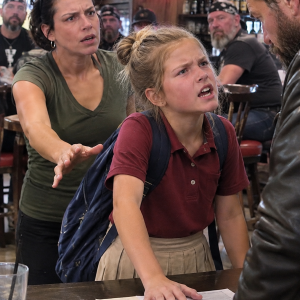
The first time my eight-year-old daughter met Grant Calloway, she climbed over the stone wall surrounding his property with two battered badminton rackets tucked beneath one arm and informed one of the most intimidating men in Rhode Island that he looked as though he had forgotten how to enjoy himself.
I wish I could say I had raised her to be fearless.
The truth was that Emma simply had not yet learned the complicated adult habit of deciding which people deserved to frighten us.
My name is Nora Whitfield, and at the time Emma and I lived in a small cedar-sided house outside Bristol, where the road narrowed near the marshes and the wind coming off Narragansett Bay seemed capable of finding every loose window frame in the building. Our house leaned slightly to one side, the furnace complained whenever temperatures dropped below freezing, and my secondhand kitchen table had one leg supported by a folded piece of cardboard.
It was not much, but it was ours.
Grant Calloway’s estate stood beyond a stretch of woodland less than a mile away, though it might as well have belonged to another country.
He was thirty-eight, wealthy, private, and enormously influential, the owner of a maritime logistics company that controlled warehouses, shipping contracts, and construction projects along much of the coast. People in town lowered their voices when they mentioned him. Some said it was because he had powerful lawyers. Others said it was because too many important people owed him favors.
Whatever the truth, nobody wandered onto his property.
Nobody except Emma.
The afternoon it happened, snow had begun falling just after lunch. When I realized the house had become suspiciously quiet, I checked Emma’s room and found an open window, an empty hook where her winter coat should have been, and two badminton rackets missing from the hall closet.
I followed her footprints through the woods.
They ended at Grant Calloway’s garden.
By the time I reached the clearing, breathless and furious, Emma was standing in the middle of a snow-covered lawn across from Grant himself.
Three members of his security staff watched from several yards away.
Grant wore a charcoal overcoat over a white shirt and dark trousers. Emma wore purple snow boots, a knitted hat with a pom-pom the size of an orange, and the expression of someone conducting serious negotiations.
Grant held one of her cheap rackets between two fingers.
“Tell me why I shouldn’t have someone walk you directly home.”
Emma pointed at the racket.
“Because we’re playing first.”
His face barely changed.
“We’re not.”
“You look unhappy.”
One of the security men suddenly found the snow near his shoes extremely interesting.
Grant’s gaze sharpened.
“I’m not unhappy.”
“You are a little.”
“You don’t know me.”
Emma considered that.
“That’s true. But you still look unhappy.”
Then she tossed him the shuttlecock.
“You serve.”
I reached them just as Grant made his first swing.
He missed by nearly a foot.
Emma laughed so loudly that a flock of birds lifted from the trees.
Every adult on that lawn became perfectly still.
Grant Calloway was not a man people laughed at.
Emma, apparently, had missed that memo.
“That was terrible,” she announced.
Grant stared at her.
Then, to my astonishment, the corner of his mouth lifted.
“Again.”
Five minutes later, his coat was hanging over a bench.
Ten minutes after that, his tie had been loosened.
By fifteen minutes, expensive leather shoes were sinking into the snow while Emma accused him of inventing rules whenever he lost a point.
And then Grant laughed.
Not politely.
Not the restrained sound a man makes because everyone else at dinner is laughing.
He bent forward, one hand against his knee, while Emma danced around the badminton net that did not actually exist.
His security staff exchanged glances.
I simply watched.
There was something almost intimate about seeing a serious man unexpectedly become young again.
Then Emma bent to retrieve the shuttlecock.
A thin silver chain slipped from inside her sweater.
Grant stopped moving.
The change in him was immediate.
He walked toward her slowly.
“Emma, may I see that necklace?”
She touched the oval locket.
“Why?”
“Please.”
Something in his voice made me step closer.
Emma lifted the chain over her head.
Grant turned the locket in his palm.
On the back were two worn initials.
G.C.
His own.
His hand trembled.
“Where did you get this?”
“Mom gave it to me.”
His eyes found mine.
I felt suddenly as though the temperature had dropped another ten degrees.
“Nora?”
“It belonged to my mother.”
Grant looked down again.
“No.”
“I’m sorry?”
He swallowed.
“It belonged to my sister.”
The playfulness had disappeared completely.
“There was only one like it. My father had it made for her.”
Emma frowned.
“Then maybe Grandma knew your sister.”
Grant closed his fingers around the locket.
When he spoke again, the powerful man everyone feared sounded unexpectedly fragile.
“My sister has been gone for sixteen years.”
The Photograph in the Library
Grant invited us inside because Emma’s mittens were soaked and, as he pointed out, my daughter had apparently decided trespassing was an acceptable winter hobby.
His house surprised me.
I had imagined glossy marble and expensive furniture no one was allowed to touch. Instead, it felt old and lived in, with dark oak floors, crowded bookshelves, framed family photographs, and an enormous stone fireplace that looked as though it had been built before electricity reached Rhode Island.
Emma noticed a pair of muddy boots near the back door.
“Those yours?”
Grant nodded.
“Yes.”
“My mom makes me leave muddy shoes outside.”
He glanced at me.
“Your mother sounds unreasonable.”
“I can still hear you,” I said.
His house manager, a cheerful woman named Margaret Dunn, appeared carrying clean towels and stopped when she saw Grant standing beside an eight-year-old holding badminton rackets.
“Well,” she said. “This is new.”
“Margaret.”
“I haven’t said anything.”
“Your face has.”
Margaret smiled.
Within minutes Emma was wearing borrowed wool socks and drinking hot chocolate while Grant searched through boxes of family photographs.
His sister’s name had been Caroline Calloway.
She was nine years older than Grant and, judging from the photographs, had possessed almost none of his seriousness.
She appeared barefoot on beaches, laughing at picnic tables, dancing at weddings, and once standing behind a teenage Grant while holding rabbit ears over his head.
Emma pointed.
“You looked grumpy when you were young too.”
“I was seventeen.”
“That’s not an answer.”
Margaret covered a smile with her coffee cup.
Then Grant found the photograph.
Caroline stood outside an old community center wearing Emma’s locket.
Beside her was a woman with short reddish-brown hair.
My heart tightened.
I leaned closer.
The woman was twenty years younger than I remembered her, but I knew the shape of her smile and the faint mark beneath her left ear.
“That’s my mother.”
Grant looked at me.
“You’re certain?”
“Absolutely.”
My mother, Judith Whitfield, had raised me alone.
She had been practical, warm, and remarkably private. For most of my childhood she worked coordinating housing assistance for families who had temporarily fallen on hard times. She died eight years earlier, leaving behind books, recipe cards, several boxes of photographs, and the silver locket I had eventually given Emma.
She had never mentioned Caroline Calloway.
Grant turned the photograph over.
October 2005.
I would have been fifteen.
Margaret studied the building.
“That’s Harbor House.”
Grant looked up.
“Caroline volunteered there.”
My mother had worked there too.
For the first time, coincidence began to look like something else.
Grant opened another album.
There were more photographs.
My mother and Caroline organizing a children’s winter drive. My mother pouring coffee while Caroline decorated a folding table. Caroline sitting beside a group of mothers during what appeared to be a job-training workshop.
They had not merely crossed paths.
They had known each other well.
That evening, Grant told me Caroline had disappeared for several days shortly before she was lost in a highway accident sixteen years earlier. When she returned, she had been unusually quiet.
“She asked me whether people could belong to more than one family,” he said.
“What did you tell her?”
He stared into the fireplace.
“I was twenty-two. Probably something useless.”
Margaret spoke from behind us.
“You told her family was made of the people who kept showing up.”
Grant turned.
“I said that?”
“You did.”
For several seconds he said nothing.
Then Emma tugged his sleeve.
“Are we still finishing badminton tomorrow?”
Grant looked down at her.
The heaviness around him eased slightly.
“You were losing.”
“I had eight.”
“You had six.”
“I counted the two times you slipped.”
“Those are not points.”
“They should be.”
I realized then that Emma was not simply amusing him.
She was giving him somewhere to stand while the past shifted beneath his feet.
The Things My Mother Never Explained

Two mornings later, I opened the cedar chest that had belonged to my mother.
I had searched it after she was gone, but grief makes people look for memories rather than evidence.
This time I looked differently.
At the bottom I found several Harbor House newsletters.
One contained a photograph of Judith Whitfield and Caroline Calloway standing together beneath a hand-painted banner for something called the Open Door Family Project.
Underneath were their names.
My mother had been a program coordinator.
Caroline had served as a volunteer advocate.
My phone rang before I could finish reading.
Grant.
“I found something.”
“So did I.”
He had discovered Caroline’s old journals.
He had never opened them before because, he said, they had belonged to her.
That answer affected me more than I expected.
“What did she write?”
“Your mother’s name appears several times.”
My heart began pounding.
Then he went quiet.
“Nora, she wrote about you.”
I sat down.
“Me?”