The Man Who Asked Me to Call Him Dad
“Would you pretend to be my daughter?”
Julian Vance asked me that while I was pouring coffee into a paper cup at Willow Creek Hospice outside Portland, Maine.
I thought I had misheard him.
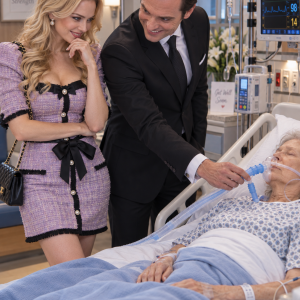
He was fifty-nine, thin enough that the hospital blanket seemed too large for him, with gray beginning to take over his dark hair. He had been at Willow Creek for nine days, and in that time I had never seen anyone visit him.
No wife. No children. No brother carrying an overnight bag. Not even a neighbor dropping off flowers.
Just me, three afternoons a week, wearing a volunteer badge and bringing him coffee he wasn’t technically supposed to drink much of.
I set the cup on his tray.
“Your daughter?”
“Just until I’m gone.”
He said it calmly, like he was asking me to water a plant.
I pulled the chair closer.
“Julian, I don’t think I’m supposed to—”
“I had one.”
His fingers tightened slightly around the paper cup.
“A daughter?”
He nodded.
Then he looked toward the window.
“I lost her before I ever got the chance to know her.”
I waited for the rest.
It didn’t come.
At thirty-four, I had spent my entire life knowing almost nothing about my own father. My mother, Claire, had raised me alone. Whenever I asked about him as a child, she gave me some version of the same answer.
He wasn’t part of our life.
By the time I was old enough to ask harder questions, I had learned not to.
Mom died two years before I met Julian.
Cancer took eleven months to reduce our little family of two to just me.
That was why I started volunteering at Willow Creek. I told people I wanted to give something back after the kindness hospice workers had shown my mother.
That was true.
It just wasn’t the whole truth.
The apartment was too quiet after she died.
Julian lifted the coffee again.
“Forget I asked.”
I looked at him.
For nine days, I’d watched nurses enter his room carrying medication and leave without anyone taking their place. I’d seen the untouched visitor chair beside his bed.
I picked up my purse.
“Okay, Dad. But if I’m your daughter, I’m telling the nurse you’re cheating on your coffee limit.”
His hand stopped halfway to his mouth.
For a few seconds, he didn’t say anything.
Then he laughed.
It wasn’t a big laugh.
But his eyes filled with tears.
“Fair enough, kid.”
I smiled and walked out.
At the time, I thought I’d just done something kind for a lonely man.
I had no idea Julian Vance had spent years waiting to hear me call him that.
Six Weeks
The arrangement should have felt strange.
It didn’t.
The next afternoon, I brought Julian a blueberry muffin from a bakery near my apartment.
“Daughters bring contraband,” I told him.
“Finally. Someone understands the job.”
I started staying after my volunteer shifts ended.
Julian never asked me to perform some sentimental version of a daughter. He didn’t expect hugs or speeches. Most days we talked about ordinary things.
Bad coffee.
Baseball.
Why he hated television news.
Why I had killed three houseplants in six months.
Sometimes we sat without talking at all.
He asked about my work as a graphic designer. He remembered the names of coworkers I’d mentioned only once. When I complained that my old Honda made a clicking noise whenever I turned left, he frowned.
“CV joint, maybe.”
“You haven’t even seen the car.”
“Still. Get it checked.”
“That sounded extremely dad-like.”
He smiled into his coffee.
“I’m getting good at this.”
There were moments like that when something about him felt oddly familiar, but I blamed the arrangement. Once you agree to call someone Dad, your mind starts filling in blanks.
Three weeks later, his doctor approved a short outing.
Julian wanted a cheeseburger.
Not some meaningful final meal. Not lobster overlooking the harbor.
A cheeseburger from Frankie’s, a diner twenty minutes away.
I pushed his wheelchair through the door, and a waitress with silver hair smiled at him.
“Haven’t seen you in forever.”
Julian looked uncomfortable.
“Been busy, Ruth.”
Her eyes moved to me.
“And who’s this?”
Before I could answer, Julian did.
“My daughter.”
The word landed differently when he said it.
Ruth’s smile disappeared for half a second.
She stared at Julian.
Then at me.
“Your daughter?”
Julian held her gaze.
“Evelyn.”
Ruth recovered quickly.
“Well, Evelyn, make sure he doesn’t order onion rings. He always regrets them.”
I laughed.
Julian didn’t.
On the drive back, I asked how she knew him.
“Old customer.”
“She looked like you’d just told her Elvis was alive.”
“Ruth is dramatic.”
He turned toward the passenger window.
I let it go.
That was one of the things about Julian. He could talk for forty minutes about engines, patents, or why diner coffee tasted better in thick ceramic mugs, then close completely when I asked about his past.
I knew he’d been an engineer.
I knew he’d once helped build a company.
I knew something had gone badly.
And I knew there had been a woman.
He wouldn’t tell me her name.
The Question He Wouldn’t Answer
Near the end of the fourth week, we were sitting in the hospice garden when I finally asked about his daughter.
Julian had a blanket over his knees. I was peeling the paper label off a water bottle.
“What happened to her?”
His hand stopped on the wheelchair arm.
“Who?”
“Your daughter.”
He stared toward the hydrangeas.
“Her mother left before she was born.”
“Why?”
“Because staying became dangerous.”
I looked at him.
“Dangerous how?”
He rubbed his thumb slowly over the edge of the blanket.
“I helped start a company with two men I trusted. We developed industrial control systems and held several patents. When serious money got involved, those men stopped being people I recognized.”
“They threatened you?”
“Not exactly me.”
That was all he said.
I waited.
“Did you ever look for your daughter?”
He swallowed.
“Every day.”
The answer came too quickly.
“Then why didn’t you find her?”
Julian finally looked at me.
For once, there was no joke waiting.
“Sometimes finding somebody and entering their life are two different things.”
I didn’t understand that answer.
I wouldn’t until later.
His health declined quickly after that.
The wheelchair became permanent. Then even trips into the garden became difficult.
One Tuesday afternoon, I found him staring at a photograph in his hand.
He turned it facedown when I entered.
“What’s that?”
“Nothing.”
“That’s suspicious.”
“Daughters are nosy.”
“Another thing I’m apparently good at.”
I reached toward the photograph.
He slid it under his pillow.
“Not yet.”
I stopped.
“Not yet?”
He looked at me for a long moment.
“There’s something I need you to have. But not from me.”
I frowned.
“That’s ominous.”
“It’s paperwork.”
“That’s worse.”