Chapter 1: The Little Boy Nobody Wanted to Understand
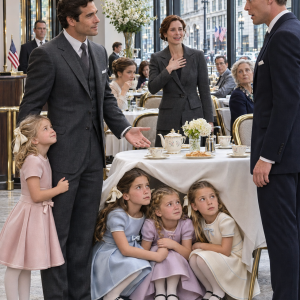
The grand ballroom of the Fairmont Hotel in Chicago was filled with laughter, elegant music, and hundreds of guests celebrating a lavish family wedding.
Crystal chandeliers sparkled above beautifully decorated tables. Women in designer gowns chatted with businessmen in expensive suits, while children ran between the tables.
But near a tall marble column stood an eight-year-old boy who seemed completely alone.
His name was Oliver Ashford.
He wore a perfectly tailored navy suit, polished shoes, and a small silver watch. His father, billionaire real estate developer Bennett Ashford, could afford almost anything a child might want.
Yet Oliver held only one thing close to his chest: a small wooden train.
It had belonged to his mother.
Two years earlier, Oliver had lost her after a sudden illness. Since then, the cheerful little boy who once filled their home with questions and laughter had become unusually quiet.
He could speak, but rarely chose to.
He disliked crowded rooms, unexpected attention, and especially loud music.
His father had consulted respected specialists across the country, hoping someone could help his son feel comfortable again.
But nothing seemed to make much difference.
That evening, Oliver stood with his hands pressed against his ears, watching the celebration from a distance.
Then three older children approached him.
One boy, perhaps twelve years old, pointed at the wooden train.
“Seriously? You’re eight and still carrying baby toys?”
Another boy laughed.
“Hey, Oliver! Why don’t you come dance with us?”
Oliver lowered his eyes.
“What’s wrong? Are you mute? Can’t you even dance?”
The children burst into laughter.
Oliver stepped backward until his shoulders touched the wall.
His fingers tightened around the little train.
Several adults noticed the exchange, but nobody stepped forward.
Nobody except the young woman sitting at the piano.
Chapter 2: The Pianist With a Secret Struggle

Twenty-seven-year-old Evelyn Hartwell had been playing the piano professionally for almost five years.
She wasn’t famous, and she certainly didn’t belong to the wealthy social circle gathered in the ballroom.
Her apartment was small, her car was old, and most months she struggled to cover her expenses.
But music had always been the one thing she understood completely.
That evening, she had accepted the wedding performance because the payment was unusually generous.
One night of playing would earn her nearly two weeks of her regular income.
And she desperately needed every dollar.
Her younger sister, nineteen-year-old Natalie, was receiving treatment at a Chicago hospital. Although insurance covered part of the expenses, the remaining bills were overwhelming.
Evelyn had already taken extra shifts teaching piano and accompanying local choirs.
She couldn’t afford to turn down this opportunity.
Before becoming a professional pianist, Evelyn had studied music therapy at a university in Illinois.
She had loved learning how music could help people express emotions that were difficult to put into words.
But after their mother’s passing, Evelyn had left school to care for Natalie and support them both.
Now, watching Oliver shrink against the wall, she recognized something the other guests had overlooked.
The boy wasn’t being rude or difficult.
He was overwhelmed.
The pounding music, crowded ballroom, and unkind comments had become too much for him.
Evelyn looked toward the event coordinator.
Then she gently lifted her hands from the piano keys.
The music stopped.
Several guests turned toward her in confusion.
But Evelyn was already walking across the room.
Chapter 3: An Invitation That Changed Everything

Evelyn approached Oliver slowly, leaving enough distance so he wouldn’t feel cornered.
She crouched slightly to meet his eyes.
“Hi, Oliver. My name is Evelyn.”
The boy stared at her without answering.
She smiled gently.
“I noticed you’ve been standing here for a while. Would you like some company?”
Oliver glanced toward the children who had been teasing him.
They were still watching.
Evelyn followed his gaze.
“You don’t have to pay attention to them.”
She noticed the wooden train in his hands.
“That’s a beautiful train. Does it have a name?”
Oliver looked down.
For several seconds, he said nothing.
Then he whispered, “Bluebird.”
Evelyn’s expression softened.
“Bluebird. I like that name.”
The boy’s shoulders relaxed slightly.
Behind them, a woman whispered that the pianist should return to her work.
Evelyn ignored the comment.
Instead, she offered Oliver her hand.
“Would you like to dance with me?”
The question drew immediate attention.
Guests began turning toward them.
Someone chuckled.
Everyone knew that Bennett Ashford’s son avoided dancing, parties, and unfamiliar people.
But Evelyn wasn’t asking Oliver to perform.
“We don’t have to do anything fancy,” she explained. “We could just sway a little. Or we could sit and listen to music. You get to decide.”
Oliver studied her face.
“Not loud?”
“Not loud. I promise.”
For the first time that evening, he lowered his hands completely from his ears.
Then he took one small step toward her.
Evelyn waited.
A moment later, Oliver carefully placed his hand in hers.
The ballroom grew quiet.
And just as Evelyn was about to guide him toward the piano, a firm voice interrupted.
“Excuse me. Who gave you permission to approach my son?”
Chapter 4: The Words His Father Had Waited Two Years to Hear
Bennett Ashford stood several feet away, his expression tense.
At forty-one, Bennett was known throughout Chicago for his business success and commanding personality.
He had built a real estate company worth hundreds of millions of dollars.
But since losing his wife, he had become increasingly protective of Oliver.
He disliked strangers approaching his son, particularly at large gatherings.
And seeing an unfamiliar pianist holding Oliver’s hand immediately worried him.
“I asked you a question,” Bennett said.
Evelyn stood calmly.
“Your son seemed uncomfortable. I was only offering him a quieter moment.”
Bennett glanced toward Oliver.
“Oliver, come here, please.”
The boy didn’t move.
Instead, he held Evelyn’s hand a little tighter.
Bennett’s expression changed.
“Oliver?”
Then something happened that nobody expected.
Oliver looked directly at his father.
“Daddy, please don’t be mad at her. She’s nice to me.”
Bennett froze.
The words were simple.
But they meant more to him than anyone in that ballroom could understand.
For two years, Oliver had rarely spoken more than a few words at a time.
He answered questions when necessary, but seldom initiated conversations.
And now, standing in front of dozens of strangers, he had spoken clearly to defend someone he had just met.
Bennett slowly knelt beside him.
“You want to stay with Miss Evelyn?”
Oliver nodded.
“She said the music could be quiet.”
Bennett swallowed.
“Then we’ll make sure it’s quiet.”
Evelyn looked at him.
“Would you mind if I played something gentle for him?”