When a cranky old man slams the door on a persistent teenager, he assumes that’s the last he’ll see of her. But when a hurricane traps them together, the storm outside uncovers a shocking link to his past—and forces them both to face truths they’d rather avoid.

Frank had grown accustomed to living alone. The solitude suited him, and he’d long since come to terms with the absence of friends or family. So when a knock echoed through his quiet house on a Saturday morning, irritation flared more than curiosity.
With a heavy sigh, Frank heaved himself out of his recliner and shuffled to the door. Standing on the porch was a teenage girl, no older than sixteen, her eyes steady and determined.
Before she could utter a word, Frank snapped, “Not interested! I don’t want to buy anything, join a church, or save the environment. Whatever it is, the answer’s no.” With that, he slammed the door in her face.
He turned to leave but froze when the doorbell rang again. Gritting his teeth, Frank returned to his recliner, grabbed the remote, and turned up the TV to drown out the sound. The weather report flashed across the screen: a hurricane warning for the city.

“Doesn’t matter to me,” he muttered, unconcerned. His basement was fortified for anything.
But the ringing didn’t stop. Ten minutes turned into fifteen, the persistent sound gnawing at his patience. Finally, he stomped back to the door and flung it open.
“What do you want?” he barked, his voice echoing down the empty street.
The girl met his glare without flinching. “You’re Frank, right? I need to talk to you.”
Frank squinted at her. “Let’s say I am. Who are you? And where are your parents?”
“My name is Zoe,” she said evenly. “My mom died recently. I don’t have parents anymore.”
“Well, that’s not my problem,” Frank growled. He grabbed the door to close it, but Zoe pressed her hand against it.
“Don’t you want to know why I’m here?” she asked, her voice steady.
“The only thing I want is for you to leave my property!” he snapped, shoving her hand away and slamming the door so hard the frame rattled.

Silence followed. Frank peered through the curtains; she was gone. Satisfied, he muttered to himself and sank back into his chair.
The next morning, Frank’s mood soured further. Stepping outside to grab the paper, he froze. Smashed eggs dripped down his walls, and black paint scrawled crude insults across his house. Grinding his teeth, he spent the entire day scrubbing, cursing under his breath.
But that evening, as he sipped tea on his freshly cleaned porch, his relief was shattered. Garbage littered his yard—rotting food, torn papers, and cans strewn everywhere. Among the mess, a note taped to his mailbox read:
“Just listen to me, and I’ll stop bothering you. —Zoe.”

By morning, things escalated. Protesters camped on his lawn, waving signs about environmental issues. Frank chased them off with a broom, fuming. On his door was another note:
“Listen to me, or I’ll get more creative. —Zoe.
P.S. The paint doesn’t come off.”
Seething, Frank called the number scrawled at the bottom. When Zoe answered, he barked, “Get over here. Now.” Then he hung up.
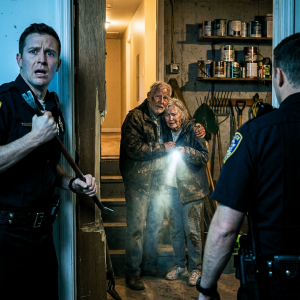
When she arrived, two police officers stood beside Frank. “You think you’re clever? Let’s see how clever you are in cuffs!” he taunted. Zoe’s eyes burned with fury as the officers led her away.

The satisfaction was short-lived. The next day, hurricane winds battered the neighborhood. Preparing to retreat to his basement, Frank spotted Zoe outside, clutching her backpack against the howling storm.