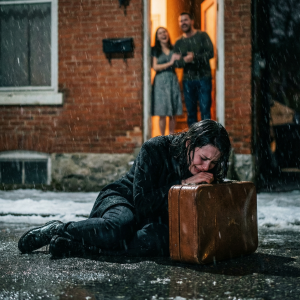
Corinne Fletcher had spent most of her fifty seven years believing her life would always be defined by sterile hospital corridors, late night emergencies, and the echo of her own footsteps in an apartment that never felt like home. She was a physician at a clinic in Silvergrove, Colorado. People in town respected her, but respect was not companionship. Admiration was not warmth. Corinne felt as if she existed behind glass. She could look into other people’s lives, yet she could never find a door that let her enter.
On a humid July afternoon, she was driving back from a medical conference. Her mind drifted between exhaustion and the soft thrum of the radio. The landscape rolled out in wide stretches of farmland and faded barns. Then she saw them. Two elderly figures at the side of the road, sitting on suitcases, thin and slumped as if life itself had deflated them. Corinne slowed. Her heart tugged with something she could not immediately identify. Pity perhaps. Or maybe recognition. She pulled over.
The woman raised her head first. She looked to be around eighty. Her silver hair was braided neatly. The man beside her was older. His hands trembled as he tried to stand.
Corinne stepped out and called, “Are you alright? Do you need help?”
The woman nodded slowly. “Please. My name is Augusta Keller. This is my husband, Raymond. We have nowhere else to go. Our son and daughter told us to leave their home this morning. They said we were a burden.”
Hearing those words felt like being struck. Corinne took a deep breath. “You must be exhausted. Get in the car. I will take you somewhere safe.”
Raymond tried to protest. “We do not want to inconvenience you.”
“You are not inconveniencing me,” Corinne replied. “You need help. Let me help.”
They rode in silence for a while until Augusta spoke again. “We raised our children to be kind. I do not know what went wrong.”
Corinne reached for her hand. “Sometimes people lose their way. It does not mean you deserved what happened.”
She brought them to her home. It was small but clean and filled with the scent of pine from candles she burned to mask the sterility she so despised. She made them tea. She prepared sandwiches. She offered them her guest room.
By the time night arrived, the Kellers were asleep. Corinne sat at her kitchen table and stared at the teacups they had used. Something had shifted inside her. She felt as if fate had opened a door she did not know she had been waiting for.
The next morning, Corinne reached out to a lawyer she trusted. She learned that Augusta and Raymond’s children had tried to seize their house and land by deceit, forging signatures and intimidating them. Their heirs saw profit, not parents. Corinne’s hands shook with anger.
She promised Augusta and Raymond she would help them reclaim what was stolen. She began documenting everything. She gathered statements. She accompanied them to court. She drove them to appointments. The Kellers’ youngest child, Delphine, who lived far away, returned as soon as she heard what had happened. She apologized through tears for not being there sooner.
“I never imagined Preston and Valerie would treat you like this,” Delphine whispered, her voice trembling. “I thought family meant something different.”
Corinne placed a hand on Delphine’s shoulder. “Family is proven by actions, not blood alone.”
Months passed. The legal battle was draining. Preston and Valerie glared at them across the courtroom, their faces twisted with resentment. Corinne gave testimony. She refused to let intimidation silence her.
When the judge finally ruled, his voice carried through the room. “The property and accumulated assets shall remain with Augusta and Raymond Keller. There is clear evidence of coercion and fraudulent intent.”
Augusta wept. Raymond covered his face with calloused hands. Corinne closed her eyes and allowed relief to wash over her. Justice had not arrived swiftly. It had arrived precisely when it was needed.
The Kellers invited Corinne to live with them on their estate just outside Silvergrove. It was a sprawling farmhouse with ivy climbing its porch rails and ancient oak trees lining the gravel drive. Corinne had never experienced a place that felt like the embodiment of peace. She accepted their invitation. Not out of obligation, but out of a sense of home she had long believed she would never know.
The years that followed were full. Corinne learned how to garden. She adopted a stray dog the Kellers named Biscuit. She cooked with Augusta, who taught her how to make blackberry pie that tasted like summer itself. Raymond shared stories from his youth, tales of traveling musicians and harvest festivals, stories that made Corinne feel as if the world was larger and kinder than she had ever allowed herself to believe.
Sometimes Corinne sat on the porch with Delphine, who visited frequently now and often brought her own children. They spoke of gratitude. They spoke of forgiveness, but also of boundaries. They agreed forgiveness did not mean letting someone wound you twice. It meant freeing yourself from the weight of bitterness.
On Corinne’s sixty third birthday, a celebration filled the estate. Music played from an old record player. Laughter rose like fireworks. Augusta embraced her and said, “You saved us, Corinne. You gave us the dignity we thought we had lost.”
Corinne leaned on her cane and replied, “I did not save you. You saved me. You gave me what I needed most. You gave me belonging.”
Delphine wrapped her arms around them both. “You are family. That is all there is to it.”
That night, after the last guest left and the stars glimmered like scattered lanterns, Corinne felt a peace so complete she could scarcely breathe. She whispered into the quiet, “I have lived well. I have loved well. That is enough.”
A year later, on a crisp spring morning, Corinne felt her strength fading. Augusta and Raymond were gone by then, both buried in the small cemetery behind the estate that overlooked acres of wheat fields. Delphine sat beside her bed. “I am here,” she said. “You are not alone.”
Corinne smiled weakly. “I have never been alone. Not since that day on the road.”
Her last thought was gratitude. Gratitude for the moment she chose to stop her car. Gratitude for the family she found. Her final vision was Augusta and Raymond waiting beneath the old oak trees, their arms open, light surrounding them like dawn breaking.
They buried her beside the Kellers, just as she wished. Her tombstone read, “Here rests Corinne Fletcher. She chose to stop.” The simplicity of those words held galaxies of meaning.
As the years passed, the estate remained the heart of the Keller family. Delphine inherited it and cared for it with devotion. Her children and grandchildren learned the story. They learned what it meant to choose love over convenience, justice over silence, compassion over indifference.
Visitors often noticed a display in the main room. A worn medical badge belonging to Corinne. Augusta’s braided ribbon. Raymond’s pocket watch. They were not valuable by any financial measure. They were priceless nonetheless. They represented a legacy of kindness that echoed into generations.
People in Silvergrove still tell the tale. They say that on nights when the moon is full, three figures can be seen sitting on the porch. A man and woman with silver hair. A doctor with a gentle smile. Skeptics claim it is merely reflection or imagination. Those who believe in something more choose to think the Kellers and Corinne are still watching over the land and the people they loved.
Teachers use the story as a lesson. Parents tell it to their children. They say, “Remember to care for those who cared for you. Remember that wealth cannot fill the space where love should be. Remember that even one moment of kindness can change everything.”
Every person who hears the story finds something different in it. Some find hope. Some find warning. Some simply find the reminder that humanity is built on the choices we make when no one is looking.
Corinne Fletcher did not change the world by grand gestures. She changed it by stopping her car when others kept driving. By choosing empathy when it would have been easier to remain detached. By fighting for justice when silence would have cost her nothing.
Her life was proof that ordinary decisions can create extraordinary legacies.
And perhaps that is what matters most. That we choose to stop. That we choose to help. That we choose to love.