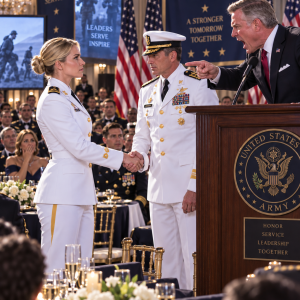
At our first private dinner, Lucas arrived without a driver, assistant, or polished executive demeanor. He resembled the exhausted engineer I had known before success taught him to conceal every vulnerability.
“I miss you, but I understand that missing you does not entitle me to have you back,” he said.
“Do you miss me, or do you miss the systems I quietly maintained around you?”
Instead of defending himself, Lucas carefully considered the question.
“I miss the woman whose work I deliberately stopped recognizing because acknowledging it forced me to confront my dependence,” he said. “My shame became contempt, and that contempt nearly destroyed everything between us.”
We discussed the aircraft without pretending that the chair had created our crisis. Lucas acknowledged that seating Paige beside him in front of thirty-two employees publicly elevated her by diminishing me. Ordering me to move backward transformed private resentment into deliberate humiliation.
“I was angry because the company’s survival no longer felt like my achievement,” he admitted. “Rather than question the story I had created about myself, I punished the one person who knew it was incomplete.”
I refused to reconcile immediately. A marriage could not be repaired through apologies made while the consequences still felt frightening. Lucas began individual counseling, delegated more authority at Wynn Cipher, and publicly corrected the company’s founding history before reporters discovered the conversion independently.
Wynn Cipher officially announced that Bradford Recovery Holdings had preserved the business during a critical period. The statement also acknowledged that the thirteen essential patents had been secured through legal strategies I initiated. My contribution finally became part of the corporate record without diminishing the engineers who developed the technology.
Meanwhile, I established Bradford Horizon Ventures, an independent investment firm supporting talented technical founders without access to conventional capital. It operated separately from Lucas, Wynn Cipher, and my family’s existing offices.
I no longer wanted to exercise influence that had to remain invisible for someone else’s comfort.
Part 7: Rebuilding Partnership Through Honesty

Four months after the confrontation aboard the jet, Lucas and I began structured marriage counseling. Reconciliation would remain possible only if neither of us returned to the arrangement that had created the imbalance.
We established separate professional systems, disclosed every meaningful financial interest, and documented all agreements between our family businesses. Wynn Cipher used regular commercial travel until the company eventually negotiated a new Bradford Atlas contract at full market value.
When Lucas showed me the first invoice, the amount made both of us laugh.
“Apparently, fuel becomes remarkably expensive when affection stops subsidizing it,” he said.
“Transparency may cost more at the beginning, but concealed expenses eventually become far greater,” I replied.
Marlene wrote me a letter acknowledging that she had repeatedly interpreted my discretion as insignificance. I accepted her apology while preserving boundaries that excluded her from our financial and marital decisions.
My father and Catherine respected my decision to consider reconciliation without confusing support with interference. Edward told Lucas directly that rebuilding a marriage required patience rather than a persuasive presentation.
“My daughter is not another company you can rescue through favorable messaging,” he warned. “She will judge your conduct over time.”
Lucas accepted that statement without arguing.
Seven months after our separation, I returned gradually to our Chicago home. There was no dramatic ceremony. We converted the shared office into two independent workspaces, removed Bradford trust correspondence from Lucas’s administrative system, and hired separate professional teams.
Our marriage did not return to its previous form because that version had depended upon my disappearance. Instead, we began building something less romantic in appearance but considerably more honest.
Lucas still buried himself in work whenever anxiety intensified, while I still tried to solve problems before anyone requested assistance. Counseling taught us that those habits were fear responses rather than admirable personal qualities.
“Please ask whether I want help before rearranging the entire world for me,” Lucas said during one discussion.
“Please remember that accepting assistance never gives you permission to erase the person providing it,” I answered.
Those agreements sounded simple, but honoring them required attention every day.
Part 8: The Seat That Finally Became a Choice
Almost one year after the original confrontation, Lucas and I boarded another Bradford Atlas aircraft for a family meeting in Boston. This time, the jet was operating under a fully paid commercial charter connected to a legitimate contract rather than an unspoken marital favor.
No secretary occupied the front-left seat, and no audience of executives waited for Lucas to demonstrate his authority. He paused beside the familiar place and looked at me.
“Do you ever wish you had canceled the flight completely that day?” he asked.
I considered his question while sunlight moved across the cabin windows. Canceling the journey might have offered immediate satisfaction, but allowing the employees to reach Seattle had separated responsible leadership from personal retaliation.
“I do not regret allowing everyone to reach Seattle safely,” I replied. “I regret waiting until humiliation forced me to establish boundaries.”
Lucas nodded and took the seat across the aisle instead of assuming that the place beside me automatically belonged to him.
“Would you like company, or would you prefer to work alone during the flight?”
That question mattered more than any particular chair because it contained something our marriage had lacked for years: choice without entitlement.
I invited him to sit beside me, not because tradition required it or because reconciliation had erased the past. His conduct over many months had gradually restored enough trust for the invitation to feel sincere.
The aircraft began moving while I watched the terminal disappear beyond the window. I had once believed that love required removing every obstacle from another person’s path without allowing them to witness the cost. Lucas had believed that independence required denying every hand that helped him rise.
Both beliefs created the same result: a marriage constructed around invisible accounts neither of us knew how to reconcile.
The confrontation aboard the aircraft did not save our relationship because it exposed my wealth or threatened Lucas’s company. It saved us by ending an arrangement in which my silence protected his pride while his pride consumed my identity.
Paige had mistaken the seat beside a powerful man for evidence that she possessed power. Marlene had mistaken concealed assistance for an attempt at control. Lucas had confused public mythology with personal worth, while I had mistaken self-erasure for unconditional love.
Our second journey could begin only after everyone stopped pretending.
The seat beside Lucas no longer symbolized my place within his empire. It became an invitation I could accept, refuse, or reconsider without sacrificing my dignity.
That freedom became the first honest foundation our marriage had ever possessed.
THE END