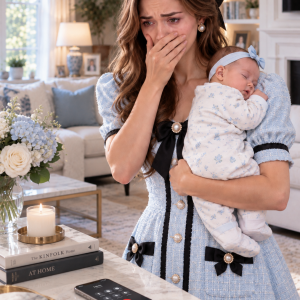
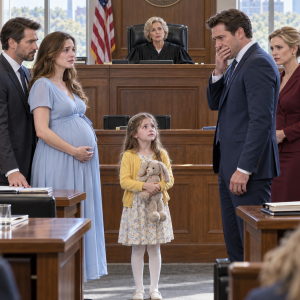
Over the following months, Graham attended every visit, every parenting course, every therapy session, and every court review.
He stopped arriving with expensive gifts.
He brought diapers instead.
Board books.
Formula when requested.
Practical things.
He sold the Barbados villa.
He removed Margaret from the family office after an ugly legal battle and opened Whitaker Meridian Group to an independent ethics investigation.
That investigation exposed misconduct across several healthcare subsidiaries.
Federal investigators became interested.
Graham cooperated anyway.
Eventually, he testified against executives, outside attorneys, and even his own mother.
When Matthew reached his first birthday, Laura hosted a small gathering in Monica’s backyard.
No reporters.
No Whitakers.
No champagne towers.
Only trusted friends, Rebecca, Monica, a blue cake, and one determined toddler trying to crush frosting between his fingers.
Graham brought a wooden whale toy.
The card read:
Matthew Rowan Hayes.
Laura noticed the surname.
She kept the card.
Later, Graham handed her a folder.
Her body immediately stiffened.
“What is that?”
“Signed divorce papers.”
He had accepted every term her attorney requested. Laura retained sole custody, his visitation remained governed by existing orders, Matthew’s trust was expanded, and protections against Margaret became permanent wherever legally possible.
Laura stared at him.
“Why today?”
Graham swallowed.
“Because I kept telling myself I wanted to earn your trust while still benefiting from a legal bond that tied you to me.”
His voice lowered.
“I cannot ask you to believe anything I do while the marriage I destroyed remains attached to your ankle.”
“You want me to sign?”
“No.”
The answer came immediately.
“I want every future conversation you have with me to be voluntary.”
Two weeks later, Laura signed.
The marriage ended.
Graham did not send flowers.
He did not call.
For the first time, he allowed her grief to exist without demanding that it comfort him.
Part 7 – The Daughter Who Had Been Erased

Fourteen months after Matthew’s birth, Rebecca called Laura shortly after six in the morning.
Her voice sounded wrong.
“Sit down.”
Laura did.
Court-ordered access had opened sealed Whitaker family records the previous day.
Among them was evidence that Graham’s deceased father, William Whitaker, had fathered a daughter before marrying Margaret.
Margaret had erased that daughter from family records after William’s death.
Laura’s stomach tightened.
“Who was she?”
Rebecca began crying.
“Me.”
The nurse who had protected Laura during childbirth was Graham’s older half-sister.
Matthew’s aunt.
William had been engaged to Rebecca’s mother before Margaret entered his life. When Rebecca’s mother became pregnant, Margaret’s wealthy family pressured William into a financially advantageous marriage and paid the pregnant woman to disappear.
When William died, Margaret buried whatever remained of the connection.
Rebecca became a maternity nurse partly because her mother had spent a lifetime explaining how powerful families could take children from women with fewer resources and rename coercion as order.
“When Margaret pushed those papers toward you,” Rebecca told Laura, “I was watching my mother’s life happen again with more expensive stationery.”
Additional sealed documents revealed something else.
Before his death, William had attempted to amend the family trust to acknowledge Rebecca.
Margaret and longtime family counsel had concealed the amendment.
Its terms were devastatingly precise: if Margaret deliberately concealed a biological child from the Whitaker inheritance structure, her authority over the family trust would terminate.
It did.
Rebecca received the inheritance withheld from her maternal line.
Money could not restore childhood.
It could at least make the theft visible.
Part 8 – The House Built After Everything Fell Apart
The final restructuring moved significant healthcare assets into patient-protection funds and supported a legal-aid foundation Laura had created for mothers facing coercion during pregnancy and postpartum recovery.
Graham contributed something more personal.
He transferred an old coastal hotel in Cape Elizabeth, Maine, into a charitable trust governed by Laura, Rebecca, and Monica.
The restored property became an inpatient recovery center and legal clinic for women leaving coercive marriages or custody situations.
Graham suggested naming the first room after Matthew.
Laura refused.
“Name it after Rebecca’s mother. She was the first woman your family forced to lose her child.”
One year later, Bellamy House opened above the Atlantic.
Laura attended carrying Matthew on one hip.
Rebecca cried beside the entrance.
Monica controlled reporters with terrifying efficiency.
Graham remained at the edge of the lawn instead of standing beside the ribbon.
Afterward, Laura found him near the path leading toward the ocean.
“I will never become the woman I used to be.”
“I know.”
“I will never become your quiet wife again.”
“I do not want you quiet.”
Laura studied him.
Then she said the words neither had expected.
“I forgive you.”
Graham did not move.
She raised one hand.
“Forgiveness does not erase Barbados. It does not erase the hospital, the unanswered calls, or the marriage you destroyed.”
“I know.”
“It means I refuse to let the worst thing you did remain the center of my life.”
His eyes closed briefly.
“Thank you.”
“That is not an invitation.”
“I know.”
Laura looked toward Matthew, who was trying to convince Rebecca to eat a leaf.
Then she looked back.
“But it is not a locked door either.”
Graham forgot how to breathe.
“Coffee,” Laura said. “Next Sunday in Burlington. One hour. No lawyers, no gifts, no speeches, and no asking me to come home.”
His face tightened briefly.
“I do not have a home to ask you back to.”
Laura looked toward Bellamy House, then toward their son.
“Good. This time, build one properly.”
Years later, Matthew would ask why his surname was Hayes rather than Whitaker.
Laura would tell him gradually.
She would explain that names were not cages and that his father had missed the beginning of his life but worked very hard not to miss the rest.
She would tell him that Aunt Rebecca heard his first cry when nobody else in Graham’s family had earned the right to hear it.
Most importantly, she would teach him that sometimes a mother leaves not because she has stopped loving.
Sometimes she leaves because love has finally learned how to protect itself.
Inside Bellamy House, beside the room bearing Rebecca’s mother’s name, a small plaque would eventually read:
For every woman handed paperwork while she was bleeding.
For every child born where power arrived carrying documents.
For every truth that survived because one woman refused to say yes.
One day, an older Matthew would read those words and ask Graham:
“Did you build this place?”
Graham would answer before Laura needed to.
“No.”
He would look at his son.
“Your mother did.”
Then, after a moment, he would add the truth that had taken him years to understand.
“I finally learned how to stop standing in her way.”
THE END