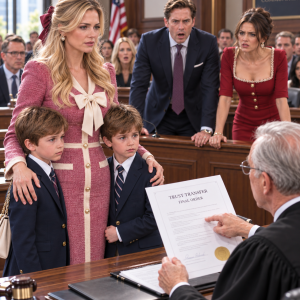
Daniel initially argued that years of living in the property gave him a marital claim despite the trust and postnuptial agreement.
His attorney abandoned that position after reading the documents Daniel himself had signed.
The house had been purchased entirely with premarital inheritance funds and later transferred into a properly structured trust preserving its separate status.
Daniel’s signature appeared repeatedly beneath disclosures stating exactly that.
His attorney also discovered the debt provisions.
Personal obligations created without mutual approval remained the responsibility of the spouse who incurred them.
Daniel had signed that clause too.
During mediation, he looked at the agreement as if someone had replaced the pages after the fact.
“I never understood that this is what it said.”
Melissa remained expressionless.
“You were advised in writing to obtain independent counsel before signing.”
Daniel looked toward me.
“You knew I would not read it.”
I almost admired the accusation.
“I told you to read every page.”
“You should have explained it more clearly.”
“I did.”
He leaned back.
That was another pattern I recognized only after leaving him.
Every consequence eventually became evidence that somebody else had failed Daniel.
Margaret claimed the assault had been provoked by stress over losing her apartment.
Her attorney tried framing it as an isolated family confrontation.
The security recording made that difficult.
The footage showed me speaking calmly.
It showed Margaret moving toward me.
It showed the slap.
It also showed Daniel watching silently before telling me to leave.
Tyler’s financial problems unfolded separately.
His customization shop collapsed under loan payments, unpaid suppliers, and debt accumulated before opening.
Without Daniel quietly feeding it additional money, it could not survive.
Tyler eventually accepted technical work at a tire and repair shop.
I felt no satisfaction about that.
Working honestly to repay debt was probably the most useful thing he had done in years.
What mattered more was recovering what could be traced.
The forensic accountant reconstructed nearly every transfer.
Some money was recoverable.
Some had already disappeared into interest payments, failed business expenses, gambling losses, or purchases with little resale value.
I had to accept that protecting myself did not mean magically reversing every loss.
It meant ensuring the losses stopped.
That distinction became unexpectedly freeing.
Part 5 – Three Months Later

The divorce was finalized roughly three months after the confrontation.
Daniel assumed responsibility for the personal debts he had incurred and the unauthorized obligations connected to his relatives.
Margaret faced consequences for the assault, including court-ordered behavioral counseling and a protective order preventing her from approaching me.
Tyler’s business formally failed.
Daniel moved into a small studio apartment.
Margaret ended up living with a cousin who, unlike Daniel, required her to pay rent every month.
I remained in the house.
For the first several weeks, I struggled with the silence.
I would occasionally hear a sound from the garage and instinctively expect Tyler’s tools.
Sometimes I walked past the guest suite and remembered Margaret’s perfume.
Once, while working late, I caught myself listening for Daniel’s key at the front door.
Then I began changing things.
Not because the house needed renovating.
Because I did.
I transformed the former guest room into a bright library filled with books that had belonged to my father.
His old leather chair went beside the window.
Photographs I had stored for years finally appeared on the shelves.
The garage required more work.
Oil stains covered parts of the floor where Tyler had worked on motorcycles.
After cleaning everything, I replaced one exterior wall with broad glass doors overlooking the garden.
The room became a small painting studio.
I was terrible at painting.
That was part of why I liked it.
Nothing about it needed to be productive.
Nobody needed me to monetize it, justify it, or explain why the room existed.
It existed because I wanted it.
Six months after the slap, rain moved across Raleigh while I sat in the library drinking coffee.
My phone vibrated.
Daniel.
I considered ignoring it completely, but curiosity won.
His message contained only two sentences.
I am sorry. I should have protected you.
I read the words several times.
Months earlier, I had imagined receiving an apology like that.
I expected anger.
Maybe satisfaction.
Perhaps some complicated urge to explain everything he had done wrong.
Instead, I felt tired for approximately five seconds.
Then nothing.
Daniel finally understood one small piece of what happened.
That understanding belonged to him now.
It was not my responsibility to reward it.
I deleted the message.
Then I opened the glass doors leading from the studio toward the garden.
Cool air moved through the house.
For years, Daniel had convinced me that boundaries were proof of selfishness.
Whenever I questioned financial activity, I was controlling.
Whenever I protected an inheritance my father had spent his life building, I was obsessed with money.
Whenever I wanted privacy in my office, I was territorial.
Whenever his family crossed another line, I was supposedly making relationships difficult.
The greatest damage had not been the missing money.
It was the way I had slowly begun wondering whether protecting myself made me unreasonable.
Margaret’s slap ended that confusion.
Not because violence gave me courage.
Because Daniel’s reaction finally showed me exactly how much peace in that marriage had always cost.
My silence.
My space.
My money.
My boundaries.
Eventually, perhaps my dignity.
I was no longer willing to pay.
The rain softened into a quiet mist over the garden.
I stood inside the house my father’s work had made possible and listened to the absence of shouting.
Nobody occupied rooms without permission.
Nobody treated my belongings as communal property simply because they wanted them.
Nobody demanded that I disappear so somebody else could avoid discomfort.
For the first time in years, locking my own front door did not feel defensive.
It felt ordinary.
That was what safety was supposed to feel like.
Not dramatic.
Not victorious.
Simply mine.
A house becomes a home when the people inside respect the person who owns the key.
And sometimes the most important thing you can do with that key is finally decide who no longer gets through the door.
THE END