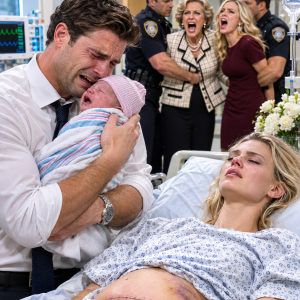
I shook my head.
He looked toward the window.
“There are things connected with my father’s work that should have been investigated decades ago. I need time to establish exactly what happened.”
I refused to accept another vague promise.
“My wife died in your hospital, and you’re telling me your father may have been involved in something she was investigating. I need the truth.”
Benjamin nodded.
“Then you deserve records, independent verification, and answers that don’t depend entirely on my family’s account.”
He gave me contact information for the hospital’s independent review team.
Before leaving, he mentioned a retired research associate named Thomas Mercer.
The name appeared in Elizabeth’s notebook.
Another clue had surfaced.
Part 3: The Daughters Who Were Separated

Thomas Mercer arrived at my home two days later.
He carried an old leather briefcase and looked like a man who had spent decades rehearsing an apology.
Margaret was visiting when he arrived.
The moment she saw him, her expression changed.
“I recognize you. You were working at the hospital when Elizabeth was born.”
Thomas lowered his head.
“I was involved with the obstetric vascular research program. I also knew what Samuel Whitmore did afterward.”
Margaret gripped the back of a chair.
Thirty-one years earlier, she had delivered a daughter who died following a severe placental complication.
Around the same time, Caroline Reynolds, a young patient participating in the research program, gave birth to twin girls.
Caroline experienced life-threatening bleeding.
During the confusion, Samuel Whitmore arranged an unauthorized exchange.
Margaret was given one of Caroline’s daughters and told the child was her own.
Caroline was informed that one twin had died.
The other girl, Rebecca, remained with her biological mother.
The infant Margaret raised became my wife, Elizabeth.
I struggled to absorb the explanation.
“You’re telling me Elizabeth had a living twin sister, and everyone allowed both families to believe one child had died?”
Thomas nodded.
“Samuel made a decision that cannot be justified. Others suspected what happened, but fear of professional consequences and legal exposure kept them silent.”
Margaret began sobbing.
She had spent thirty-one years believing Elizabeth was the baby she’d delivered.
Now she learned that her biological daughter had died and another woman’s child had been placed in her arms.
Yet the revelation didn’t erase the years she’d spent loving Elizabeth.
“She was my daughter,” Margaret whispered. “Whatever those records say, I raised her, and I loved her every day of her life.”
Thomas agreed.
He explained that Caroline’s twins carried an inherited vascular marker being studied by Samuel’s research team.
Elizabeth’s medical condition was connected to that biological history.
She had begun discovering inconsistencies after her earlier pregnancy emergency, when her medical records became entangled with historical research files.
The review had led her to Samuel.
According to Thomas, Samuel feared that exposure would destroy his reputation.
When Elizabeth challenged him, records were altered, and a misleading prenatal report was generated.
Thomas admitted that he had delayed coming forward because he feared responsibility for remaining silent.
I wanted to throw him out.
Instead, I asked one question.
“Did Samuel cause Elizabeth’s death?”
Thomas shook his head.
“I don’t have evidence that he caused her medical emergency. Concealing information was wrong, but that doesn’t establish that he deliberately harmed her.”
Benjamin later confirmed that the hospital was reviewing both the falsified records and the treatment Elizabeth received.
The distinction mattered.
I wanted accountability.
But I couldn’t allow grief to become an excuse for accusing someone of murder without evidence.
Thomas left me an old photograph showing Samuel, Margaret, Caroline, and himself outside the research department.
On its reverse, a handwritten note referred to the original study.
Then he gave me a bank document.
Elizabeth had rented a safe-deposit box shortly before her death.
The box number was 214.
Part 4: The Woman Elizabeth Never Met
At the bank, I opened the box using the authorization Elizabeth had arranged before delivery.
Inside were medical documents, photographs, a sealed letter, and a USB drive.
The video file was labeled with her name.
I watched it alone.
Elizabeth appeared on our bedroom sofa, visibly pregnant and exhausted.
“Hello, Nathan. If you’re watching this, something terrible probably happened, and I’m very angry that my backup plan became necessary.”
I began crying before she finished.
She explained her investigation into the duplicate records, the research program, and her suspected biological relationship with Caroline and Rebecca.
Then she corrected something she’d written in her earlier letter.
Her first pregnancy emergency had been an ectopic pregnancy rather than the miscarriage initially recorded in her chart.
The incorrect diagnosis had resulted from confused medical coding associated with the duplicate records.
The pregnancy could not have developed normally.
Elizabeth described the grief of losing it and the anger of discovering that an administrative mistake had distorted her understanding of what happened.
Then she spoke about our daughters.
“I signed my medical instructions because I wanted the doctors to understand my wishes. You did not choose my death, Nathan, and I never wanted you carrying that burden.”
She acknowledged that Samuel had manipulated documents and hidden her origins.
But she also cautioned me against treating every tragedy as evidence of deliberate violence.
“Sometimes frightened people make terrible decisions, and the consequences reach children who never deserved to inherit them.”
I replayed the video until her voice became almost unbearable to hear.
When I left the bank, Benjamin was waiting.
He handed me newly verified DNA results.
Samuel Whitmore was the biological father of both Elizabeth and Rebecca.
The retired physician had fathered Caroline’s twins while she was connected with his medical practice and research program.
Benjamin admitted he could not determine whether Caroline had been pressured or exploited without hearing her account.
Samuel’s relationship with a much younger patient raised serious ethical questions.
The DNA results, however, established the twins’ biological parentage.
A day later, Benjamin took me to visit his father.
Samuel was eighty-seven and living in a care facility.
He was physically frail, although he experienced occasional periods of clarity.
When I asked why he’d exchanged the infants, he cried.
“Margaret believed her child was alive, Caroline was unconscious, and I panicked when one infant was dying. I convinced myself I could explain everything the next morning.”
But he hadn’t.
One morning became thirty-one years.
He had built his professional life upon a decision that separated sisters and deprived two mothers of the truth.
“Elizabeth never had the chance to forgive you,” I told him. “You don’t get to ask me to offer forgiveness in her place.”
Then I left.
That evening, I showed Margaret the DNA results.
She cried for Elizabeth, for the daughter she’d lost at birth, and for Rebecca, who had grown up without knowing she had a sister.
Before we finished talking, my telephone rang.
“My name is Rebecca Hale,” a woman said. “I believe your wife was my twin sister.”
Part 5: A Family Reassembled

Rebecca visited two days later.
She didn’t look exactly like Elizabeth, but she had the same delicate facial expressions and the same habit of tucking loose hair behind one ear.
When she saw Elizabeth’s photograph in our living room, she began crying.
Margaret stepped forward.