Part 1: The Seat He Ordered Me to Give Up
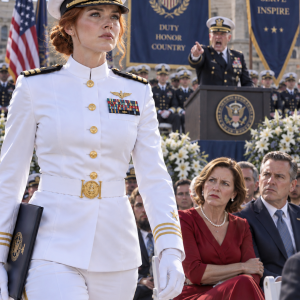
The moment I stepped into the first-class cabin of the chartered jet, I stopped beside the entrance. Another woman was sitting in the seat I had occupied throughout six years of marriage.
Paige Foster, the executive secretary my husband had hired three months earlier, leaned toward Lucas Wynn while offering him peeled segments of blood orange from a porcelain dish. When she noticed me, she gave an exaggerated gasp and dropped one piece onto his trousers. Instead of moving away, she casually brushed his thigh with such familiarity that several nearby executives immediately fell silent.
“I’m terribly sorry, Mr. Wynn. Turbulence always makes my hands unsteady,” she murmured.
Lucas looked at me with irritation rather than embarrassment. As the founder and chief executive officer of Wynn Cipher Systems, he had perfected the commanding expression that encouraged investors to mistake impatience for intelligence.
“Paige becomes extremely airsick in the rear cabin, so I promised she could sit here,” he said. “Take one of the empty seats in row six and stop delaying the flight.”
Before I could respond, his mother, Marlene Wynn, interrupted from the seat behind him.
“Evelyn, this young woman worked until three in the morning preparing Lucas’s presentation,” she said. “Showing a little consideration will not diminish your importance. There is no need to embarrass everyone over a chair.”
Nobody aboard the aircraft knew the complete history of Wynn Cipher Systems. The business press portrayed Lucas as a self-made technology genius who had turned an obscure data-compression theory into an international licensing empire. Journalists generally described me as Evelyn Bradford Wynn, the privileged daughter of a wealthy investment family who had benefited from her husband’s achievements.
They did not know that thirteen foundational patents existed because I had introduced Lucas to specialized intellectual-property attorneys when he was still an unknown engineer. They also did not know that my family trust had quietly transferred $1.5 billion into a rescue structure when Wynn Cipher came dangerously close to collapse five years earlier.
I had concealed my contributions because Lucas’s father abandoned him during adolescence, leaving him painfully sensitive about depending upon anyone. I believed that supporting him invisibly would preserve his dignity and protect the equality within our marriage.
Over time, however, Lucas stopped interpreting my silence as generosity. He began treating it as proof that I had never contributed anything meaningful.
“Must you challenge me in front of thirty-two employees, Evelyn?” he asked. “For once, understand your position and behave accordingly.”
Something inside me became unexpectedly still. I stepped backward, adjusted the strap of my handbag, and looked directly at him.
“I understand my position perfectly, Lucas,” I answered. “That is exactly why I will not compete for a seat.”
Then I turned toward the aircraft door while everyone behind me assumed humiliation had driven me away.
Part 2: The Jet He Had Forgotten Belonged to My Family
Rosa Delgado, the senior flight attendant, followed me into the boarding corridor before I reached the terminal. She had worked for my family’s aviation company for nearly twelve years and understood that my departure created more than a seating inconvenience.
“Would you like operations to cancel the flight, Mrs. Wynn?” she asked quietly.
Every conversation inside the cabin stopped. Lucas turned toward us, Paige froze with one hand suspended above the dish of oranges, and Marlene stared at Rosa as though a flight attendant had suddenly challenged the natural order of authority.
The jet belonged to Bradford Atlas Aviation, a private company owned by my family trust long before I met Lucas. Wynn Cipher enjoyed international travel privileges through an executive program I had approved four years earlier. Those benefits included subsidized fuel, priority crews, flexible scheduling, hangar services, and reduced maintenance costs.
Lucas remembered that my family had arranged the access, but years of effortless service had transformed generosity into an entitlement he considered permanent.
“Do not cancel the flight,” I told Rosa. “Everyone should still reach Seattle safely. Convert today’s journey into a standard commercial charter and invoice Wynn Cipher at the current corporate rate.”
Relief briefly crossed Lucas’s face, but it disappeared when I continued.
“Remove every Bradford family subsidy from today’s flight, then suspend the executive aviation agreement after the aircraft lands.”
I opened the authorization application on my phone, reviewed the stated consequences, and selected the suspension option. Rosa received confirmation almost immediately through her company device.
“The account has been updated,” she announced professionally. “All future flights will require advance payment.”
Lucas stood and stepped into the aisle, his arrogance replaced by visible confusion.
“You cannot withdraw an operational resource because we disagreed about a seat,” he protested.
“This aircraft was never an operational resource owned by Wynn Cipher,” I replied. “It was a privilege extended by my company.”
Paige looked between us before finally asking what everyone else seemed afraid to say.
“Does your family actually own this jet?”
“Bradford Atlas operates the entire fleet,” I answered. “The agreement existed long before you joined Lucas’s office.”
Marlene demanded to know when such an arrangement had begun. Her disbelief nearly made me laugh because she had used the aircraft repeatedly while treating me like an ornamental passenger.
“The aviation company existed before Lucas and I met,” I explained.
Lucas accused me of hiding important information, but I reminded him that both our signatures appeared on the original agreement. He insisted that his finance department had described the program as executive fleet access rather than a personal family subsidy.
“You heard the version that allowed you to forget the difference,” I said. “This discussion should continue privately.”
I instructed Rosa to complete the trip safely, then left without waiting for Lucas. At the terminal entrance, my driver opened the rear door and asked whether we were returning to my marital home in Chicago.
I looked back at the white aircraft gleaming beneath the September sunlight.
“Take me to the Bradford estate near Lake Geneva,” I replied.
Part 3: What My Father Had Never Forgotten

My father was examining roses inside the greenhouse when I arrived. At seventy, Edward Bradford employed three professional gardeners, but he still inspected every plant personally because retirement had never suited him.
He removed his gloves when he saw me approaching.
“You have not appeared unexpectedly on a weekday since you resigned from the museum board at twenty-six,” he observed. “Since that was nine years ago, I assume something serious brought you home.”
We sat in the breakfast room with tea because my father believed alcohol complicated sorrow rather than curing it. He listened without interrupting while I described Paige, the stolen seat, Marlene’s criticism, and Lucas ordering me to understand my position.
“The dispute was never actually about a chair,” I said.
“Conflicts involving dignity rarely concern the object everyone can see,” my father replied.
He asked whether I had suspended Wynn Cipher’s aviation agreement, and I wondered how he had learned so quickly.