The Boy Everyone Walked Past
Nine-year-old Noah Bennett stood behind a crowded restaurant in Nashville, Tennessee, holding a paper bag that someone else had thrown away.
Inside was half a sandwich and a handful of cold fries.
His sneakers were worn thin at the toes, and the sleeves of his faded gray shirt were slightly too short for him. Around him, downtown Nashville moved through another busy Saturday afternoon. Cars rolled past. Families hurried toward restaurants. People laughed as they checked their phones.
Most of them never noticed Noah.
Those who did usually looked away.
Inside Hawthorne Kitchen, nine-year-old Caleb Whitmore was sitting across from his father when he happened to glance through the window.
Caleb stopped chewing.
His father, Graham Whitmore, noticed immediately.
“What is it?”
Caleb pointed discreetly toward the side alley.
“Dad, look.”
Graham followed his son’s gaze.
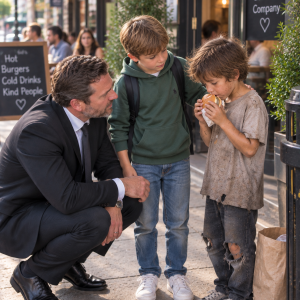
He saw Noah carefully removing the cold fries from the discarded bag.
For several seconds, Graham said nothing.
Then Caleb pushed his plate away.
“Can we help him?”
Graham looked at his son.
Caleb wasn’t asking for dessert or another drink. His expression carried the uncomfortable seriousness of a child who had just realized that another child his own age lived in a completely different world.
Graham placed his phone on the table.
“Come with me.”
A Seat at the Table
When Graham and Caleb approached, Noah immediately stepped backward.
He held the paper bag close to his chest.
Graham stopped several feet away.
“Hey. I’m Graham. This is my son, Caleb.”
Noah watched them suspiciously.
“What’s your name?”
After a long hesitation, he answered.
“Noah.”
Graham nodded toward the restaurant.
“Have you eaten today, Noah?”
Noah looked down.
That was enough of an answer.
“Come inside and have lunch with us.”
Noah’s eyes moved toward the restaurant window.
The people inside wore clean clothes. Plates covered the tables. Servers moved through the room carrying glasses filled with ice.
Then Noah looked down at himself.
“I can’t go in there.”
Caleb frowned.
“Why not?”
Noah glanced at his worn sneakers.
Caleb understood.
He stepped beside him.
“You’re sitting with us. Nobody cares about your shoes.”
For the first time, Noah looked directly at Caleb.
Something about hearing those words from another nine-year-old made him believe them.
He followed them inside.
Graham ordered him chicken, potatoes, vegetables, bread, and lemonade.
When the bread arrived first, Noah ate one roll almost immediately. Then he stopped, embarrassed by how quickly he had eaten.
Caleb pretended to be fascinated by something outside the window.
Graham noticed the small gesture and felt unexpectedly proud.
When Noah’s meal arrived, the boy stared at it.
Then he looked at Graham.
“Why are you buying me food?”
Graham answered quietly.
“Because you were hungry.”
Noah seemed confused by the simplicity of the answer.
“You don’t know me.”
“I don’t have to know everything about you to know you deserve lunch.”
Noah lowered his eyes and began eating.
The Uncle Who Was Trying
Graham waited until Noah had nearly finished before asking where he lived.
“With my uncle Dean.”
“Where’s your uncle today?”
“Working.”
Noah explained that Dean worked temporary loading jobs near an industrial park south of the city.
Some weeks he worked mornings.
Other weeks nights.
Sometimes there were enough hours.
Sometimes there weren’t.
Then Graham gently asked about Noah’s parents.
Noah became quiet.
His mother, Rachel, had passed away the previous winter after a long illness.
His father had disappeared years earlier.
At least, that was what Noah had always been told.
“Uncle Dean takes care of me,” Noah said quickly. “He’s not bad. He tries really hard.”
Graham heard the defensiveness in the boy’s voice.
“I believe you.”
Noah looked surprised.
“Sometimes he doesn’t eat dinner so I can.”
Graham looked down at the table.
That sentence stayed with him.
He asked for Dean’s phone number.
When Graham called, a tired voice answered.
The moment Dean learned where Noah was, panic filled his voice.
“Is he all right?”
“He’s safe,” Graham assured him. “He’s sitting beside me right now.”
Dean released a long breath.
“I finish at six-thirty. I’ll come straight there.”
Before ending the call, Graham asked one more question.
“Dean, what exactly do you do for work?”
The answer changed the direction of the entire afternoon.
An Opportunity, Not Charity
Graham Whitmore owned Whitmore Freight Solutions, a regional transportation company with distribution centers across Tennessee and Kentucky.
He knew warehouses.
More importantly, he knew how difficult it was to find dependable employees willing to work demanding schedules.
Dean had spent years doing exactly that without the security of a permanent position.
Graham called his operations director.
“Do we still need someone for the Antioch distribution team?”
“Yes. We’re interviewing next week.”
“Move one interview to tomorrow morning.”
“For whom?”
Graham looked across the table at Noah.
“Dean Bennett.”
He paused.
“Full-time schedule. Benefits. Standard company wage. He goes through the same interview and screening as everyone else.”
After ending the call, Noah stared at him.
“Are you giving Uncle Dean a job?”
“No.”
Noah’s expression fell.
Graham smiled slightly.