“Who?”
She hesitated.
“Victor Langford.”
The Man With the Silver Ring
Victor stood in the lobby wearing an expensive charcoal suit.
The silver ring was still on his hand.
Graham approached him.
“You shouldn’t be here.”
Victor smiled.
“I thought we should talk privately.”
“There won’t be anything private about this.”
Victor’s smile weakened.
Graham had already contacted his attorney and the appropriate investigators after discovering the questionable documents.
“You became careless, Victor.”
Victor’s expression hardened.
“You don’t understand what’s involved.”
“Then explain why a nine-year-old child was photographed outside his home.”
Victor didn’t answer directly.
Instead, he said something unexpected.
“The house isn’t the only reason that family matters.”
Graham stared at him.
“What does that mean?”
Victor glanced toward Dean, who had entered the lobby.
“Ask him what his sister left behind.”
Dean froze.
“Rachel?”
Victor said nothing more.
Minutes later, investigators arrived to speak with him regarding the property records and disputed signatures.
As Victor was escorted away for questioning, Noah stood close to his uncle.
He didn’t understand every legal detail.
But he understood that the man with the silver ring was finally being questioned by people who could protect their family.
The Envelope Rachel Left Behind
That evening, Dean searched through Rachel’s belongings.
Most had remained untouched since her passing.
Inside an old wooden sewing box, he discovered an envelope hidden beneath the fabric lining.
Written across the front were the words:
FOR NOAH — WHEN THE TIME IS RIGHT.
Inside was a letter and a small brass key.
Dean’s hands trembled.
He read the letter twice before calling Graham.
When Graham arrived, Noah was sitting beside his uncle.
“What’s happening?” Noah asked.
Dean couldn’t speak.
So Graham carefully read the letter.
Rachel had known someone was interested in documents connected to the neighborhood.
But that wasn’t the most important part.
The final paragraph concerned Noah’s father.
Noah had spent years believing his father simply walked away.
Rachel’s letter told a different story.
According to her, Noah’s father had discovered irregular property dealings and became frightened after receiving repeated warnings to stay quiet.
He left to protect his family and later lost contact with Rachel.
She had never been able to prove exactly what happened afterward.
But she wanted Noah to know one thing.
His father had not left because he didn’t love him.
Noah stared at Graham.
“So he didn’t just leave me?”
Dean pulled his nephew close.
“No, buddy.”
Noah’s eyes filled.
“I thought I wasn’t important enough for him to stay.”
Dean held him tighter.
“You were always important.”
Caleb, sitting nearby, reached for Noah’s hand.
“You’re important now too.”
The Door That Finally Opened
Several weeks later, Dean earned the warehouse position.
He didn’t receive special treatment.
He completed training, learned the systems, and quickly became one of the most dependable members of his shift.
For the first time in years, he knew exactly how many hours he would work each week.
The refrigerator stayed full.
Bills were paid on time.
And Noah stopped worrying about where his next meal would come from.
The disputed property documents were turned over to professionals for review, and the questionable transfer involving Dean’s home was challenged.
The family remained there while the matter was resolved.
Graham also changed something inside his company.
He created an employee assistance initiative designed to connect workers facing temporary hardship with food resources, housing guidance, emergency support, and financial counseling.
He called it the Open Door Initiative.
Caleb understood the name immediately.
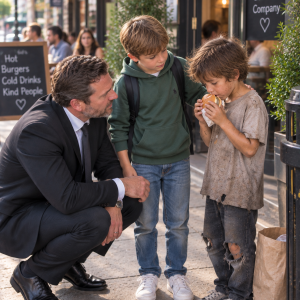
Months later, Graham took Caleb, Noah, and Dean back to Hawthorne Kitchen.
Noah wore clean sneakers and a blue button-down shirt.
A full meal sat in front of him.
Halfway through lunch, he looked at Caleb.
“Do you know what I remember about the first day we met?”
Caleb grinned.
“My dad ordering way too much food?”
Noah laughed.
“No.”
He became serious.
“You didn’t look at me like there was something wrong with me.”
Caleb shrugged.
“You were just a kid who needed lunch.”
Noah smiled.
Graham watched the two boys talking.
Months earlier, hundreds of people had passed Noah without stopping.
Graham had believed he was simply buying a hungry child a meal.
Instead, that decision helped a hardworking uncle find stability, brought questionable property dealings to light, protected a family’s home, and uncovered a truth Noah desperately needed to hear about his father.
Sometimes changing someone’s life doesn’t begin with a grand gesture.
Sometimes it begins when one person notices what everyone else has learned to ignore.
Sometimes the most meaningful thing we can do is stop, look someone in the eyes, and make room for them at the table.
A person’s hardest season should never become the label we use to define their entire life, because behind worn clothes, unpaid bills, or an empty refrigerator may be someone working harder than anyone around them realizes.
Real kindness does not always mean handing someone money; sometimes the most respectful form of help is creating a fair opportunity that allows them to rebuild their life with dignity.
Children remember far more than the things adults buy for them, because they also remember who noticed their sadness, who protected their dignity, and who treated them as though they truly belonged.
We should be careful before judging struggling parents or caregivers, because many people who appear to be falling behind are quietly sacrificing their own comfort every day to keep someone they love safe.
One compassionate decision can travel much farther than we imagine, touching not only the person directly in front of us but also families, workplaces, friendships, and people we may never meet.
Being successful means very little if we become so busy protecting what we have built that we stop noticing the people standing right outside our window who simply need someone to see them.
Helping someone does not require becoming the hero of their story, because sometimes the most powerful thing we can do is open a door and allow them to prove what they were capable of all along.
A child should never grow up believing that hardship makes them less worthy of respect, because circumstances can change quickly while the value of a human being never depends on the clothes they wear or the money their family has.
The truth may remain hidden for years, but patience, courage, careful questions, and people willing to stand beside one another can eventually bring clarity to wounds that once seemed impossible to understand.
Never underestimate the importance of simply stopping when everyone else keeps walking, because the moment you choose to notice another person may become the moment they finally realize they are not invisible, forgotten, or alone.