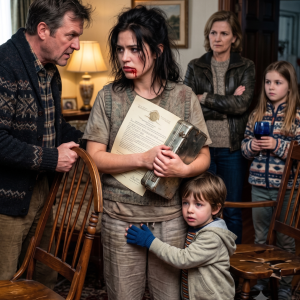
“My name is Malcolm Ashford, and I was Adrian Benton’s father.”
The room became silent.
“For years, I believed my son’s talent was something he would eventually outgrow. I wanted a businessman. I wanted a successor. Adrian wanted to be an artist.”
He looked toward Callie and June.
“He left my house, built a family, became a husband, became a father, and became the artist he told me he would become. I missed all of it.”
His voice weakened.
“I would like to tell you that I found my lost family. But that would make this story easier than it deserves to be. I cannot get my son back. I cannot ask him to forgive me.”
Then Malcolm pointed toward the paintings.
“What I can do is stop pretending his life mattered only because he was an Ashford. This was Adrian Benton. This was his work. And that little girl is his daughter—my granddaughter.”
The Man Who Feared Losing Everything
A slow clap came from the entrance.
Derek stood there.
“Beautiful speech.”
Callie instinctively pulled June closer.
Derek looked around at the guests.
“You forgot the part where the housekeeper suddenly became part of one of Connecticut’s wealthiest families.”
Malcolm did not raise his voice.
“Leave.”
Derek laughed.
“You really believe all this?”
Samuel stepped forward.
“The legal records have been verified. The family relationship has been confirmed. And your recent communications concerning the paintings have been preserved.”
Derek’s expression changed.
Malcolm looked directly at him.
“I spent too many years deciding what everyone else should be. I’m not doing it anymore. Whatever questions remain will be handled properly. But you will no longer represent my companies, and you will not contact Callie or June.”
Derek turned toward Callie.
“You arrived with nothing.”
Callie finally answered.
“I arrived without money. That isn’t the same as arriving with nothing.”
She looked around at Adrian’s paintings.
“I brought the part of this family everyone else had forgotten.”
Derek had no answer.
Too Late for a Son, but Not for a Granddaughter
Over the following months, Malcolm reorganized parts of his estate.
Callie established boundaries.
June would remain June Benton.
Adrian’s paintings would remain with his wife and daughter.
Any educational support for June would be placed into a carefully managed trust.
Most importantly, affection would never be purchased.
Callie did not move into Malcolm’s mansion.
Instead, she rented a modest apartment closer to Greenwich so June could gradually know her grandfather.
“She needs a grandfather,” Callie told Malcolm. “She doesn’t need another person controlling her life.”
“I understand.”
And for once, he truly seemed to.
Adrian’s exhibition eventually became a permanent collection, and Callie began helping the gallery organize programs for talented young artists who lacked connections or financial support.
One afternoon, Malcolm found her standing before Adrian’s portrait.
“I’ve changed contracts, accounts, business plans, and my will,” he said. “But there’s one thing paperwork can’t fix.”
“What?”
“The years I chose pride over my son.”
Callie looked across the room.
June was sitting on the floor drawing.
“Then what are you going to do with that regret?”
Malcolm watched his granddaughter.
“Live differently enough that she never has to wonder whether her grandfather wanted her.”
Callie nodded slowly.
“Adrian would have wanted to hear that.”
“I know.”
“But you’re too late to tell him.”
Malcolm’s eyes lowered.
“I know that too.”
A moment later, June came running toward them.
“Grandpa!”
Malcolm still seemed surprised whenever she called him that.
June walked toward the small memorial display containing Adrian’s old brushes and sketchbooks.
There was an empty shelf beneath one of his paintings.
She placed a brand-new pencil on it.
Malcolm crouched beside her.
“What’s that for?”
June smiled.
“For Daddy.”
“Why does he need a new pencil?”
She looked at her father’s paintings.
“So he can keep drawing wherever he is.”
Malcolm’s eyes filled with emotion.
After a moment, he asked, “Do you think your dad would like this place?”
June considered the question with the seriousness only a child could give it.
Then she nodded.
“Yes.”
“Why?”
June looked around the bright gallery.
“Because nobody is hiding him anymore.”
Callie turned away for a moment.
That was when she finally understood something.
A happy ending did not erase what had happened.
Adrian was still gone.
Malcolm would never recover the years he had thrown away.
June would eventually grow old enough to understand why her father had stayed away from the family into which he had been born.
But Adrian’s paintings were no longer packed inside dusty boxes.
His daughter could speak his name proudly.
And a man who had once confused love with obedience had finally learned that family was not preserved by forcing people to become what you wanted.
Sometimes love meant opening the door without conditions.
Malcolm had learned that lesson too late for his son.
But perhaps, Callie thought as she watched June place her small hand inside her grandfather’s, it was not too late for the next generation.
Sometimes the deepest distance between two people is not created by miles, but by the moment one person makes the other feel that love must be earned through obedience.
Parents may dream about their children’s futures, but loving them also means accepting that their dreams may lead toward a completely different life.
Pride can feel powerful while we are holding onto it, yet years later it may become the heaviest thing we carry when we realize what it cost us.
Money can provide comfort, opportunity, and security, but it cannot purchase back an ordinary afternoon with someone who is no longer there to share it.
A sincere apology matters, but the strongest apology is often found in the way a person chooses to behave differently when life gives them another chance.
Children should never have to carry the unfinished arguments of previous generations, because they deserve relationships built on kindness rather than inherited resentment.
A person’s worth is not determined by the surname they carry, the house they live in, the profession they choose, or the amount of money attached to their name.
Sometimes honoring someone means more than remembering them privately; it means allowing the world to finally see the talent, love, and goodness that others once refused to recognize.
We cannot rewrite yesterday, but we can decide whether yesterday’s mistakes will continue shaping every relationship we have tomorrow.
Keep the door open for the people you love, because there may come a day when you would give everything you own simply to hear them knocking on it one more time.