The Question at the Christmas Table

My seven-year-old daughter was still crying when my brother told us to leave, and my father sat beneath the Christmas garland with his eyes fixed on his plate, as if the safest thing he could do was pretend none of us were in the room.
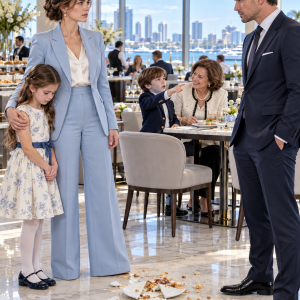
I had one arm around Maisie and her coat gathered in my other hand. Behind us, the dining room at Birchmere Inn shimmered with candlelight and polished silver, while a casserole lay tipped across the tablecloth, its contents spread over the place settings and onto the floor. My mother stood rigid beside her chair, my brother’s face was flushed with anger, and somewhere in the next room a Christmas record kept playing softly, cheerful enough to make the silence feel even more strained.
My mother looked at me as though I had caused all of it.
“Your daughter needs to learn when to keep a question to herself.”
I felt Maisie’s fingers tighten around mine. A few minutes earlier, she had been laughing over a dinner roll and admiring the tiny sugared trees on the dessert tray; now she was watching the grown-ups with the uncertain expression children wear when they are trying to figure out whether they have somehow become responsible for a room full of adult feelings.
My brother, Reid, pointed toward the hallway, then caught himself and lowered his hand, not because he had changed his mind but because he knew there were employees nearby.
“If you’re going to turn Christmas dinner into a scene, go home, and don’t come back.”
I looked at him, then at my mother, and finally at my father, who still had not lifted his head. I had spent enough years trying to soften every sharp edge in our family to know that another explanation would not help, and I had spent enough time with Maisie to know that she needed to see her mother stand beside her without making her apologize for being a child.
So I picked up my phone.
“We were already leaving,” I said, keeping my voice low. “And I suppose you won’t mind what I’m about to do.”
Then I sent the message I had been putting off for weeks.
A Question About Christmas Bonuses
The trouble had started with an honest question, the kind a child asks when she has noticed that two things do not seem to make sense together.
We had gathered at Birchmere Inn, a sprawling old property on the Maine coast that my family had once owned and that I had bought back from the edge of collapse five years earlier. In December, the inn became a Christmas postcard, with wreaths on the windows, greenery winding around the staircase, and a tall tree in the foyer that took two people to decorate. My mother, Celeste, loved the way guests admired it, and Reid liked to describe the place as if its revival had been his own idea.
Maisie and I had arrived just before dusk. She wore a navy velvet dress with a pale blue ribbon at the waist, and she had spent the drive telling me which cookies she planned to make when we got home. I was glad she was excited. Christmas had become a complicated event for me over the last few years, but I wanted her to have the warm, ordinary memories I had once hoped to give her.
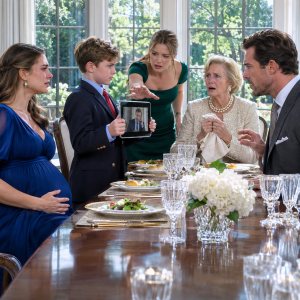
At dinner, she sat between me and my father, Wallace, with a glass of sparkling cider and a little plate of roasted potatoes. When the conversation turned to Reid’s new car, my mother asked whether he had chosen the dark green model or the silver one he had first considered. He smiled and said the green one had arrived just in time for the holidays.
Maisie looked up from her plate.
“Uncle Reid, how did you get such a nice car when the kitchen staff haven’t received their Christmas bonuses yet?”
She had overheard me discussing the missing payments with our bookkeeper a few days earlier. She had not understood the details, and she had not meant to embarrass anyone; she was simply trying to connect something she had heard with something she could see.
Reid’s smile disappeared.
“That’s not something you need to worry about, Maisie.”
My mother turned toward her, her expression already hardening.
“You should apologize to your uncle.”
Maisie blinked, looking from one adult to another.
“But I was just asking.”
Reid gave a small laugh that carried no warmth.
“She gets that from her mother. Always asking questions about money.”
I was about to tell him that Maisie had asked politely, and that the employees’ bonuses were a fair subject for discussion, when my mother pushed back her chair and stood up. Her hand caught the edge of the casserole dish, and she swept it sharply toward the empty end of the table. The dish slid, the food spilled across the linen, and the sudden clatter made Maisie flinch.
She began to cry, frightened more by the force of the movement than by the mess itself.
I moved beside her at once, putting an arm around her shoulders and drawing her close.
“It’s okay, sweetheart. I’m here.”
My mother did not apologize for startling her. Instead, she looked straight at me.
“You should teach her some manners.”
I could scarcely believe what I was hearing.
“She’s seven, Mom. She asked a question.”
“Then teach her when not to ask it.”
I looked toward my father, hoping he might at least say something kind to his granddaughter, but Wallace kept his eyes lowered. Over the years, he had become skilled at sitting through difficult moments without making them worse or better, and I had often told myself that his silence was a way of keeping peace. Watching him avoid Maisie’s tearful eyes changed the way that silence felt.
She leaned against me and whispered, “Mommy, can we go home?”
“Of course we can.”
The House I Had Bought Back

While Maisie put on her coat, Reid followed us into the hallway. My mother came after him, still holding herself stiffly, and my father remained behind in the dining room.
“You think you can walk out and make us feel bad?” Celeste said. “You wouldn’t have anything without this family.”
For a moment, I almost laughed, not because the remark was funny but because it was so far from the truth.
Five years earlier, Birchmere Inn had been days away from closing its doors. The building needed major repairs, the business owed money to vendors, and the employees had gone too long without receiving everything they had earned. My parents had tried to hold the property together with borrowed money and optimism, while Reid, who had been managing day-to-day operations, insisted that one good season would solve everything.
It had not.
I was working as a financial consultant then, and I had been saving for years, first for a home of my own and later for Maisie’s future. When I saw how much the inn meant to the staff and to the surrounding town, I began looking at the numbers. What I found was a business with real potential, but only if someone was willing to pay what it owed, repair the building, rebuild trust with vendors, and make difficult decisions before the situation grew worse.
I brought in an attorney and a lender, put together the financing, and purchased the property and the operating company through a new business entity. The legal documents gave me the voting control. My parents and Reid were offered management roles because they knew the property and because I hoped we could preserve some part of the family’s history without letting old mistakes follow us into the future.
I did not ask for public credit. I was not interested in posing for newspaper photographs or correcting my mother whenever she introduced me as the daughter who “helped with the accounts.” When guests congratulated Reid on the improvements, I let him accept the praise. When my father spoke about the inn as a family success, I did not interrupt. I thought that keeping the business stable and giving the staff dependable work mattered more than being recognized.
For a while, it did matter more.
The inn reopened with new rooms, a refurbished kitchen, and a reservation system that finally worked. People came back. The staff stayed. The business began to earn enough to pay its bills and set aside money for repairs. At family gatherings, I told myself that the arrangement was working because everyone had a place and the inn had a future.
But what I called generosity, my relatives seemed to take as proof that I had no intention of asserting my authority.
Over the previous six weeks, our bookkeeper had raised questions about a series of payments to a company called Pine Harbor Advisory. The company appeared on invoices for consulting services, though no one could provide clear records of the work. Its registered owner was Reid. Celeste had approved several invoices, while Wallace had authorized the transfers.
The payments totaled just over half a million dollars.
At the same time, the kitchen staff were still waiting for their holiday bonuses.
I asked Reid about the invoices in a private meeting. He said they were part of a business arrangement and that the paperwork would be sorted out later. My mother accused me of treating ordinary family business as if it were a courtroom matter. My father said he did not know enough to answer.
Their responses might have been enough to satisfy me once, but by then I had learned that vague explanations usually meant more questions were waiting underneath.