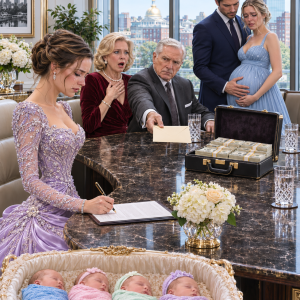
“It isn’t your house.”
Her expression changed. Confusion came first, then the faintest suggestion that she was beginning to understand how little she knew.
Graham gave a forced laugh and faced the guests.
“Willa is upset. You should all go home before she embarrasses herself any further.”
I walked toward the marble fireplace. The estate had belonged to Graham’s grandfather, and the family often spoke as if Graham had inherited it outright. In truth, the story was more complicated.
Three years earlier, Whitaker Development had been close to collapse after two commercial projects ran into serious trouble. The banks had stopped lending, suppliers were demanding payment, and the company’s directors were openly discussing whether it could survive another quarter. Graham told his family that private investors had stepped in to save the business.
He had not told them who the investor was.
It was me.
Through my firm, Northline Capital, I had purchased the estate’s overdue mortgage, invested thirty-two million dollars in Whitaker Development, and personally guaranteed an emergency credit line. I had agreed to help because I believed Graham’s company could recover, and because I thought we were building a future together. I had read every page of the financing agreements. Graham had signed the documents I brought to him without asking what they said.
He had assumed my signature was there because I was his wife.
That assumption had cost him more than he knew.
Grant opened a thick binder and set it on the glass table. The first pages held certified audit findings, transfer records, and copies of account authorizations. Preston picked up the binder and began to read. Before he reached the second page, his face had gone pale.
“What is this supposed to mean?”
“It means the books have been examined,” Grant said. “And the records show that company money was moved through a series of false consulting accounts.”
Graham went rigid.
Four months earlier, I had noticed a transfer that did not match the company’s usual spending. I had asked for supporting documents and received an explanation that sounded reasonable at the time. Then I found another transfer, followed by several more. As Grant’s review continued, the money led to shell companies, incomplete invoices, and expenses that seemed to serve no business purpose.
Among them were a luxury apartment for Sloane, a new Mercedes, jewelry, and overseas vacations. Each purchase had been routed through a company account or one of its subsidiaries.
The private benefits were only part of it. Graham had also used company assets to secure new loans, placed my digital signature on two transactions I had never approved, and made plans to move a large sum into accounts abroad before asking me for a divorce.
Sloane lowered her glass.
“You told me you paid for the apartment yourself.”
Graham turned toward her.
“Don’t start.”
“You said the money was yours.”
“Be quiet.”
I almost smiled, though there was nothing funny about the moment. Even now, he believed that speaking sharply could bring the room back under his control.
He turned on me.
“You’ve been watching me?”
“I’ve been reviewing my investment.”
Preston struck the table with his palm.
“You idiot. What did you think would happen?”
Marlene looked from her husband to Graham and back again.
“What happens now?”
Reid answered in the same measured tone he might have used in a courtroom.
“Now the financing agreement takes effect. The company has defaulted because of the conduct documented here.”
Graham looked at him without speaking.
The emergency agreement gave Northline Capital the right to assume fifty-one percent of the board’s voting authority if the company committed financial fraud. It also gave me authority to freeze certain transfers, remove executives, and demand repayment under specific conditions. The evidence in Grant’s binder showed that those conditions had been met.
Clover—or rather Sloane—had begun moving toward the doors.
Bennett did not block her.
“You’re free to go, Ms. Mercer.”
She stopped.
“But the apartment is owned by a Whitaker Development subsidiary,” he continued. “So is the car. The company is already reviewing both.”
Her lips parted.
Graham lunged toward me, and Everett moved between us before he could reach me. Everett did not grab him or raise a hand. He stood in the way, calm and immovable.
“Don’t take another step,” Everett said quietly. “If you do, the authorities can handle it from here.”
The guests were no longer pretending not to watch. Several held their phones up. The board members near the windows were speaking in urgent whispers. Sloane looked frightened, Preston looked furious, and Marlene had both hands pressed to her necklace.
Graham finally understood that the woman he had tied to a beam less than an hour earlier held the mortgage on the estate, a controlling position in his company, and the documents that explained exactly how he had used its money.
I checked my watch. It was 11:58.
“Two minutes,” I said.
His voice shook.
“Two minutes until what?”
“Until my birthday ends.”
Part Three: At Midnight