The sentence was so quiet that at first I thought I had misunderstood.
Grant’s expression hardened.
“What did you do?”
Lauren’s chin lifted, although her confidence had begun to fracture.
“Your marriage was already finished. You told everyone you were miserable, and she kept pulling you back into the same conversations. I knew if she contacted you again, you’d feel guilty and start questioning the divorce.”
My chest tightened.
“So you answered for him?”
She looked at me as if I were an inconvenience rather than the person whose life she had altered.
“I sent one message.”
Grant stared at her.
“You used my account.”
“Because you needed distance.”
“You decided what I needed?”
“I was protecting you.”
Grant laughed once, but there was no humor in it.
“From my own children?”
Lauren looked toward the ballroom entrance.
Her voice became smaller.
“I didn’t know she was expecting.”
I believed that part might have been true.
Perhaps Lauren had intended only to make sure Grant and I never spoke again.
Perhaps none of us could have imagined what that single message would cost.
That possibility did not make it harmless.
Sometimes the choices that change a family are not made by people planning enormous consequences; they are made by ordinary people who convince themselves they have the right to control one small piece of another person’s life.
Grant folded the printed email in his hand.
Then he looked at me.
“Why didn’t you try again?”
The question hurt because I had asked myself exactly the same thing hundreds of times.
“Because I believed you.”
His shoulders lowered.
“Rachel—”
“I believed every word because it came from your account, because the divorce had already taught me that you didn’t want me anymore, and because I was frightened enough to think that not contacting you was the one thing I could control.”
He closed his eyes briefly.
“I would never have told you to handle that alone.”
I wanted to be angry.
Instead, I felt tired.
“I know that now.”
What Happened After the Wedding Stopped

Grant did not marry Lauren that evening.
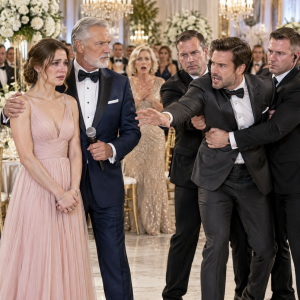
There was no dramatic announcement, no public speech, and no scene designed for the people already holding their phones near the dance floor; he simply asked the hotel manager to end the reception early, then disappeared into a private conference room with Lauren, her parents, and two members of his family.
I took my sons home.
Grant called the following morning.
I did not answer.
He called again that afternoon.
Then, rather than leaving ten messages, he sent one.
“I understand if you don’t want to speak to me yet. I won’t come to your home or contact the boys without your permission. But if they are my sons, I want the chance to know them, and I want to do this in whatever way makes them feel safest.”
That message mattered more to me than any apology could have.
A week later, we met with attorneys and arranged a private parentage test.
The results confirmed what their gray-green eyes had been saying all along.
Grant was their father.
He cried when he read the report.
I had seen Grant emotional before, but never like that, because five years of birthdays, first steps, fevers, preschool photographs, lost teeth, bedtime stories, and ordinary Tuesday mornings seemed to arrive on his face all at once.
“I missed everything.”
I did not tell him it was all right.
It wasn’t.
But I also did not pretend the entire responsibility belonged to Lauren, because although she had interfered with our lives in a way neither of us could undo, our marriage had already become fragile long before she touched his email, and I had still made the final decision not to reach out again.
The truth did not make either of us innocent.
It simply made the past more complicated than we had believed.
Grant began meeting the boys slowly.
The first visit lasted forty-five minutes at a park near our house.
He brought no expensive gifts because I had asked him not to.
Instead, he brought three inexpensive baseball gloves after I mentioned that Caleb had recently become fascinated with the sport.
Mason barely spoke to him.
Ethan asked seventeen questions.
Caleb asked whether Grant was rich.
I nearly sank through the park bench.
Grant laughed.
“I do okay.”
Caleb considered that answer carefully.
“Mom says people who say that usually have money.”
For the first time since the wedding, I laughed too.
Nothing became perfect overnight.
Grant had to learn that being their father biologically did not make him their father emotionally, while I had to learn that allowing him into their lives did not erase the five years when I had raised them without him.
The boys called him Grant for nearly a year.
Then one afternoon, Mason fell asleep in the back seat after a baseball game, and when Grant carried him toward my front door, Mason opened his eyes just enough to mumble, “Thanks, Dad,” before falling asleep again.
Grant stood completely still on my porch.
I pretended not to notice his eyes filling.
Some moments deserve privacy even when you are standing beside them.
As for Lauren, I learned later that Grant ended both their personal relationship and their remaining professional ties, although I never asked for details, because after spending years letting her decision occupy space in my life, I finally understood that I did not want to build my future around what happened to her.
People occasionally ask whether Grant and I reunited.
We did not.
There was affection between us eventually, and forgiveness, and even moments when I remembered exactly why I had once believed we would grow old together, but neither of us tried to turn those memories into a second marriage.
Some relationships are meant to be repaired into something different rather than restored into what they used to be.
We became parents together.
Real parents.
Not perfectly, and not without disagreement, but honestly.
Years later, when Ethan asked why his father had not been around when they were babies, Grant and I told the boys an age-appropriate version of the truth together.
We did not make Lauren into a monster.
We did not make ourselves heroes.
We simply explained that adults sometimes make frightened, selfish, or mistaken choices, and that one person’s decision can affect people they never intended to hurt, which is why honesty matters even when telling the truth feels uncomfortable.
That evening, after the boys had gone upstairs, Grant stood in my kitchen looking at a framed photograph of the three of them covered in chocolate frosting on their second birthday.
“I would’ve given anything to be there,” he said.
For years, hearing those words would have broken something inside me.
Instead, I found that they no longer did.
“I know.”
He turned toward me.
“Do you ever wish you’d tried one more time?”
I thought about the frightened woman I had been at twenty-nine, sitting alone at a kitchen table with an unexpected future growing inside her, reading an email she believed had come from the man who had just left her.
Then I thought about everything that had happened afterward.
“Sometimes.”
Grant nodded.
“Me too.”
There was nothing else to say.
The past did not change because we finally understood it.
The boys had still taken their first steps without him, I had still spent countless nights raising them alone, and Grant had still lost five years he could never recover.
But understanding the truth changed what came next.
And perhaps that was the lesson hidden inside all those years of anger: sometimes justice does not mean returning to the life you should have had, because no one can hand those years back to you; sometimes it means refusing to let the mistake that shaped your past decide the shape of your future.
On the night of Grant’s wedding, when he first looked across that ballroom and saw three little boys with his eyes, I believed the secret I had carried for five years was about to destroy everything.
Instead, it became the first honest thing between us in a very long time.
And although none of us walked away with the future we had once imagined, my sons eventually gained a father, Grant gained the chance to become one, and I finally stopped carrying the terrible question of whether I had made the wrong choice all those years ago.
Because by then I understood something I wish I had known sooner.
One false message had separated us.
Only the truth could decide what we did after we found each other again.