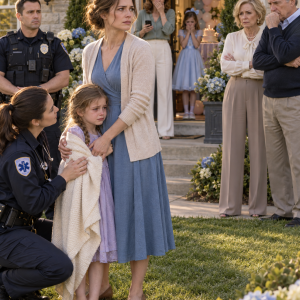
The Child Who Would Not Walk Away

For nearly seven hours, my eight-year-old daughter sat beside her father’s open casket without asking for food, without wandering toward the cousins playing quietly in the kitchen, and without shedding the kind of tears everyone seemed to expect from a child who had been told that her father was no longer coming home.
That was the first thing that frightened me.
My daughter, Lily, had never been quiet when she was afraid. If thunder rattled the windows, she climbed into my bed and talked until sunrise. If she scraped her knee, she cried before she even looked at it. If she sensed that my husband and I were keeping something from her, she asked questions with the persistence of a courtroom attorney.
But that evening, inside my mother-in-law’s sprawling old house outside Minneapolis, Lily did none of those things.
She simply watched her father.
My husband, Daniel Harper, was forty years old, active, annoyingly disciplined about his morning walks, and the kind of man who read nutrition labels even when buying crackers. Less than two days earlier, I had been told that he had suffered a sudden medical collapse while inspecting one of the refrigerated storage facilities owned by his family’s business.
By the time I reached a small private medical center outside St. Paul, Daniel had already been pronounced without signs of life.
Everything after that had happened too quickly.
His older brother, Nathan, arranged the funeral home before I had even figured out how to explain the situation to Lily. He told me he was trying to spare me decisions because I was overwhelmed, and at the time, I had been grateful enough to let him.
Now, sitting in the soft light of his mother Margaret’s living room while neighbors whispered and relatives carried trays of untouched sandwiches through the house, I began wondering whether I had mistaken control for kindness.
At eleven twenty that night, I finally walked toward Lily.
She was standing beside the casket now, both hands gripping the polished wooden edge.
I placed my hand gently on her shoulder.
“Sweetheart, come upstairs with me. You need some rest.”
She did not turn.
“No.”
“You’ve been here all evening.”
Her gaze remained fixed on Daniel’s face.
“I know.”
I leaned closer.
“Daddy is resting now.”
That was when she finally looked at me.
There was something unsettlingly calm in her blue eyes.
“No, he isn’t.”
I felt my stomach tighten.
“What do you mean?”
She looked back at him.
“I don’t know yet.”
Yet.
An eight-year-old child had said the word yet.
And suddenly I remembered the last conversation Daniel and I had shared before he went to the warehouse.
We had been cleaning the kitchen after dinner when he stopped beside the sink and said, almost casually, “If Nathan brings you anything from the company this week, don’t sign it until I talk to you.”
I had laughed.
“What exactly are you two fighting about this time?”
Daniel had dried his hands slowly.
“I’m not sure we’re fighting. I’m checking something.”
“Checking what?”
He kissed my forehead.
“Probably nothing.”
Daniel had been saying “probably nothing” to me for twelve years, and it almost always meant something.
Now he was lying in front of me, and Nathan had already asked twice whether I wanted him to handle Daniel’s company shares until I was ready to deal with legal paperwork.
Suddenly those conversations felt very different.
The Watch That Should Have Stopped
At eleven thirty-seven, I noticed Daniel’s wristwatch.
It was a simple silver watch Lily had helped me choose for our anniversary, and I remembered seeing it when the clinic allowed me a few minutes alone with him. I had taken a photograph almost without thinking, perhaps because some irrational part of me had wanted proof that I had actually been there.
In that photograph, his watch showed 4:13.
Now it showed 11:37.
The second hand was moving.
I knew immediately that a running watch proved almost nothing about Daniel himself, yet it told me something important about the way he had been handled afterward.
Several ordinary preparations had apparently never been performed.
Nathan had told me Daniel had once said he wanted everything kept simple and untouched. He had therefore arranged for a small independent funeral home owned by an old acquaintance.
At the time, I had accepted the explanation.
Now I crouched beside Lily.
“Tell me what you’ve been watching.”
Her mouth tightened.
“You’ll think I’m imagining it.”
“Try me.”
She pointed toward the area beneath her own nose.
“Sometimes Daddy moves right here.”
I stared at her.
“Moves how?”
“Just a tiny bit.”
Before I could ask another question, Nathan appeared behind us.
“Emily, this has gone far enough.”
His voice was controlled, but there was no gentleness in it.
“Lily needs sleep.”
I turned.
“Give us a minute.”
“She’s been standing here for hours staring at Daniel. This isn’t healthy.”
Maybe he was right.
Under ordinary circumstances, I might have agreed.
But ordinary circumstances had disappeared the moment Lily said she had seen movement.
Before either Nathan or I could stop her, Lily pushed a chair closer to the casket, climbed onto it, swung one leg carefully over the cushioned edge, and lowered herself beside her father.
Several people gasped.
Margaret called her name.
Nathan immediately stepped forward.
“Get her out of there.”
I caught his arm.
“Wait.”
Lily curled against Daniel’s chest and pressed one ear against his suit jacket.
She stayed there so long that I became aware of every sound in the room—the clock above the fireplace, someone breathing behind me, the faint hum of the heating system.
Then Lily raised her head.
All the color seemed to have left her face.
“Mommy.”
I moved closer.
“I’m here.”
She whispered,
“I felt two little bumps.”
The room went completely still.
I reached toward Daniel, placing my fingertips along the side of his neck, though I barely knew what I was searching for.
For several seconds, there was nothing.
Then I thought I felt the faintest movement beneath my fingers.
I immediately reached for my phone.
Nathan stepped toward me.
“Emily, stop. You’re upsetting everyone.”
“I’m calling emergency services.”
His own phone lit up on the side table at that exact moment.
Neither of us meant to look.
But the screen faced me.
The preview contained only two sentences.
Get Daniel’s computer before Emily does.
If she finds the maintenance records, we’re all in trouble.
The sender was Colin Mercer, the company’s longtime operations director.
I looked at Nathan.
He saw my expression and froze.
For perhaps three seconds, neither of us spoke.
Then I heard sirens outside.
The Heartbeat Nobody Expected
Two emergency medical technicians entered Margaret’s house carrying equipment while relatives moved aside in stunned silence.
I lifted Lily from the casket myself.
She wrapped both arms tightly around my neck.
“You believed me.”
I pressed my cheek against her hair.
“Yes, honey.”
One of the responders, a woman named Erin, checked Daniel carefully, repositioned her fingers, then looked toward her partner.
“Bring the monitor.”
Nathan lowered himself into a chair.
Margaret stood near the doorway with both hands pressed together.
Sensors were attached. Equipment began producing numbers I did not understand.
Then Erin looked at me.
Her voice was calm, but her expression had changed completely.
“We’re detecting cardiac activity.”
For a moment, the words meant nothing.
Then they meant everything.
“He’s alive?”
“He has signs of life. We need to move quickly.”
The next few minutes passed in fragments—oxygen, warming blankets, equipment cases snapping open, short medical instructions exchanged between professionals while everyone else stood uselessly around the room.
There was no dramatic moment when Daniel opened his eyes and called my name.
He remained completely still.
But a faint rhythm existed where we had been told there was none.
At the hospital, doctors discovered that Daniel’s body temperature was extremely low and his heart rhythm dangerously slow but still present. His blood pressure was difficult to measure, and he remained unresponsive as a medical team gradually warmed him.
At two in the morning, a physician named Dr. Rebecca Lawson sat beside me.
“Your husband experienced profound hypothermia,” she explained. “In severe cases, breathing and circulation can become extraordinarily difficult to detect.”
I stared at her.