The Note on the Kitchen Table

For nine months, I had imagined coming home to the smell of cedar, the ticking hallway clock, and Graham Cole standing at the stove, pretending not to be proud of whatever supper he had made. Instead, when I unlocked our front door in Cape Elizabeth, Maine, on a gray November afternoon, I stepped into air so cold that my breath showed.
I had been away with a federal disaster-response team, working as a critical-care nurse practitioner in communities recovering from floods and wildfires. Throughout the assignment, I sent money home because my mother, Judith, said Graham’s advanced pancreatic disease had made their expenses impossible to manage. He was my stepfather, though that word had never described what he meant to me. He entered my life when I was eleven, never demanded a title he had not earned, and spent the next twenty-five years quietly earning it.
My suitcase had barely crossed the threshold when I noticed the note on the kitchen table. It was written in my mother’s slanted handwriting on the back of an envelope.
“We used the treatment money for the Alaska cruise. Graham is making the whole house smell. Take care of him before we get back. We are tired of doing everything.”
For several seconds, I simply stared at the page. I told myself there had to be some explanation, perhaps a poorly worded joke or one of my mother’s dramatic attempts to make me feel guilty for being away. Then I saw the untouched mail, the empty fruit bowl, and the thermostat set at fifty-two.
“Graham?”
No answer came from the living room. I dropped my bag and hurried down the hallway.
He lay curled beneath a summer quilt, wearing the same flannel shirt I had seen during our video call five days earlier. His lips were dry, his cheeks hollow, and his hands trembled inside mine. Most troubling were the water glass beyond his reach and the cordless phone on a dresser he could no longer walk to.
His eyes opened slowly.
“Claire,” he whispered. “You made it home.”
I turned up the heat, gave him water a spoonful at a time, changed his clothes and bedding, and called the after-hours number for his medical team. While I waited for instructions, I warmed chicken broth and moved a chair beside his bed.
“Where is Mom?” I asked, although the note had already answered me.
He looked toward the window. “Somewhere off the coast of Canada by now.”
My mother had taken my brother, Owen, my sister, Mallory, and Owen’s girlfriend, Tessa. For months they had said that Graham required constant supervision and that prescriptions were draining the household account. I believed them and transferred part of every paycheck into an account labeled Family Care.
The tablet on the sofa lit up with a social-media notification. Owen was grinning on a cruise-ship deck in a new wool coat, one arm around Tessa. Beneath the photograph he had written, “Work hard, enjoy harder. Finally living the life we earned.”
I opened the banking app.
The balance was $31.84.
Cruise fares, spa treatments, jewelry, excursions, and withdrawals from the ship’s gaming room totaled $19,760—nearly everything I had contributed that year.
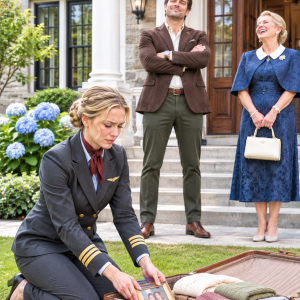
When I returned to Graham’s bedroom, I noticed that the walnut display case above his desk was empty. It had once held his flight badges, service ribbons, and a small brass compass from his years as an Army helicopter mechanic.
“Where are your service keepsakes?”
His mouth tightened. “Judith sold them online. Said they were old pieces of metal taking up space.”
I had no answer that would not make the moment worse, so I checked his medications. Several routine bottles were nearly empty. The stronger liquid prescribed for his most difficult episodes was still half full, but when I lifted it, the fluid moved too easily. Graham caught my wrist.
“Don’t give me that.”
“Why not?”
“It isn’t what the label says anymore.”
I held the bottle toward the lamp. “What happened?”
He closed his eyes, embarrassed by something that was not his shame to carry. “Judith poured out what was left and filled it with water. She said the real prescription cost too much for somebody who wasn’t going to be around much longer.”
My training had taught me to become calm when a room was falling apart. I placed the bottle in a clean plastic bag, marked the time, and moved it where no one could disturb it. Then I called Graham’s care team again and described exactly what I had found.
The bottle told me this was more serious than selfishness. I did not call my mother or warn my siblings. I began taking photographs.
What the Empty House Revealed
By morning, the house had become a record of what had happened there. I photographed the thermostat, the empty refrigerator, the overdue utility notices, the inaccessible telephone, the bank transactions, and the condition of Graham’s room. His physician arranged an urgent home assessment, adjusted his care plan, and told me to preserve the bottle exactly as I had found it.
Our neighbor, Mrs. Evelyn Harper, a retired librarian who had known us for two decades, confirmed that everyone left Thursday morning. “I asked who was staying with Graham,” she said, “and your mother told me he was asleep and wanted to be left alone. Claire, I would have checked if I had known.”
That afternoon, after the visiting clinician had gone and Graham was resting more comfortably, he asked me to shut the bedroom door. He pointed toward a row of old aviation books.
“Take out the blue maintenance manual.”
Behind it was a narrow fireproof folder. Inside were property deeds, investment statements, trust documents, and letters from a law office in Portland. Graham watched me read until I finally looked up.
I had believed Graham lived on a modest pension and income from his work as a commercial real-estate appraiser. The documents showed that, before marrying my mother, he had invested in three neighborhood shopping properties through a private trust now worth a little over $3.8 million.
“Does Mom know about this?” I asked.
“She knows I once did well,” he replied. “She thinks I lost most of it when the market turned. I let her think that.”
“Were you testing everyone?” I asked.
“Not at first. I wanted privacy. But when people thought I had money, they found reasons to visit. When I stopped paying for dinners and fixing their problems, they became busy.”
“The money was never the real test, Claire. I only wanted to know whether somebody would bring me a glass of water when I could no longer pay for the glass.”
He was not pleased to have outsmarted anyone. He had hoped he was wrong. “You came home,” he said. “You were the only one who came.”
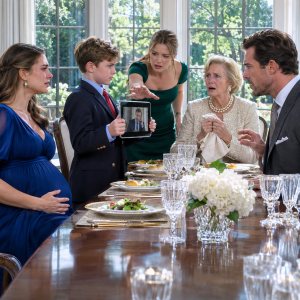
That evening, his attorney, Rebecca Sloan, arrived with an independent physician and a notary. After the physician confirmed that Graham fully understood his decisions, we gathered at the dining-room table.
Graham revised his estate plan. Most of the trust would support former service members and their families. A substantial portion would pass to me, along with responsibility for its charitable work. My mother, Owen, and Mallory would receive none of the assets Graham was free to distribute.
“This is not revenge,” he told Rebecca. “I simply will not reward people who began dividing my belongings while I was still asking for water.”
Graham still wanted to know whether they would return if they understood how little time he might have. I wrote in our family chat, “Graham’s condition has changed. His physician believes he may not make it through tonight. Please come home now if you want the chance to see him.”
Owen read it first. Mallory followed. My mother’s reply arrived three minutes later.
“Do not start another crisis. The cruise ends Tuesday.”
Owen added, “You work in medicine. Handle it.”
Graham was looking at the screen. I watched a final bit of hope leave his face, though he still asked me to make a video call. My mother answered from a crowded lounge where music played behind her and people raised glasses toward the camera.
“What is it now?” she called over the noise.
“I need you to come home,” I said. “Graham may have only a few hours.”
Her expression barely shifted. “Claire, we paid a fortune for this trip. We are not throwing it away because he chose this exact weekend to get worse.”
Owen leaned into view, laughing at something off camera. “Tell him to hold on until Tuesday.”
“He can hear you,” I said.
The laughter stopped for half a second. Then my mother shrugged.
“If something happens, take care of it. You are the responsible daughter. You always remind us of that.”
When the call ended, Graham stared at the dark screen for a long while.
“Save the recording,” he said at last.
Then he nodded toward the trust folder.
“When they come back, they will learn that the most expensive part of their cruise was not the twenty thousand dollars they spent.”
Peaches at Three in the Morning

I slept in a chair beside Graham’s bed, waking whenever his breathing changed or the old house settled. Shortly after three, he opened his eyes and asked a question so ordinary that, for a moment, we were no longer surrounded by medical supplies and legal documents.
“Do you remember how to make cinnamon peaches?”
I smiled. “I remember opening a can. After that, my qualifications become questionable.”