The Girl Behind the Loading Dock

By the time I saw the little girl, I had already spent most of that cold November morning thinking about everything except children.
My name is Nathan Whitmore, and for nearly twenty-two years I had built a comfortable life around a company that manufactured custom furniture for hotels, universities, and retirement communities throughout the Midwest. I understood contracts, lumber prices, shipping schedules, payroll, and the thousand small emergencies that could turn an ordinary Tuesday into a fourteen-hour workday, but that morning I was standing behind an abandoned distribution warehouse outside Pittsburgh, looking at several acres of broken pallets, rusted appliances, rain-soaked cardboard, and illegally dumped household trash.
My company had purchased the property three weeks earlier. We planned to build a new production facility there.
According to the environmental report, cleanup would take six weeks.
According to the reality in front of me, whoever wrote that report had been unusually optimistic.
I was walking behind one of the old loading docks when something moved between a discarded refrigerator and a stack of wooden crates.
At first I thought it was an animal.
Then I saw two blue-gray eyes staring at me.
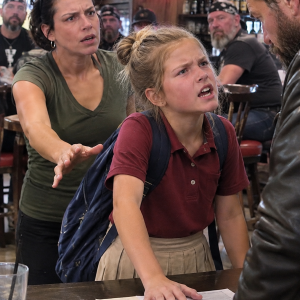
She couldn’t have been older than seven.
The child was painfully thin, wearing an oversized green sweater, faded jeans, and two sneakers that clearly had not begun their lives as a pair. Her pale blond hair hung around her face in tangled strands, and although her cheeks were streaked with dirt, what unsettled me most was how completely silent she was.
She didn’t cry.
She didn’t call for anyone.
She simply watched me with the wary concentration of someone who had learned that adults had to be studied before they could be trusted.
I crouched several feet away.
“Hey there. My name’s Nathan. What’s yours?”
Nothing.
I removed my work gloves and slowly held out one hand.
“You don’t have to come over. I’m just going to stay right here, okay?”
Nearly a minute passed.
Then a tiny hand appeared from inside that enormous sweater.
She reached forward and wrapped two cold fingers around my index finger.
That was all.
Yet somehow, standing in the mud behind an abandoned warehouse, I felt as though a contract more serious than anything I had ever signed had just been placed in my hands.
I called the authorities immediately. While we waited, one of my employees brought a blanket and a cup of warm cocoa from the truck. The girl accepted the blanket but wouldn’t drink until I took a sip first.
When the officers arrived, they agreed she should be examined before anything else happened.
I knew exactly where to take her.
And that decision changed all of our lives.
Room 418
My wife, Claire, had been living at Hawthorne Neurological Recovery Center outside Sewickley for almost eighteen months.
Before all of this, Claire had been a landscape architect, the sort of woman who could walk through an empty backyard and describe the garden she already saw there—the dogwood near the fence, lavender along the stone path, a bench beneath a maple tree.
Then came the highway accident.
She had been driving my SUV that afternoon because my own schedule had changed at the last minute. A mechanical failure sent the vehicle off the road, leaving her with serious neurological complications and very limited movement.
The specialists initially believed she might regain significant function.
Progress came slowly.
Then it seemed to stop.
Hawthorne was expensive, private, beautiful, and reassuring in all the ways frightened families want a medical facility to be reassuring. There were landscaped courtyards, polished floors, private rooms, and doctors who spoke in careful sentences about patience.
I paid for everything.
Special therapy.
Imported supplements.
Experimental rehabilitation programs.
Private nursing.
If someone had told me that standing on one foot under a full moon might help Claire move her hand again, I probably would have asked where to buy the ladder.
Hope can make intelligent people surprisingly easy to persuade.
Dr. Preston Hale, Hawthorne’s medical director, came downstairs personally when I arrived with the girl.
He was in his mid-fifties, silver-haired and polished, with the calm manner of a man who had spent years learning how to make worried families feel safe.
“Nathan, I wasn’t expecting you this early.”
He glanced at the child.
“And who’s your friend?”
“I found her at the warehouse property. She needs to be checked.”
When a nurse approached, the girl tightened both hands around mine.
Hale noticed.
“Let her stay with you for a few minutes. We can examine her upstairs.”
So I took her to Claire’s room.
My wife was awake, lying near the window while pale November sunlight stretched across the blanket.
“Hey, sweetheart,” I said. “I brought someone to meet you.”
The girl finally released my finger.
She approached the bed slowly, studying Claire’s face, then placed her small hand over Claire’s.
Something happened.
Claire’s fingers moved.
Barely.
A tremor, perhaps.
But I saw it.
“Claire?”
Her eyes shifted toward me.
For eighteen months, I had trained myself not to turn every tiny movement into a miracle, but hope doesn’t care much about training.
Then Dr. Hale appeared in the doorway carrying a small tray.
“Actually, Nathan, your timing is excellent. We received something new this morning.”
On the tray sat a syringe and a dark glass vial.
The label was covered with Chinese characters.
Hale explained that it was an imported compound being studied overseas for nerve recovery. He said my business partner, Everett Sloan, already knew about it and had even offered to help with the cost.
That should have seemed generous.
Everett had been my closest friend for nearly twenty years.
He had stood beside me at my wedding.
He knew Claire well.
He also knew I had barely been present at the company since her accident.
Hale inserted the needle through the vial’s rubber top.
The little girl stared at the label.
Her expression changed so suddenly that I noticed before she spoke.
“No!”
She rushed forward and struck Hale’s wrist.
The vial slipped from his hand, hit the floor, and shattered.
Hale jumped backward.
I stared at her.
For the first time since I had found her, she raised her voice.
“Don’t give that to her!”
She pointed at the broken bottle.
“Bad chemical. The words say it’s dangerous.”
For perhaps two seconds, Dr. Hale’s practiced expression disappeared.
Then the smile returned.
But those two seconds were enough.
What Lucy Knew
The girl’s name, I eventually learned, was Lucy Mercer.
Dr. Hale insisted she was frightened and confused.
“Nathan, she’s been through something difficult. Children make associations. She probably recognizes the warning symbols.”
Maybe.
But Lucy hadn’t looked at the symbols.
I had watched her eyes move across the characters.
“Bring me another vial.”
Hale’s face tightened.
“I can’t release restricted medication.”
“Then I’ll have one tested independently.”
“That isn’t necessary.”
Those three words bothered me more than anything else he had said.
I looked at Claire.
For eighteen months I had accepted every explanation because I wanted desperately to believe the people caring for her knew more than I did.
Suddenly I wondered whether trust had become an excuse not to ask questions.
Before the staff could clean the floor, I collected several pieces of glass with a towel and sealed them inside an empty specimen bag.
Then I called my attorney and an old college friend named Daniel Brooks, who now worked as an investigator for the county.
That evening Lucy finally began telling us about herself.
Her parents, Emily and Grant Mercer, were American teachers who had spent several years working at an international school in Taiwan before returning to Pennsylvania. Lucy had attended a bilingual elementary program there and had learned enough Mandarin to read simple signs, labels, and warnings.
Her grandfather had also worked for a company supplying industrial cleaning products, and whenever Lucy visited his workshop, he made a game of teaching her warning labels.
Months earlier, Lucy had become separated from her parents under circumstances investigators were still trying to understand. She had been kept inside a house with several adults she didn’t know, later moved to an old storage building, and eventually slipped through an unlocked side door one night.
She walked until she found a delivery truck with its rear door partly open.
She hid among empty boxes.
When the truck stopped near our property the following morning, Lucy climbed out, saw workers nearby, panicked, and hid behind the abandoned loading dock.
The place where I happened to find her.
Just before midnight, my phone rang.
The independent laboratory had analyzed residue from the broken vial.
The chemist spoke carefully.
The substance was not the nerve-recovery medication Dr. Hale had described.
It contained compounds capable of producing profound weakness and neurological symptoms when administered repeatedly.
My stomach tightened.
“Could repeated exposure make someone appear as though an existing neurological condition wasn’t improving?”
There was a pause.