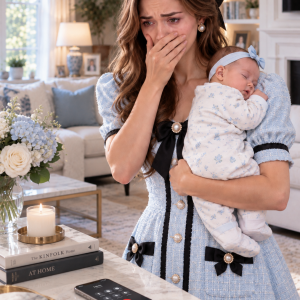
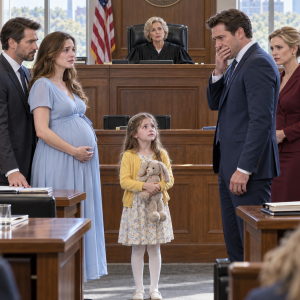
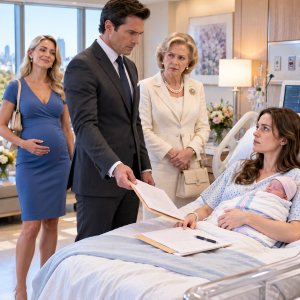
When Graham confronted her, I wasn’t there.
But he told me later what she said.
“I was protecting you.”
Graham’s answer was simple.
“You weren’t protecting me. You were controlling my life.”
Lenora insisted she had never intended for the embryos to be used without my knowledge. She claimed Preston had acted beyond anything she had authorized.
Whether that was true became a matter for investigators and attorneys.
I didn’t need every answer immediately.
For once, I needed peace more than revenge.
Graham Made a Choice
Graham stepped away from his family’s company.
It shocked everyone who knew the Whitmores.
He gave up his board position and placed his shares under independent management while the investigation continued.
When I asked why, he looked almost offended by the question.
“Because my children are lying upstairs.”
I reminded him that biology didn’t automatically make us a family.
He nodded.
“I know.”
“And saving them doesn’t erase what happened five years ago.”
“I know that too.”
Then he said something that stayed with me.
“I’m not asking you to forgive the man I was. I’m asking for the chance to become someone Lila and Noah deserve.”
That was different.
He wasn’t asking me to love him.
He wasn’t asking me to forget.
He was asking to show up.
So I let him.
The First Time He Held Them
Lila was the first baby Graham held.
She looked impossibly small against his chest.
The brilliant surgeon who could walk into an operating room without hesitation suddenly looked terrified.
“Am I holding her correctly?”
I almost laughed.
“You’re the doctor.”
“Not this kind.”
For the first time in five years, I smiled at him.
Noah came home eleven days later.
Lila needed another four.
Graham visited every day.
He learned how to warm bottles.
He learned which lullaby settled Noah.
He discovered that Lila hated having her socks changed.
None of those things repaired our past.
But slowly, they began building something new.
Six Months Later
I did not marry Graham.
I did not move into his house.
And I didn’t pretend that finding out he was my children’s father magically restored the relationship we’d lost.
Real life doesn’t work that way.
Trust isn’t a switch.
It’s a bridge.
And when someone has broken it once, rebuilding it requires more than apologies.
Graham understood.
He rented a house ten minutes from mine.
We created a parenting schedule.
We attended counseling separately before eventually agreeing to attend several sessions together.
He apologized without making excuses.
I learned that forgiveness did not require forgetting.
One Sunday afternoon, six months after Lila and Noah came home, we sat together in my backyard.
Noah was asleep against Graham’s chest.
Lila was curled against me.
Graham looked across the yard.
“Do you ever wonder what would have happened if I’d believed you?”
I thought about it.
Then I shook my head.
“Sometimes.”
He looked at me.
“And?”
I watched our daughter wrap her fingers around mine.
“I can’t change the five years we lost.”
Graham nodded.
“Neither can I.”
I continued.
“But we get to decide what we do with the years ahead.”
His eyes met mine.
There was no dramatic kiss.
No promise that everything would suddenly become perfect.
He simply reached across the space between our chairs and held out his hand.
This time, I chose whether to take it.
And after a moment, I did.
Not because the past had disappeared.
Not because Graham was wealthy.
Not because some impossible twist had brought us together again.
I took his hand because, for six months, he had shown me that regret could become responsibility.
And because our children deserved parents who understood one important truth:
Family isn’t created by money, appearances, or even DNA alone.
Family is created by the people who keep showing up.
Sometimes the truth arrives years later, but when it finally does, it can explain wounds you once believed would never make sense and give you the freedom to stop blaming yourself for choices other people made.
Love cannot survive for long without trust, because even the deepest feelings become fragile when fear, pride, outside influence, and unspoken assumptions are allowed to become stronger than honest conversation.
A sincere apology cannot rewrite yesterday, but when it is followed by patience, accountability, and consistent action, it can become the first brick in a completely different future.
Being related by blood may connect people biologically, but becoming a true parent requires waking up, showing up, listening, protecting, comforting, and choosing your children again and again when nobody is watching.
Forgiveness should never be confused with pretending that nothing happened, because healthy forgiveness allows you to remember the lesson while deciding that the pain will no longer control every decision you make.
People who truly care about you will not demand immediate forgiveness simply because they apologized; they will understand that rebuilding trust happens according to the wounded person’s timeline, not their own convenience.
Some of life’s most painful endings eventually reveal themselves as unfinished chapters, but returning to a person or situation should always depend on what has genuinely changed rather than how beautiful the past once seemed.
Money, status, reputation, and powerful family names can open countless doors, but none of them can replace integrity when a person must decide whether to stand beside the people who depend on them.
Children do not need a picture-perfect family nearly as much as they need adults who treat one another with respect, accept responsibility for their mistakes, and create a home where love never has to compete with fear.
When life gives you an unexpected second chance, you do not have to recreate the relationship you once had; sometimes the wisest choice is to move slowly, protect your peace, and build something entirely new from the truth.