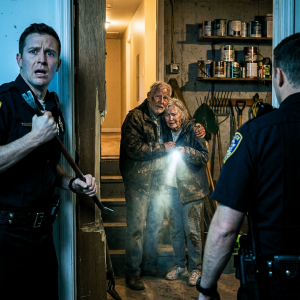
I thought Murphy just needed to go out when I woke to find him staring at me. But he wasn’t nudging or moving—just frozen, ears back, eyes fixed—not on me, but slightly downward. Toward under the bed.
Curious and uneasy, I leaned over the mattress, peering into the shadows.
That’s when I saw her.
A young girl, maybe twelve, curled tightly beneath the bed, wide eyes locked on mine. She looked more scared than threatening, hands gripping the bedframe like it was her last anchor.
I jumped back, startled. Murphy didn’t move, just kept staring.
I stood up, voice shaking. “Who are you?”
No answer. Her lips moved silently, terrified.
I softened my tone. “It’s okay. I won’t hurt you.”
She didn’t budge, but her eyes followed my every move. Murphy sat by my side, calm, almost protective.

“I’m going to call someone,” I said gently.
“Don’t,” she whispered. Her voice was faint, but filled with fear.
“Why not?”
Her small body trembled. “He’ll find me.”
That sent a chill through me.
“Who?” I asked, but she didn’t say.
So I made a decision. I told her she could stay. That she was safe here.
Slowly, she crawled out.
She was wearing an oversized hoodie, mismatched socks, and looked like she hadn’t eaten in days.
I made her toast, gave her juice. She sat quietly at the table, clutching a warm mug, eyes on the window like someone might crash through it at any second.
I called in sick. Something told me this was more important.
“Do you want me to call anyone?” I asked later.
She shook her head fast. “They don’t know. They can’t.”
I didn’t push.

For two days, she mostly stayed in the guest room, sleeping with Murphy curled beside her.
I realized she needed help—but not the kind from police or hospitals. The kind that starts with safety and trust.
On the third night, just as I was dozing off, she appeared in the hallway.
“I had a brother,” she said quietly.
I sat up. “Yeah?”