PART 1 — THE PRICE OF STAYING
“Mom, I have $146. If I give it all to you, can I please stay here a little longer?”
My nine-year-old son stood beside our kitchen table, carefully straightening seven twenty-dollar bills, a five, and a crumpled one. Across from him, my husband went pale. My mother-in-law stopped pouring her coffee. Neither of them seemed surprised by what Austin was asking.
Then my son reached into his backpack and pulled out a small blue notebook.
“I wrote down some other things I can do,” he whispered. “I promise I won’t cost so much anymore.”
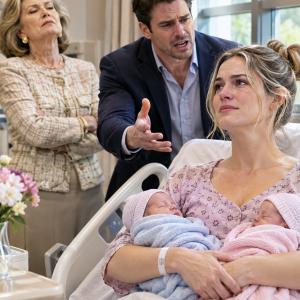
Four weeks earlier, I’d given birth to twins after an emergency C-section. I was still recovering, sleeping in two-hour stretches, and trying to remember when I’d last eaten a proper meal. But I knew one thing with absolute certainty: I had never told my oldest child he needed to pay to live in our home.
“Austin, honey, put your money away,” I said, shifting his baby sister against my shoulder. “Nobody’s asking you to leave.”
He looked toward his father instead of answering.
That frightened me more than the money.
Peter sat at the kitchen counter, gripping his coffee mug. His mother, Gretchen, had been staying with us since the twins were born, supposedly to help while I recovered. She set down the coffeepot and gave me the tight smile she used whenever she thought I was making a fuss.
“Claire, don’t get yourself worked up,” she said. “The boy’s misunderstood a perfectly sensible conversation.”
“Then explain it to me.”
Peter cleared his throat. “Mom thought Austin might enjoy staying with Aunt Joanie for a while. Just until things settle down.”
Aunt Joanie was Gretchen’s younger sister, a widow who lived outside Columbus, nearly four hours from our home near Cincinnati. Austin loved visiting her during summer vacations. She took him fishing and made chocolate-chip pancakes, but she’d never been anything other than a beloved relative.
“How long is a while?” I asked.
Peter stared into his coffee.
“We hadn’t decided.”
Gretchen sighed. “Honestly, Claire, you’re exhausted. The babies need constant attention, and Austin’s old enough to understand that families sometimes make adjustments.”
I looked at my son. His baseball shirt hung loosely over his narrow shoulders, and the toes of his sneakers were worn almost white.
“Austin, did somebody tell you that you were going to live with Aunt Joanie?”
He nodded.
“Dad said you needed a break from me. Grandma said three kids were too expensive, especially now that we have the babies.”
Peter closed his eyes.
“Buddy, that’s not exactly what I said.”
“You said Mom agreed.”
The kitchen went quiet.
I had known Peter for thirteen years. We’d been married for eleven, and I’d seen him frightened, angry, disappointed, and overwhelmed. But I’d never seen him look at me the way he did then, as though he was waiting for me to discover something he’d already decided not to tell me.
I placed baby Hailey in her bassinet beside the counter.
“Peter, did you tell our son I wanted him gone?”
“I said you needed rest.”
“That’s not what I asked.”
Gretchen stepped between us.
“This is exactly why we didn’t want to bring it up while you were recovering. You’re taking everything personally.”
I turned toward her.
“My child is standing here offering me his birthday money so he can sleep in his own bed. How else am I supposed to take it?”
Austin reached for the bills.
“It’s okay, Mom. I can help with the twins. I can make my own breakfast, and I don’t need new baseball shoes yet.”
He swallowed, then added something I’ll remember for the rest of my life.
“I just wanted to stay until your stomach stops hurting.”
I knelt carefully beside him, ignoring the pulling sensation around my incision.
“Sweetheart, listen to me. You are not going anywhere. Not for a month, not for a school year, not because we have two babies. This is your home.”
He searched my face.
“Even if I can’t give you any more money?”
“You don’t have to give me a single dollar.”
I gathered the bills into their envelope and placed them in the kitchen drawer. Then I took Austin’s hand.
“Come upstairs with me for a minute.”
Behind us, Peter said my name. I didn’t turn around.
Austin’s bedroom was at the end of the hallway, across from the nursery. We’d painted it blue when he was six, and he’d helped me stick glow-in-the-dark stars above his bed.
Now three cardboard boxes sat beside his dresser.
His baseball trophies were missing from the shelf.
I stopped in the doorway.
“Who packed these?”
Austin looked down.
“Dad said I should get started so Aunt Joanie wouldn’t have to wait on Saturday.”
Saturday was three days away.
I opened the nearest box. Inside were Austin’s winter sweaters, his school photographs, and the framed picture of the three of us taken at the county fair two summers earlier.
Peter had already begun packing our son’s life into cardboard boxes while I was upstairs recovering from surgery.
“Did Dad say you were leaving this Saturday?”
Austin nodded.
“He said Aunt Joanie was coming to get me. I thought maybe if I helped enough, you could change your mind.”
I sat on the edge of his bed and drew him beside me.
“Austin, I didn’t know about any of this. I never agreed to send you away.”
He twisted his fingers together.
“Then why did Dad say you did?”
I couldn’t answer that without making excuses for a man who had no right to them.
“I don’t know why he told you that. But I’m going to find out.”
Austin looked toward the boxes.
“Mom, is it because I’m adopted?”
I felt my stomach tighten.
Peter and I had adopted Austin when he was an infant. We had photographs from the courthouse, a little album of his first year, and a copy of his adoption decree in our family records.
But we’d made a mistake. We’d kept putting off the conversations that should have grown with him as he got older. We’d told ourselves we’d explain everything when he could understand it.
Instead, we’d allowed his grandmother to tell him first.
“Who told you that, sweetheart?”
“Grandma. She said the babies are your real children because they came from your tummy. She said you and Dad chose me before you knew you’d have your own.”
I closed my eyes for a moment.
“Austin, you are our real child. We adopted you because we wanted to be your parents. Nothing about that changed when Hailey and Mason were born.”
He studied his hands.
“Can adopted kids get sent back if their parents don’t have enough money?”
I put my arm around him.
“No, honey. Adoption means you’re our son, legally and in every way that matters. We should’ve talked to you about it a long time ago. I’m sorry we didn’t.”
“But Grandma said—”
“Grandma was wrong.”
He leaned against me, and I stayed there until his breathing slowed.
Then I noticed the blue notebook sticking out of his backpack.
“Is that what you were trying to show me downstairs?”
He hesitated before handing it over.
On the first page, in the careful handwriting of a third grader, he’d written:
Things I Can Do So Mom Can Keep Me.
Beneath the title were eight numbered promises. He would fold the babies’ clothes without complaining. He wouldn’t ask for new baseball shoes, even if his toes hurt. He would eat cereal instead of asking me to cook breakfast. He wouldn’t have a birthday party next year.
The last line said:
Be really quiet so nobody gets tired of me.
I had to stop reading.
For weeks, Austin had been bringing me water, fetching diapers, and entertaining himself while I fed the twins. I’d thought he was adjusting beautifully to being a big brother.
Now I understood that he’d been trying to prove he deserved to stay.
“Did somebody ask you to make this list?” I asked.
He shook his head.
“I just thought it might help.”
I closed the notebook gently.
“You don’t have to earn your place here, Austin. You can be noisy. You can need things. You can have a bad day. None of that makes you less my son.”
He looked at me for a long moment.
“Can I still play baseball?”
I almost cried again.
“Of course you can.”
After helping him unpack one box, I asked him to stay in his room with his favorite book while I made a phone call.
I went into my bedroom, closed the door, and called Joanie.
She answered cheerfully.
“Claire, honey! How are those beautiful babies?”
“They’re doing fine. Joanie, I need to ask you something about Austin.”
Her voice changed.
“Is everything all right?”
“Did Peter tell you Austin was coming to live with you?”
A pause followed.
“He said you both thought it would be best for the boy to stay here while you recovered.”
“For how long?”
“Well, he mentioned the school year. He thought moving him back and forth would be disruptive.”
I gripped the edge of the dresser.
“The entire school year?”
“That’s what he said. Claire, I assumed you’d discussed it together.”
“I found out this morning when Austin offered me his birthday money to stay another month.”
Joanie made a small, distressed sound.
“Oh, that poor child.”
I told her about the boxes, Gretchen’s remarks, and Austin’s notebook. She listened without interrupting.
“Claire, I love that boy,” she said when I finished. “I thought I was giving him a nice place to stay while you got back on your feet. Peter told me Austin was excited.”
“He thinks we’re sending him away because he isn’t our biological child.”
“Then somebody has done him a terrible wrong.”
I wiped my cheeks.
“I need to know whether you’re planning to come Saturday.”
“Absolutely not. Not now. I’ll call Peter myself, but you tell Austin something for me. He can visit whenever he wants, but my house is not a place people send him because they don’t want him.”
I thanked her and ended the call.
For a while, I sat on the bed, listening to the faint sounds of the twins downstairs.
Peter had told Joanie I agreed. He’d told Austin I wanted him to leave. And he’d allowed his mother to make our son believe that being adopted meant he was the easiest child to give away.
I knew we were having money problems. Peter’s overtime hours at the manufacturing plant had been cut, and my unpaid leave had been extended because of complications after surgery. We’d received several hospital bills, and I knew our savings were shrinking.
But Peter hadn’t shown me how serious things had become.
He’d simply decided that removing Austin was the answer.
When I opened the bedroom door, Peter was waiting in the hallway.
“You called Joanie,” he said.