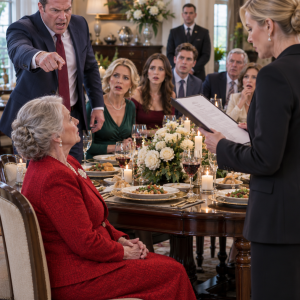
That was the last conversation we had before the police became involved.

What Had Already Left the House
Once the disputed transfers were frozen, smaller things became visible.
Credit cards.
A company SUV retitled to Marcus.
Investment accounts someone had repeatedly tried to access.
Antiques missing from rooms Dad hadn’t entered since the accident.
Then Daniel called me about my mother’s jewelry.
Dad had kept most of it in a safe deposit box.
The box was nearly empty.
One piece bothered me more than the rest.
My mother’s sapphire earrings.
She wore them every Christmas, even when she was cooking. I had a photograph of her standing over a turkey in an apron, laughing, with those ridiculous blue stones hanging from her ears.
Three weeks later, an investigator located them at a Manhattan jewelry dealer.
They had been placed on consignment.
The name on the paperwork was Marcus Hale Mercer.
When Marcus was questioned, his story changed twice.
First, Dad had given him the jewelry.
Then Vivian had given it to him.
Then he said he assumed everything in the house would eventually belong to his mother anyway.
He was arrested in connection with the financial exploitation investigation and possession of property investigators believed had been taken without authorization.
I saw him once afterward.
He looked smaller without my father’s watch.
“Mom told me Richard wanted me involved in the company,” he said.
“Did Dad ever tell you that?”
Marcus looked toward the wall.
“She said he did.”
“Did he ever tell you?”
“No.”
I waited.
He rubbed both hands over his face.
“She kept saying you were gone. That you didn’t care anymore.”
I thought about the unanswered calls, the messages Vivian had returned for Dad, the visits she’d postponed because he was supposedly tired.
Then I asked the question I’d been saving.
“Did you know she withheld his medication?”
Marcus looked at me.
His mouth opened.
Nothing came out.
I didn’t ask again.
Vivian’s Own Handwriting
The notebook became the center of the case because nobody had to explain it.
Vivian had documented the pattern herself.
She later claimed she’d merely been tracking how Dad reacted to medication so she could schedule important conversations when he felt better.
The problem was her own wording.
Hold dose until signature.
More agreeable after medication.
Finish papers before pain meds.
Those entries sat beside dates matching disputed documents.
The more investigators compared them, the simpler the case became.
Vivian had been controlling access to a man recovering from a serious injury while financial documents steadily moved control toward her.
Dad had been made to believe he was difficult, confused and dependent.
She had spoken for him until other people stopped expecting him to speak for himself.
The legal process took much longer than the dramatic part.
Almost two years.
Marcus eventually accepted a plea agreement and cooperated. The notary connected to several questionable documents lost his license. One physician involved in Dad’s medication management faced professional discipline and a civil claim.
Vivian fought everything.
At trial, she wore conservative suits and spoke softly. She described herself as an exhausted wife who had sacrificed her own life to care for a stubborn husband.
Some of that may even have been true.
Caregiving had been difficult.
But difficulty did not explain the transfers.
It did not explain my mother’s jewelry.
And it did not explain the notebook.
Dad testified on the fourth day.
I sat behind Daniel while he walked slowly to the witness stand with a cane.
His recovery had been better than anyone expected, although he would probably always need some assistance.
When he was asked why he hadn’t called for help, he stared at his hands.
“I was embarrassed.”
The courtroom stayed quiet.
“Embarrassed about what?”
“Needing help. Being afraid in my own house.”
He swallowed.
“She told me people were tired of me. She said my daughter had moved on and didn’t want to deal with an old man who couldn’t take care of himself.”
I looked down at my lap.
The prosecutor asked whether he believed her.
Dad nodded.
“Eventually.”
Vivian was convicted on the main charges involving financial exploitation, coercion, fraud and abuse of a vulnerable older adult. She received a prison sentence, was ordered to pay restitution, and lost any claim to the assets she had attempted to obtain through the challenged documents.
I expected to feel something enormous when the verdict was read.
I didn’t.
I watched Vivian remove her glasses and fold them carefully on the table.
Then I thought about the first day I came home.
My father on the marble floor.
The medication bottle in her hand.
Marcus wearing his watch.
That was enough.
The House My Mother Planted
Dad never moved back into the mansion.
Neither of us wanted it.
After his rehabilitation, he chose a smaller one-story house outside Dallas with wide doorways, a back patio and no staircase.
A year later, we sold the old property to a nonprofit that worked with older adults recovering from abuse and people rebuilding their lives after disabling injuries.
The first time Dad and I visited after the renovation, the marble floor was still there.
But the room where I’d found him crawling now held chairs, physical-therapy equipment and tall windows facing my mother’s garden.
Her roses had survived.
The library became offices where families could meet with legal-aid volunteers.
Dad stood at the doorway for a long time.
“Your mother would’ve liked this.”
“The roses?”
He smiled.
“All of it.”
We still had things to fix between us.
Vivian had isolated him, but she hadn’t created every problem in our family.
One Sunday afternoon, I finally said what I’d avoided since coming home.
“You let her push me out before the accident.”
Dad looked down at his coffee.
“I know.”
“You let me believe you didn’t want me here.”
“I know.”
I waited.
He didn’t defend himself.
That mattered.
“After your mother died, I wanted everything to stop hurting,” he said. “Vivian made things easy because she always had an answer. When you were angry with me, I let her tell me what your anger meant instead of asking you.”
He rubbed his thumb along the rim of the mug.
“I failed you before she ever started taking advantage of me.”
I didn’t tell him it was okay.
It wasn’t.
I moved my chair closer to his and asked whether he wanted more coffee.
That was how we started again.
What He Put in My Hand
On my fortieth birthday, Dad came to my apartment carrying a small wooden box.
We had dinner, argued mildly about whether I worked too much, and ate a chocolate cake he had bought from the same bakery my mother used when I was a kid.
Before he left, he put the box in front of me.
“Open it.”
Inside was the gold watch.
I hadn’t seen it since investigators recovered it from Marcus.
The scratches were still there. So was my mother’s engraving on the back.
BUILD SOMETHING WORTH COMING HOME TO.
I closed the box.
“Dad, this is yours.”
“It was.”
“Mom gave it to you.”
He nodded.
“She gave it to me because she said I’d built a life for us.”
He pushed the box back toward me.
“You rebuilt it.”
I didn’t have a clever answer.
I put the watch on.
It was too large for my wrist, so it slid halfway down my hand.
Dad laughed.
For a second, he sounded exactly like the man I remembered before our family fell apart.
Six years earlier, I had left that house convinced that staying away was the only way to protect myself. When I returned, I thought I was coming back to protect my father.
In the end, neither of those things was quite the whole truth.
My father had needed someone willing to look at what was happening and refuse to look away. I had needed him to finally admit what had happened long before Vivian ever put a medication bottle in her hand.
That evening, after Dad left, I stood by the window and turned the watch over once more.
My mother’s words were still there.
This time, there was somewhere worth coming home to.