The Price of Saying No
Three days before my marriage fell apart, my parents asked me for $90,000.
They did not call it a loan.
My mother, Darlene Prescott, sat across from me at our kitchen table in our home outside Loveland, Colorado, and spoke as though the money already belonged to her.
My younger brother, Colby, had accumulated debts after a string of failed business ideas. My parents had spent years rescuing him, and this time they expected me to do the same.
“You and Aaron have savings,” Mom said. “Ninety thousand would clear everything and give your brother a fresh start.”
I stared at her.
My husband and I had saved that money slowly. I was a high school math teacher. Aaron worked in county law enforcement. We had a ten-month-old daughter, Lila, and we were hoping to buy a home within two years.
“No,” I said.
Mom blinked.
Apparently, she had expected an argument, not a complete sentence.
“Excuse me?”
“I said no. I love Colby, but I’m not taking money from Lila’s future to erase another problem he created.”
My father, Russell Prescott, sat silently beside her.
He had always been the quiet one.
When I was a child, I mistook that silence for weakness. Only much later would I understand that my father had been keeping records in his head while everyone else was keeping score.
Mom pushed back her chair.
“Family takes care of family.”
“Helping someone and repeatedly rescuing them are not the same thing.”
Her expression changed.
It wasn’t anger exactly.
It was something colder.
“You’ll remember this conversation.”
I did.
Three days later, I understood why.
The Photograph
Aaron came home early on Thursday.
The moment I saw his face, I knew something was wrong.
He was standing beside the kitchen counter in uniform, holding a printed photograph.
Mom stood near the front door.
My stomach tightened.
“What’s going on?” I asked.
Aaron placed the photograph on the counter.
It showed me outside a public library with my arms around a young man.
His name was Tyler Ames.
Tyler had been one of my former students. He had struggled with math for years, and recently he had contacted me because he needed help preparing for an entrance examination for a healthcare training program.
For nearly four months, I had tutored him every Thursday afternoon.
Aaron knew that.
The photograph had been taken the day Tyler received his passing score.
He had hugged me because he was overwhelmed.
Someone had photographed that single moment from across the parking lot.
My mother had apparently provided the rest of the story herself.
“Tell him the truth,” she said.
I looked at her.
“I am going to.”
Then I turned toward my husband.
“That’s Tyler Ames. I’ve been tutoring him. You know that.”
Aaron’s jaw tightened.
“Your mother says she’s seen you meeting him for months.”
“Because I have been tutoring him for months.”
“She says there’s more to it.”
I waited for the obvious question.
What more?
Where was the evidence?
When had Mom supposedly seen us?
Why hadn’t anyone asked Tyler?
The questions never came.
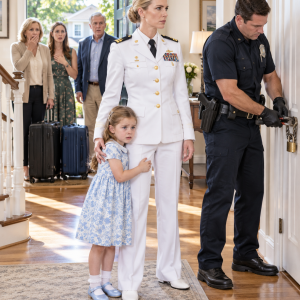
Instead, Aaron walked toward the utility room and returned carrying several large black bags.
He began filling them with my clothes.
For years, I had watched my husband insist that facts mattered.
That assumptions could destroy lives.
That every story had more than one side.
But when the person being accused was his own wife, he didn’t investigate anything.
He chose the easiest version.
“Aaron, look at me.”
He kept packing.
“Take Lila and go.”
For a moment, I genuinely thought I had misheard him.
“You’re throwing your wife and your baby out because of one photograph?”
“I need space.”
“Then ask me questions.”
Silence.
That hurt more than shouting would have.
The Suitcase
Mom carried Lila’s infant seat toward me.
Then she disappeared into the garage and returned dragging an old brown leather suitcase.
I recognized it immediately.
It had belonged to my great-grandfather.
The leather was cracked, the corners were worn, and a thick strap wrapped around its middle.
Mom shoved it toward me.
“Your father said you could have this old thing.”
Then she leaned closer.
“This is what happens when you turn your back on family.”
I looked past her toward my father.
He was standing near the hallway.
He didn’t defend me.
But he looked directly at the suitcase.
Then at me.
Then back at the suitcase.
It lasted perhaps two seconds.
At the time, I thought he was ashamed.
Later, I realized he was giving me the only signal he could.
I loaded my daughter, the black bags, and the old suitcase into my car.