
Milton was eventually placed in the care of his friend’s family, noting that his adoptive parents were actually considered foster parents. “I thought I had been adopted,” he said. “I don’t know how they got away with it.” He went through some issues, eventually landing in a mental hospital where he was diagnosed with schizophrenia. He was released in 1967 and moved to Chicago before eventually settling down in Tuscon. “My in-laws gave us $500, and we moved to Arizona,” he said.
Meeting Lucille
Milton, like his sister, also met their birth mother long after she put her children for sale. In 1970, he stayed with her for a month. However, he got into a fight with her husband at the time, and the husband was arrested. As a result, Lucille threw Milton out. “My birth mother, she never did love me,” he said. “She didn’t apologize for selling me. She hated me so much that she didn’t care.”
Sue Ellen
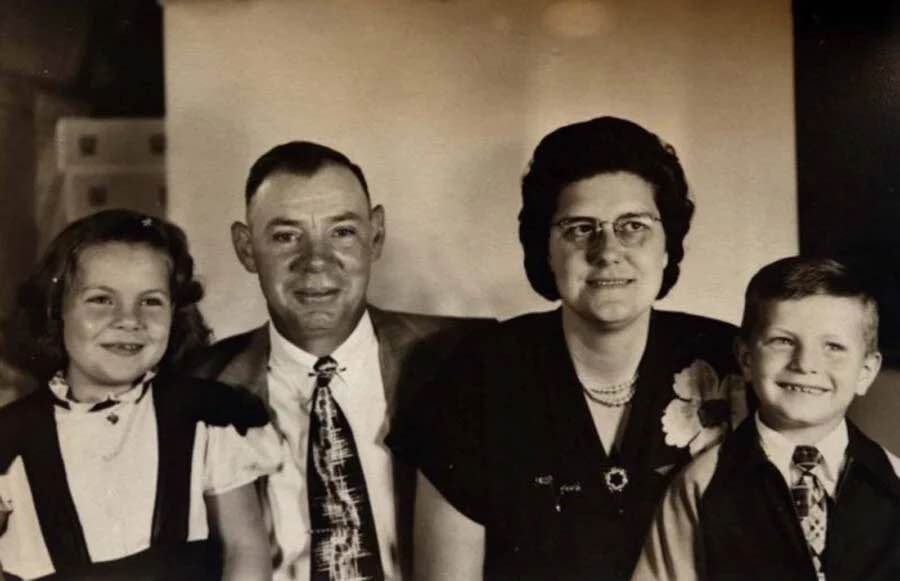
Sue Ellen also had no record of her adoption but believed she had been adopted “legitimately” by a couple whose last name was Johnson. Sadly, she passed away from lung disease in 2013 but not before reuniting with Rae. “It’s fabulous. I love her,” Sue Ellen wrote of her sister. In contrast, “She needs to be in hell burning,” she wrote of her biological mom.
The Youngest to Go
Their youngest brother, David, born Bedford Chalifoux, was not one of the children for sale. Instead, he was taken from his mother and put into the custody of the McDaniels, who were unable to have a child. “I had bed bug bites all over my body,” he said. “I guess it was a pretty bad environment.” His adoption records state that his biological father had left them, and he “does not return to his home because of a criminal record against him in Cook County, Illinois.”
He grew up only a few miles from Rae and Milton and would occasionally visit them. “They’d be tied up in the barn,” McDaniel said. “They were badly abused.” McDaniel also met his birth mother, noting that he had remarried and had four more children. All of whom she kept. “As soon as my mom seen me, she said, ‘You look just like your father,’” McDaniel said. “She never apologized. Back then, it was survival. Who are we to judge?”
“We’re all human beings. We all make mistakes. She could’ve been thinking about the children. Didn’t want them to die.” he concluded.
The image of the children for sale is hauntingly horrific because it was initially believed to be the result of hard times. While that may still be true, it’s evident from the stories of these siblings that their mother had ulterior motives that undoubtedly shake the core of loving mothers everywhere.


