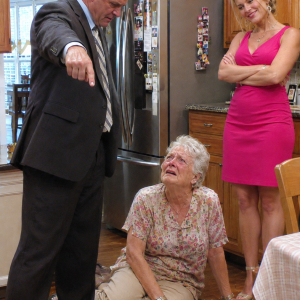
“About what?”
“About sharing your place temporarily.”
“I had already said no.”
“Because you weren’t looking at the situation realistically.”
My attorney remained silent.
I asked another question.
“What were the envelopes for?”
Paige’s expression changed.
“What envelopes?”
I opened the blue folder and slid the photographs across the table.
Her eyes dropped to them.
My father moved slightly in his chair.
“Those don’t prove anything,” he said.
I looked at him.
“I didn’t ask what they proved. I asked why Paige had mail addressed to my home before she supposedly made a spontaneous decision to come over.”
Paige crossed her arms.
“I was trying to make sure important mail didn’t get lost during the move.”
“The move where?”
She didn’t answer.
I took out the building log.
“Eleven days before you entered my apartment, you told the front desk you were going to be staying with me.”
My mother looked at Paige.
“You went there before?”
That reaction surprised me.
“You didn’t know?” I asked.
My mother looked genuinely confused.
“I knew they were talking about moving in. I didn’t know she’d already gone to the building.”
For the first time, I saw that even among the three of them, there had been different levels of involvement.
My mother had encouraged the pressure.
My father had researched it.
Paige had taken concrete steps.
That distinction didn’t excuse anyone, but it mattered.
Then I removed the attorney’s email.
My father saw the letterhead and rubbed his forehead.
“Dad, you asked an attorney about this.”
“I asked what Paige’s options were.”
“And what did he tell you?”
“That it was complicated.”
My attorney finally spoke.
“That’s not what this email says.”

My father looked at her.
She turned the page toward him.
“The advice is quite direct. It says Paige did not have authorization to enter, and it specifically warns against trying to create the appearance of residency through mail or unauthorized occupancy.”
My mother stared at my father.
“You sent that to Paige?”
He exhaled.
“I wanted her to understand what not to do.”
I looked at Paige.
“And after reading it, you brought mail to my home and entered anyway.”
Her face reddened.
“Because nobody was giving me a real solution.”
“I offered you money for another apartment.”
She hit her palm against the table.
“Because you wanted me living somewhere you approved of.”
“No. I offered the amount I could comfortably give you. You were free to choose the apartment.”
“You don’t understand what it’s like.”
“Then explain it.”
Paige looked at me for several seconds.
When she finally spoke, her voice was lower.
“You always have everything.”
Nobody interrupted her.
“What does that mean?” I asked.
She gestured toward me as though the answer were obvious.
“Your career. Money. That place. You travel. Something goes wrong and you just fix it. Do you know what it’s like watching that when I’m trying to keep two kids in the same school district and worrying every month about rent?”
For the first time since London, Paige wasn’t talking about bedrooms or children or what was fair.
She was talking about me.
Or, more accurately, the version of me she had built in her head.
“You think because I can solve some problems, everything I have is available to solve yours.”
“We’re family.”
“I’m family too.”
My voice came out quieter than I expected.
“When did that start meaning I get to have boundaries?”
My mother began crying.
Normally, that would have ended the conversation.
For most of my adult life, my mother’s tears had functioned like a fire alarm. Everyone stopped whatever else was happening and rushed to make the discomfort disappear.
This time, I waited.
My attorney explained the practical consequences. Paige would be responsible for the damage to the office lock. The incident had already been documented, and any employment-related security review involving my workspace would proceed independently. Building access would remain restricted.
Nothing theatrical happened.
Nobody lost everything.
Paige wasn’t marched away.
My parents weren’t publicly humiliated.
They simply had to accept that the story could no longer be reduced to “Marissa wouldn’t help her sister.”
There were messages.
There were access records.
There was video.
There was the attorney’s warning.
And there was a damaged lock.
Paige eventually paid part of the repair bill. My parents paid the remainder.
I paid nothing.
That surprised them more than almost anything else.
Over the following weeks, I changed how I handled family assistance.
Nobody had keys to my home.
Nobody received temporary codes unless I personally arranged the visit.
I stopped sharing my detailed travel calendar.
I stopped sending open-ended transfers accompanied by messages like use whatever you need.
If Ethan needed school supplies, I bought the supplies.
If Lily needed money for an activity, I paid the organization directly.
If Paige had an emergency, she could call me.
But a no was no.
My parents called that cold.
Maybe it looked that way from the outside.
Paige didn’t speak to me for several months.
I never blocked the children.
They hadn’t chosen any of it.
One afternoon, I took Ethan for ice cream. He spent most of the drive talking about school, but when we were sitting outside the shop, he stared down at his cup and asked:
“Are you still mad at Mom?”
I took a moment before answering.
“I’m sad about what happened.”
“But do you still love her?”
“Yes.”
He looked confused.
I folded the napkin beside my cup.
“Loving somebody doesn’t mean they get to do anything they want to you.”
He nodded slowly.
That was all I said.
A few weeks later, my parents visited my apartment for the first time since the incident.
They stayed in the living room.
Nobody asked for a tour.
Nobody joked about the empty bedrooms.
My mother eventually looked down the hallway.
The new office lock reflected the afternoon light.
“This changed our whole family,” she said.
I followed her gaze.
The tiny dent was still visible beside the new keypad.
“No,” I said. “It made something visible that was already happening.”
My father didn’t argue.
He didn’t apologize either.
But for once, he didn’t explain why I was wrong.
Months later, Paige finally sent me a message.
I was sitting at my kitchen island when it appeared.
“I shouldn’t have gone into your place. And I definitely shouldn’t have touched the office door. I still think there were other ways you could’ve helped me, but what I did was wrong.”
It wasn’t perfect.
For a minute, I considered correcting the part about how I could have helped.
Then I didn’t.
I wrote back:
“Thank you for saying that. I did want to help you. I just wasn’t willing to give you my home to prove it.”
She didn’t respond that night.
We never returned to the relationship we’d had before.
Eventually, though, we built a smaller one.
A more careful one.
And strangely, a more honest one.
One evening several months later, I came home after a long assignment and carried my suitcase upstairs.
When I reached the office, I stopped beside the repaired keypad.
The little dent in the frame remained.
For months, I’d considered having it fixed.
Instead, I left it there.
I put my hand on the office door and remembered Paige standing in that same hallway with the fireplace poker. I remembered my mother saying she’d stay once the children were settled. I remembered my father asking how long someone had to live somewhere before things changed.
Most of all, I remembered the message I’d sent from London before any of it happened.
You do not have permission.
For years, I’d treated words like those as the beginning of a negotiation whenever I said them to family.
That night, I entered my code, finished what I needed to do and locked the office behind me.
Then I walked to the front door.
The apartment was quiet.
Three bedrooms.
More space than one person technically needed.
Exactly as my family had said.
I checked the lock once, turned off the hallway light and went upstairs without feeling guilty about any of it.
Behind me, the lock clicked into place.
This time, it didn’t sound lonely.
It just sounded like my door.