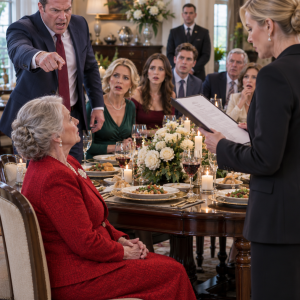
Vanessa laughed. “Richard supplied everything because he built the business alone.”
“That misconception may prove to be the costliest gift he ever gave you.”
When Laura arrived that afternoon, Caroline was visibly tired but fully attentive at the dining table. Their files contained the original capitalization papers, warehouse deeds, trust records, forged approvals, security data, consulting payments, hospital timelines, and the invoice for the bracelet on Vanessa’s wrist.
Laura warned that litigation could never guarantee a perfect result and that certain assets would still be divided as marital property. Caroline understood that Richard’s cruelty did not magically exempt her from the law. She wanted only to preserve separate property, halt unauthorized transfers, recover misappropriated belongings, and expose conduct requiring independent corporate scrutiny.
“I do not need a judge to pronounce me morally superior,” Caroline explained. “I need enforceable orders that stop Richard from spending reality faster than we can prove it.”
Laura requested temporary financial restrictions, exclusive occupancy of the home during Caroline’s recovery, preservation of business records, reinstatement of insurance, and the return of personal possessions. Richard’s legal team answered by calling Caroline secretive, apparently overlooking that their client had falsified her approval while she lay in surgery.
The first hearing drew reporters because Richard had publicly styled himself as a celebrated entrepreneur fleeing a destructive marriage. He entered the courthouse expecting the proceedings to affirm a legend he had carefully manufactured for decades.
Part 4: Caroline Enters the Courtroom
Richard arrived at the Mecklenburg County Courthouse in a tailored gray suit, with Vanessa holding his arm in an ivory dress that suggested victory had already been declared. Several reporters, two company executives, and Richard’s longtime golfing companion followed them into the gallery.
Caroline entered beside Laura without a wheelchair, a nurse, or any visible trembling. She wore a dark green dress, pearl earrings, and supportive shoes hidden beneath the hem. Surgery had diminished her physical strength, but months of preparation enabled her to reserve what remained for the moments that mattered.
Richard studied her with a dismissive smile. “You appear even more exhausted than you did in the photographs.”
“And you appear more certain than your paperwork permits,” she replied.
His attorney began by presenting Richard as Mercer Industrial Group’s sole creative and financial founder. Caroline was characterized as a medically vulnerable wife whose contributions had been emotional and domestic, after which the attorney requested sweeping access to assets allegedly essential to uninterrupted operations.
Laura wrote “remarkably ambitious” on her legal pad, rose, and introduced the original warehouse deed, trust disbursement statements, loan guarantees, payroll ledgers, and twenty-six years of tax records naming Caroline as the company’s founding financial contributor.
“Mercer Industrial Group survived because Mrs. Mercer furnished inherited collateral, the first line of credit, its operating premises, and years of financial oversight,” Laura told the court.
As reporters increased the speed of their notes, Richard shifted uncomfortably beside his counsel. Laura next demonstrated that Caroline had lawfully protected inherited holdings two years earlier, after discovering a pattern of suspicious transactions.
The judge leaned over the bench. “What transactions are you referring to?”
“Electronic authorizations bearing forged signatures, private purchases charged to company accounts, and concealed consulting payments made to Vanessa Cole despite the absence of corresponding work.”
Vanessa instinctively covered her bracelet. Richard muttered that every accusation was invented, causing Caroline to turn toward him.
“Your lawyers may prefer that you remain quiet until the forensic accountant has testified.”
Laura submitted the transaction records, digital-signature logs, Caroline’s anesthesia schedule, internal security reports, and an invoice from a Paris jeweler. The evidence showed that the bracelet had been taken from Caroline’s safe and resized for Vanessa only weeks later.
After examining the invoice, the judge looked directly at her. “Ms. Cole, are you currently wearing the bracelet identified in this exhibit?”
Vanessa lowered her hand, although the diamonds were far too distinctive to hide.
Part 5: The Evidence Takes Control

Richard’s attorney asked for a recess, but the judge declined, emphasizing the temporary nature of the proceeding and the immediate threat to contested assets. Laura then presented her final request.
“Mr. Mercer demands control over inherited property that was never his, unlimited entry to accounts already protected by valid instruments, and business authority that may facilitate further unauthorized transactions. We ask the court to preserve the assets immediately, grant Mrs. Mercer exclusive residential use, order the return of her belongings, suspend his financial authority temporarily, and refer the forged approvals for proper investigation.”
Ignoring his attorney’s attempt to restrain him, Richard stood abruptly. “Caroline, tell them that I created this company and finally gave your family name something worth remembering.”
For one aching instant, Caroline could see the twenty-five-year-old man she had loved inside their rented office, drinking scorched coffee and promising they would build a future together. Then she remembered how that same man had stood beside her sickbed and spoken of her illness as though it were depreciation.
“I supported every foundation you eventually became too proud to recognize, and you interpreted my silence as evidence that I owned nothing.”
The judge preserved Caroline’s separate accounts, restored her access to health insurance, awarded her temporary exclusive possession of the residence, and prohibited Richard from transferring disputed marital property. His corporate signing authority was suspended pending an independent review, and records involving the forged authorizations were referred for additional investigation.
Before leaving the courthouse, Vanessa was instructed to surrender the bracelet. Her fingers shook as she opened the clasp and placed it on the clerk’s evidence tray, while cameras waited outside the doors.
Reporters surrounded Richard on the courthouse steps, demanding answers about corporate funds and the use of his wife’s identity. One question stripped away what remained of his polished expression.
“Mr. Mercer, did you authorize transactions in Caroline’s name while she was unconscious after surgery?”
Vanessa walked toward the waiting car without turning around, proving that devotion founded upon anticipated wealth came with remarkably precise limitations.
Caroline avoided the press and entered her home through a side door. Roses were opening outside the music-room windows, and her mother’s piano still stood exactly where Richard had failed to take it.