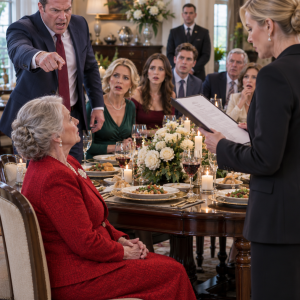
The hearing did not finalize the divorce or settle every question of ownership. It achieved something more immediate: Richard’s access had been stopped, crucial evidence had been protected, and the story he told the public had been replaced by a financial history that could be verified.
Part 6: The Price of Richard’s Freedom
Over the next six months, independent investigators reconstructed years of financial activity. Mercer’s directors uncovered dangerous loans, hidden conflicts of interest, payments benefiting Vanessa, and documents Richard had kept from internal reviewers. Fearing that lenders would reconsider their support, the board demanded his resignation.
Richard sold the uptown penthouse to meet legal costs and repayment obligations. Vanessa soon left for Miami with a fitness investor, after moving a significant share of the money Richard had deposited into an account under her control. Caroline took no satisfaction from that humiliation, because foreseeable betrayal did not amount to meaningful justice.
The divorce agreement recognized Caroline’s inherited warehouse, protected trusts, individual accounts, and property acquired before marriage. Assets accumulated jointly were divided through negotiation after the parties addressed improper transfers, reimbursement demands, and company liabilities.
Richard rented an apartment above a dry-cleaning shop and complained to their grown children about the constant mechanical noise. He portrayed himself as the victim of Caroline’s calculated scheme, never admitting that she had needed protection only because he exploited the access she once gave him in trust.
During mediation, Richard asked why she had spent two years quietly reorganizing her finances instead of confronting him.
“Confronting you would have revealed which evidence needed to disappear, while lawful safeguards protected what was still left,” Caroline answered.
“You planned to ruin me while pretending to recover beside me.”
“I planned to survive after you forged my permission. Whatever ruined you came from choices carrying your own signature.”
Without corporate power forcing every room to revolve around him, Richard appeared considerably older. Caroline finally understood that she had devoted decades to shielding him from the ordinary dimensions of his character.
Her physical recovery proceeded more slowly than outsiders imagined. Certain mornings still demanded medication, cautious movement, and assistance from her children. Even so, she grew stronger once she stopped measuring her worth against Richard’s impatient definition of usefulness.
Laura stayed with her through the last negotiations, challenging every attempt to dismiss domestic labor as financially meaningless. What had begun fifteen years earlier as an estate-planning relationship ended the divorce as proof that careful preparation could also be an expression of self-respect.
Part 7: Familiar Voices Return to the House

One year after the pivotal hearing, Caroline hosted dinner in the house Richard had intended to take from her. Her children filled the dining room, her grandchildren raced through the garden, and the restored piano caught the evening light streaming into the music room.
The gathering was not a celebration of Richard’s losses, because Caroline refused to construct peace from someone else’s collapse. Instead, the family honored her recovery, the home’s legal security, and a future no longer shaped by the need to anticipate his moods.
Before the meal, her eldest daughter asked whether she regretted remaining quiet while Richard and Vanessa publicly celebrated.
“Silence born from fear can preserve abuse, but silence used temporarily within a careful plan can preserve evidence,” Caroline replied.
Her son admitted that he had once accepted Richard’s claim that he alone had created Mercer Industrial Group. Caroline showed him the earliest payroll ledger, written in her hand, along with the warehouse loan backed by her father’s trust.
“Your father brought ambition and ability, but partnership became deception when he erased every resource and every person supporting him,” she explained.
After dessert, Laura lifted her glass. “To Caroline, whose greatest error was allowing arrogant people to mistake compassion for ignorance.”
Caroline touched the returned bracelet around her wrist. It had once represented the agreement that helped launch the company. After Vanessa wore it as stolen evidence of victory, Caroline considered selling it, but ultimately retained it as a reminder that possessions could be restored even when trust could not.
“I would prefer a toast to peace. Being underestimated matters only until you no longer need acknowledgment from people determined to misunderstand you.”
Warm evening light crossed the roses she had planted twenty years before. Their branches showed scars left by storms and pruning, yet fresh blossoms continued emerging wherever the underlying structure remained sound.
When the final guest had gone, Caroline sat at the piano and played the imperfect melody her mother taught her at eighteen. A few notes came late, and her hands tired before she reached the end, but no one interrupted or corrected her. The music belonged to the house once more, and the house belonged securely to Caroline.
Part 8: The Victory No Judge Could Grant
Later public versions reduced Caroline’s experience to the tale of a clever wife secretly shifting money before humiliating an adulterous husband. The truth demanded greater accuracy. She had neither stolen marital funds nor falsified ownership or hidden illegal transfers. Under legal guidance, she had separated inherited assets, canceled permissions, secured personal accounts, and recorded wrongdoing.
Richard was not destroyed because Caroline outmaneuvered an innocent man. His collapse resulted from forged signatures, abused company funds, irresponsible loans, stolen jewelry, and the arrogant assumption that sickness had turned his wife into an obstacle without rights or memory.
Caroline eventually sold several business interests and created a scholarship for women returning to financial careers after serious illness. Every recipient also received access to independent legal and financial education, because Caroline believed lasting security should come from knowledge rather than dependence on another person’s goodwill.
Two years after the divorce, Richard wrote from his rented apartment and requested a private conversation without attorneys present. He said her illness had frightened him, Vanessa had manipulated his discontent, and pride had prevented him from admitting how much he depended upon Caroline.
She read his letter beside the flowering roses and believed that some portion of his remorse was genuine, because consequences sometimes taught what devotion never could. Believing him, however, did not require her to reopen a door that had nearly closed upon her forever.
Her response was brief and civil. “I hope you create an honest life from whatever remains, but my peace no longer depends upon your presence.”
There was no cruelty in the message, because Caroline no longer confused boundaries with revenge. Richard had once warned that she could not imagine the loneliness awaiting her after he left. Instead, solitude gave her enough room to understand how profoundly lonely she had already been inside their marriage.
At fifty-three, Caroline initially thought recovery meant becoming the woman she had been before surgery. In time, she realized recovery could create someone new: a woman less willing to accommodate disrespect, more exact about truth, and no longer prepared to subsidize betrayal in the name of loyalty.
The court protected her home, accounts, and evidence, but no judge could award the transformation that followed. That victory belonged entirely to the woman who kept reading every page while everyone around her assumed that pain had rendered her powerless.
THE END