The Envelope in the Safe

Three weeks after my husband passed away, my mother-in-law placed a real estate listing on the kitchen counter and told me my daughter and I had thirty days to leave our home.
Her daughter stood beside her, sipping coffee from a paper cup as if she had come to inspect a property rather than threaten a grieving family.
“You should be grateful Mom is giving you a month,” she said.
I didn’t argue. I didn’t ask them to reconsider, and I didn’t tell them they were cruel. I only watched my seventeen-year-old daughter appear on the stairs, pale and uncertain, and felt the last of my patience settle into something colder and steadier.
“Are we being kicked out?” she asked.
I didn’t know the answer yet. But I knew where to look.
My husband had left a sealed envelope in the safe at the back of his closet, with my name written across the front in his careful block letters. I took it to his attorney the next morning. When he read the first page, all the color seemed to leave his face. He closed the office door, turned the lock, and looked at me.
“Mrs. Hayes,” he said quietly, “you’d better sit down.”
The House We Had Built
The trouble began on a rainy Tuesday morning in early November, twenty-one days after I stood beneath a gray sky while an Army honor guard folded the flag that had covered my husband’s casket.
I had served in the United States Army for twenty-eight years, most recently as a logistics and operations officer at Fort Liberty, and I had spent much of my adult life learning how to keep my attention on the task at hand. I could read a supply report while a room buzzed with unanswered questions. I could look at a schedule that had come apart at the seams and still find the next useful step. I knew how to make a plan when other people were waiting for someone to tell them what to do.
Grief, however, did not respond to orders.
That morning, I had been home from the base for less than an hour. My boots sat by the mudroom door, and I was still wearing my tan Army T-shirt and faded jeans. In the kitchen, a stack of insurance forms waited beside my coffee mug. I kept looking at the microwave clock, not because I needed to know the time, but because it was something to look at besides the paperwork.
Owen had always handled the larger financial matters. He knew which papers belonged in the filing cabinet and which ones needed a signature that day. He remembered renewal dates and account numbers and the name of the man who had serviced the furnace. Those details had seemed ordinary when he was here. Now every envelope carried the possibility of one more thing I hadn’t known I would have to manage alone.
The front door opened without a knock.
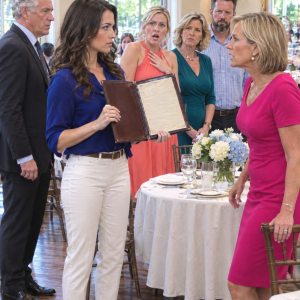
My mother-in-law, Marjorie, came in first, bringing the cold, damp air with her. She wore a wool coat and sensible leather shoes, and she did not pause to wipe them on the mat. Her daughter, Paige, followed close behind, her large sunglasses pushed up into her highlighted hair and a designer coffee cup in one hand.
They were both white Americans, like Owen and me, and had been part of my life for years. I had shared holidays with them, sat beside them through family worries, and watched Paige grow from a girl into a woman who was often charming when she wanted to be. I had thought of Marjorie as family, even when we disagreed.
That morning, neither of them looked at me as if I were family.
“We need to talk about the transition,” Marjorie said.
I glanced at the listing in Paige’s hand. It showed a familiar brick house on a tree-lined street in Fayetteville, North Carolina. Our house. The one with the kitchen Owen and I had repainted twice because we couldn’t agree on the color. The one where our daughter, Lily, had learned to ride a bicycle in the driveway and where we had hosted more Thanksgiving dinners than I could count.
“What transition?” I asked.
Paige leaned against the counter and took a sip of her latte.
“Mom has spoken with a real estate agent. We’re going to put the property on the market. You and Lily will have thirty days to pack and move. That should be plenty of time if you stay organized.”
For a moment, I wondered whether I had heard her correctly. I looked from the listing to Marjorie, waiting for one of them to say this was a misunderstanding. Neither did.
“You’re selling my house?” I asked.
Marjorie’s mouth tightened.
“It was Owen’s house. The property came from the family, and I’m trying to settle things fairly before the estate becomes complicated.”
Fairly. The word did not belong in that kitchen. Owen had only been gone three weeks. Lily was upstairs in his oversized Panthers sweatshirt, moving through the rooms as if she were afraid the house might change while she wasn’t looking. The last thing either of us needed was to learn that our place in the home had been temporary.
A board creaked on the landing. Lily stood halfway down the stairs, one hand gripping the banister.
“Grandma?” Her voice was small. “Are we supposed to leave?”
Marjorie turned her head but didn’t answer. Paige suddenly became interested in her coffee cup. Their silence lasted only a few seconds, but my daughter’s face changed while she stood there listening to it.
I had watched people hesitate under pressure before. I knew the look of someone trying to understand whether the person across from them was a threat. Lily didn’t know what this conversation meant. She only knew that two adults she had trusted were standing in her home, talking about removing her from it.
I walked to the front door and opened it.
“You need to leave.”
Paige gave a short, disbelieving laugh.
“Ignoring the financial situation won’t make it disappear, Rebecca.”
“I said, leave my house.” I held her gaze. “And don’t threaten my daughter again.”
Marjorie collected her handbag, looking more offended than ashamed.
“You’re being unreasonable.”
“I’ll be reasonable when I know the facts. Right now, I’m asking you to go.”
Paige stepped past me, shaking her head.
“You’ll regret this.”
I closed the door behind them and turned the lock. The click sounded louder than it should have.
Lily was still on the stairs.
“Can Grandma make us leave?”
I wanted to tell her no, that the house was ours and nobody could take it. But I had spent too long in the Army pretending to have information I did not possess. False certainty might calm someone for a minute; it could not protect them.
“I don’t know yet,” I said, taking her hands. “But I’m going to find out.”
What Owen Had Left Behind

I spent the next two hours searching Owen’s office. I went through the desk drawers, the filing cabinet, and the neat stack of binders he had labeled in a handwriting I could recognize from across a room.
I found tax returns and appliance manuals, insurance papers and old photographs. I found a folder with our daughter’s school records and a folded birthday card from me that he had kept for some reason. I did not find anything that explained why Marjorie believed she had a claim to our home.
At noon, I remembered the small fire safe at the back of Owen’s closet. He had told me its combination once, a few years earlier, and I had written it on a card that now seemed to have vanished. Still, I knew the numbers well enough to try. I turned the dial slowly, one hand braced against the closet wall.
The safe opened.
Inside were our passports, a few family documents, and a thick manila envelope. My name was printed across the front in Owen’s squared-off handwriting.
Rebecca. If anything happens to me, take this immediately to Samuel Reed. Do not open it alone. And do not trust Paige.
I read the sentence twice. On the third reading, the room seemed to grow smaller.
I knew Owen had been worried about Paige’s business. He had mentioned that her boutique staging company was having a difficult year, but he had never told me the problem was serious. I had assumed he was helping her as a brother might help a sister: with advice, a little time, perhaps a small loan.
I had not known he was preparing for a dispute over our home.
I took the envelope downstairs and set it on the kitchen table. It felt heavier than a folder of paper should. Lily was in the living room, sitting with a blanket around her shoulders and the television turned off. I put the envelope away in my bag, then sat beside her.
“I found something Dad left for me,” I said. “I need to take it to his attorney.”
She nodded, but her eyes stayed on the rug.
“Is it about the house?”
“I think it might be.”
She swallowed.
“Mom, I don’t want to move.”
I pulled her close. Her hair smelled like the lavender shampoo she had used since middle school.
“I know. We’re going to take this one step at a time. You don’t have to solve anything today.”
That night, she slept in her father’s old sweatshirt, and I sat at the kitchen table long after the lights were off upstairs. I could hear the refrigerator hum and the wind touch the windows. I kept thinking about the envelope and the warning on its front.
Do not open it alone.
I didn’t. I waited for morning.
The Papers on Samuel Reed’s Desk
Samuel Reed’s office was in a modest brick building in downtown Fayetteville, above a tax preparer and across the street from a small coffee shop. Owen had used him for years. Samuel was a silver-haired man with kind eyes and an unhurried way of listening that had always made me feel he was taking in more than the words I said.
I arrived in uniform, partly because I had come straight from Fort Liberty and partly because I needed the steadiness of it. The envelope lay between us on his desk.
“Owen told me not to open this by myself,” I said. “Marjorie and Paige came to the house yesterday. They say Marjorie owns it and that we have thirty days to leave.”
Samuel studied the envelope before picking up a letter opener.
“Did they give you anything in writing?”
“Only a listing. They said an agent was coming to walk through the house.”
He opened the envelope and removed several legal documents, a smaller sealed letter, and a USB drive. He slid the letter toward me without opening it.
“This one is for you,” he said. “We’ll read it when we’ve reviewed the rest.”
He examined the first document, then the next. His eyes moved steadily over the pages until they stopped at a heading. He went back to the top, read the paragraph again, and took off his glasses.
“What is it?” I asked. “Does she own the house?”
Samuel placed one hand on the paper.
“This changes the picture considerably.”
He turned the document around. It was a warranty deed dated six years earlier. According to it, Marjorie had once owned an interest in the property, but Owen had bought her out in full. Samuel showed me the notarized transfer and a copy of a cashier’s check for $126,000. The note on the check said Final House Interest Buyout.
“Your husband paid her for her remaining share,” Samuel said. “This deed and the payment record establish that the property belongs to you and Owen’s estate. Marjorie has no ownership interest to sell.”
I let out a breath I hadn’t realized I was holding.
“Then why would Paige tell her that she could put the house on the market?”
Samuel picked up the USB drive.
“Let’s see what Owen saved.”