The drive contained scanned papers, emails, and audio files. Samuel opened a folder labeled Paige — Financial Records and found a request to transfer part of the house back into Marjorie’s name. Paige had sent it to Owen two months earlier. He had refused.
In an email beneath it, he wrote that he would not put my home or Lily’s future at risk to solve Paige’s financial problems.
I leaned toward the screen.
“He never told me.”
“He may have been trying to handle it quietly,” Samuel said. “Some people believe they can keep a family problem from spreading if they carry it alone.”
That sounded like Owen. He had always believed the right amount of patience could solve almost anything.
Samuel opened another file, but before he could explain what it contained, my phone vibrated against the desk. A message from Paige appeared.
The realtor is coming at four for a preliminary walkthrough. Please have the house ready.
Samuel read it over my shoulder.
“Don’t let them in,” he said. “They have no authority to enter, and you should direct any further contact to me.”
I typed a reply.
No one has permission to enter my home. Direct all questions to my attorney.
Samuel nodded.
“Good.”
Then he turned the laptop toward me. A document on the screen carried the heading Promissory Note. The name on it was Paige’s.
I began to read the amount, but my phone rang again. This time, it was Lily.
“Mom, Aunt Paige is here,” she said. Her voice was tight with worry. “There’s a woman with her, and they’re coming up the front walk.”
I stood so quickly my chair scraped the floor.
“Stay inside. Lock the door, and don’t open it for anyone. I’m on my way.”
Holding the Front Door

I left Samuel’s office without waiting to hear the rest of the explanation. My car crossed the streets of Fayetteville under a low, cloudy sky, and I spent the drive telling myself to keep my attention on the road.
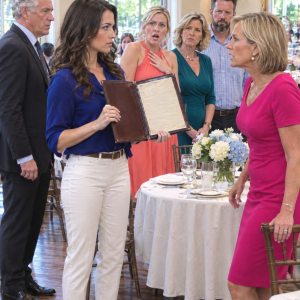
When I turned onto our street, Paige’s silver Lexus was parked across part of the driveway. She stood on the porch, pressing the doorbell again and again. A woman in a navy blazer waited a few steps behind her, holding a clipboard and looking as though she wanted to be anywhere else.
I parked, got out, and walked up the front path.
“Step away from the door.”
The woman with the clipboard immediately backed toward the sidewalk. Paige crossed her arms.
“We’re just taking a quick look at the property.”
“The property isn’t for sale. You don’t have permission to enter.”
“Mom owns this house.”
“She doesn’t. Owen bought her share six years ago. I have the deed and the canceled check.”
The agent looked from Paige to me.
“I think I should wait until the title is confirmed.”
“That would be wise,” I said.
She returned to her car. Paige watched her go, her face losing the composure she had worn at the door.
“You think a few papers settle everything?” she asked. “Owen owed this family.”
“He paid your mother for her interest in the house.”
“She deserves more than that.”
“That isn’t your decision.”
Her gaze hardened.
“You have his pension. You have the insurance money. Mom gets nothing while you keep the house?”
I took a step toward her.
“Marjorie was paid. You’re not coming inside, and you’re not bringing another agent here.”
Paige shook her head.
“You’ll regret this. Owen isn’t here to protect you anymore.”
“I can protect my daughter myself.”
She left in a rush, tires hissing over the wet pavement. I stood on the porch until the car disappeared around the corner, then went inside.
Lily waited in the hall, her arms wrapped around herself.
“Are we safe?” she asked.
I pulled her into a hug.
“We’re here, and the door is locked. That’s where we start.”
That evening, after Lily went upstairs, I opened the smaller envelope Owen had left for me. His letter began with an apology.
He wrote that he had spent two years trying to deal with Paige’s troubles without bringing them into our home. He had hoped that if he gave her time and a chance to repay what she owed, she would find her way back to solid ground. He had not wanted me to carry another worry while I was balancing the Army and our family.
He wrote that he had been wrong to keep it from me.
I stopped there, unable to read for a few minutes. Owen had been gone only three weeks, and the letter was the first time I had heard his voice in my mind so clearly since the funeral. I could almost see him at the desk, choosing each word carefully.
The note mentioned the promissory agreement on the drive. I opened the file.
Two years earlier, Owen had loaned Paige $84,000 from a separate inheritance he had received. She had made four payments and then stopped. His records included the original agreement, the payment history, and messages in which Paige asked him to forgive the balance.
Her business was failing. The money she owed him was more than a number on a page; it was the reason she wanted the estate in turmoil. If she could persuade Marjorie that she owned part of the house, a sale might bring cash into reach before anyone had time to examine the records.
The thought made my stomach tighten. Paige was trying to turn our home into a solution for a problem she had created, and she was using her mother to do it.
Before I could call Samuel, a message appeared on my phone.
Paige has hired an attorney. He filed a petition in probate court claiming Marjorie was pressured into signing the deed. He’s asking the court to freeze estate assets.
The message was from Samuel. A second one followed.
He is also threatening to challenge Lily’s trust.
I sat at the kitchen table with the letter in my hands. Owen had tried to manage this by himself. I understood why. He had wanted the people he loved to remain on speaking terms, to protect his mother from embarrassment, to give his sister a chance to make things right.
But I had learned something in my years of service: a boundary you refuse to establish does not disappear. It only becomes harder to restore.
The Cost of a Lie
The next week was harder than I expected. Paige’s attorney filed papers, and questions about the house moved through family conversations faster than facts could catch up. Paige never used my name on social media, but she posted remarks about relatives who showed their character when an older family member was vulnerable. She wrote about protecting a parent from greedy in-laws and about people who mistook inheritance for entitlement.
In a military town, gossip did not need much help traveling. I heard that someone had seen the posts. A woman I knew from the commissary gave me a cautious, sympathetic look. I kept my face composed and went on with my work.
At Fort Liberty, I managed supply plans and operational budgets worth millions of dollars. At home, I could not remember which coffee Owen bought.
The moment caught me on a Thursday afternoon. I had stopped at the commissary for milk, bread, and coffee. I stood in front of the shelves, looking at six brands of dark roast, and realized I could not remember which one he preferred. The fluorescent lights hummed overhead. A cart rattled somewhere behind me. Ordinary life continued, but the person who had made small choices with me was gone.
For twenty-eight years, I had learned how to keep moving through fatigue and worry. Nobody had taught me how to stand in a grocery aisle and wonder how many more ordinary things I would forget.
I left the cart where it was and walked to my car. I rested my forehead on the steering wheel and cried until I could breathe again.
When I arrived home, an old Buick was parked in the driveway. Marjorie stood on the porch, shivering in the late afternoon chill. She carried no paperwork and had not brought Paige with her.
I approached carefully.
“What are you doing here?”
She looked down at her hands.
“Could I come in? I need to talk to you.”
I should have said no. I remembered how she had stood in my kitchen and announced that Lily and I had thirty days. Still, she looked smaller than I had ever seen her, and I opened the door.
We sat at the kitchen table. It was the same place where she had laid the listing on the counter, and for a while, neither of us spoke.
At last, she pulled a folded document from her purse.
“Paige’s attorney sent this for me to sign,” she said. “It says Owen and you pressured me into giving up my share of the house.”
“Did we?”
Marjorie stared at the page.
“No. I had my own attorney review the agreement. I knew what I was signing. Owen paid me exactly what we agreed on.”
She pressed her lips together, then covered her mouth with one hand.
“Paige told me you and Owen had received a great deal of money, and that he had left his mother with nothing. She said you were trying to erase our family from the house.”
The anger I had held onto since that first morning shifted into something more complicated. Marjorie had come into my home with a plan to push us out, but she had not made that plan alone. Paige had given her a story designed to fit the fear Marjorie already carried: the fear that her son’s life was moving on without her, that she had been forgotten, that she no longer mattered.
“Did Paige tell you about the $84,000 Owen loaned her?” I asked.
Marjorie lifted her head.
“What money?”