The Empty Chairs

I was sitting in the small chapel at St. Matthew’s Hospital when I called my father. My hands were still shaking, and the paper cup of water beside me had gone untouched. Through the chapel windows, the afternoon light fell across the floor in pale rectangles, the kind of ordinary detail that stays with you when everything else has stopped making sense.
My husband, Samuel, had been driving our two children along Interstate 81 outside Roanoke that morning. A commercial truck crossed into their lane, and there had been no time for Samuel to steer away. By the time I reached the hospital, the doctors had told me there was nothing more they could do.
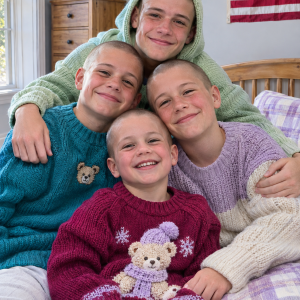
My daughter, Annie, was eight. My son, Owen, had just turned five. Samuel was thirty-nine, and he had been the person who made even a routine Tuesday feel like a day worth remembering.
I was the only one in our little family who had not been in the car.
That fact settled over me with a terrible weight. I was still here, still able to breathe and make phone calls, while the three people I loved most were gone. I knew there was no reason to blame myself for not being in the car, but grief does not always wait for reason before it begins asking questions.
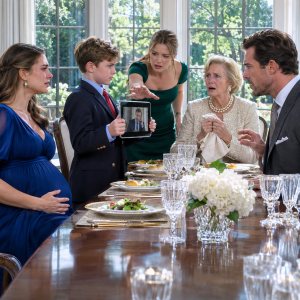
My father answered on the fourth ring. Behind him I heard music, laughter, and the soft clatter of dishes. My younger sister, Brooke, was celebrating her birthday. I could picture my parents’ dining room, the table set for guests, and the cake my mother would have ordered from the bakery near their house.
“Dad,” I whispered. “There’s been an accident.”
The sounds behind him grew quieter.
“What happened?”
I tried to speak, but my throat tightened. When I managed to get the words out, I told him Samuel was gone. I told him Annie and Owen were gone, too. My mother took the phone from him, asking me to repeat what I had said, and I did, though each word felt harder than the last.
Then I asked them to come to the funeral on Friday.
My father paused. I heard him take a breath.
“Friday?”
“Yes. Please, Dad. I need you there.”
He was silent long enough for me to imagine he was trying to find the right words. Then he said the dinner reservation for Brooke’s birthday had been booked weeks earlier.
“We can’t leave her alone on her birthday,” he said. “We’ll be with you another time.”
For a moment, I thought I had misunderstood him. My husband and children had just been lost in a single morning, and my father was explaining why he could not attend their funeral.
“Dad, I’m burying my family.”
“I know, sweetheart. But we’ve already made plans.”
He ended the call before I could answer.
At the funeral, Samuel’s parents stayed close enough to hold me upright when my knees weakened. His mother, Joan, cried quietly beside me, her hand wrapped around mine. His father, Peter, stood at my other side, one steady palm resting on my shoulder as if he could keep me from being swept away by the moment.
The chairs reserved for my family were nearly empty.
My parents were not there. Brooke was not there. Neither were my cousins. My aunt Vivian was the one person from my side of the family who came. She had driven nearly five hours after hearing about the accident from a neighbor, because my parents had not even thought to tell her.
Three days later, my mother sent me a text. I remember the hope that rose in me when I saw her name on the screen. It lasted only until I read the message.
“I hope you’re managing. Brooke felt hurt that you didn’t call her on her birthday.”
I read it again and again, until the words blurred. Something in me seemed to go quiet. It was not peace, and it was not forgiveness. It was the moment I understood that I could no longer pretend my family would show up simply because I needed them.
For the next six months, I stopped answering their calls. There were not many, and most of the messages they sent were cheerful in a way that made them feel even farther away. They shared holiday photographs in the family group chat and sent casual invitations to Brooke’s engagement party, as though I had merely been too busy to attend.
My days were full of things no one asked about. There were legal forms, insurance calls, medical records, and boxes of belongings I could not bring myself to sort. Samuel’s coffee mug stayed beside the kitchen sink. Annie’s school jacket hung by the front door, and Owen’s small sneakers sat crooked beneath the bench where he always left them. I could not move those things, but I could not look at them for long, either.
No one in my family asked what I needed. No one asked how it felt to wake in a house that still seemed to expect the sound of children coming down the hall. I was left to learn, one day at a time, that the people I had counted on were not coming.
What the Settlement Could Not Buy
The legal process continued through the winter. It meant sitting in conference rooms while attorneys and insurance representatives discussed my family in the language of reports and numbers. Each meeting left me tired, but I understood why the work mattered. The evidence showed that the truck driver had fallen asleep at the wheel, and the company accepted responsibility for what had happened.
At one meeting, my attorney, Martin Hale, placed a folder in front of me.
“The settlement is finalized,” he said. “The total is eighteen million, seven hundred thousand dollars.”
I looked at the figure on the page. It was so large that, for a moment, it seemed to belong to someone else’s life.
I did not feel wealthy. I did not feel lucky. I felt the familiar ache of knowing that no number could buy another morning with Samuel, another drawing from Annie, or one more of Owen’s elaborate explanations about why every passing truck deserved a wave.
Martin explained how the funds would be handled and what steps I needed to take to protect them. I listened, then looked down at the folder.
“Could some of this help other families?” I asked.
He leaned forward.
“Certainly. We’d need to set it up carefully, but you could establish a foundation.”
The idea had been forming in me for weeks. I could not change what had happened to my family, but perhaps I could help another parent learn about child passenger safety or support someone left with the same kind of bewildering paperwork and grief. I wanted Samuel, Annie, and Owen to be remembered as people who had mattered, not as names attached to a headline.
“I want to do something for children,” I said. “Road safety, education, and help for families after serious accidents. I don’t want my children remembered only for how we lost them.”
The foundation began as a name written in a notebook: the Annie and Owen Child Safety Foundation. It was not grand at first. It was a purpose, and a reason to get out of bed on mornings when the quiet felt too heavy.
Samuel had always been careful behind the wheel. He checked the children’s seat belts, even when they insisted they had already done it themselves. If Owen tried to unbuckle before the car had stopped, Samuel would remind him to wait. He used to tell Annie that looking after people was a kind of courage.
I wrote that down, too.
The foundation took shape slowly, with help from Martin and a financial adviser. We discussed child passenger safety programs, community education, and assistance for families facing the practical burdens that follow a serious road accident.
Then, on a freezing Tuesday in January, my name appeared in a local news headline: WIDOW OF I-81 CRASH VICTIMS RECEIVES $18.7 MILLION SETTLEMENT, ANNOUNCES CHILD SAFETY FOUNDATION.
The article included a photograph of me beside a picture of Samuel, Annie, and Owen. I had agreed to speak because I wanted other people to understand why the foundation mattered. I had not expected the headline to travel as far as it did.
By noon, my phone had begun to ring. Some calls came from reporters, and some came from people offering condolences or asking about the foundation. Then my father’s name appeared on the screen.
He had not called in nearly six months.
I let it ring. My mother called next, then Brooke. My father tried again. When I still did not answer, a message appeared.
“We just saw the wonderful news. We’re so proud of you. Please call us, sweetheart.”
A second message followed.
“Your father and I would love to see you. We should get together as a family.”
Brooke sent her own.
“I can’t believe the settlement is eighteen million! We have so much to catch up on.”
I stared at the screen, trying to understand how they could have been absent for half a year and suddenly sound so eager to see me.
My aunt Vivian called that afternoon.
“Have your parents contacted you?”
“Yes.”
She let out a slow breath.
“I thought they might. Be careful, honey. You don’t owe anyone access to your life just because you share a last name.”
I looked at the family photograph on the mantel, the one taken at a summer picnic. Samuel was sitting in the grass with Annie leaning against his shoulder, while Owen held a toy airplane over his head.
“I know,” I said, although I was not sure I did.
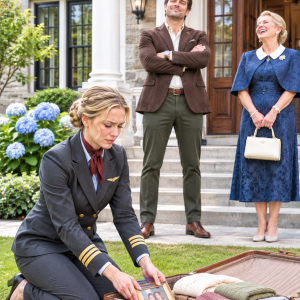
At 6:18 that evening, someone knocked hard on my front door. I looked through the curtain and saw my parents’ car in the driveway. My father was on the porch, with my mother and Brooke beside him. Brooke held a bouquet of white roses.
My phone buzzed again.
“Open the door,” she had written. “We have so much to talk about.”
The roses were the same kind I had chosen for Samuel’s funeral. I stood behind the curtain longer than I meant to, then finally opened the door.
My father stepped forward with his arms raised, ready to hug me.
“There’s our girl.”
I moved back. His arms remained in the air for a moment before he lowered them.
My mother looked past me into the hall.
“You look tired, sweetheart.”
I could have told her I had been tired since the day she chose a birthday dinner over her grandchildren’s funeral. Instead I asked the one question I could manage.
“Why are you here?”
Brooke lifted the flowers.
“We came to see you.”
I looked at my father.
“After six months?”
He cleared his throat.
“Family should stick together.”
I stepped aside, just enough to let them enter. My father glanced at the photographs on the mantel, but he did not mention Samuel or the children. My mother set her handbag on the living-room table. Brooke placed the roses beside it.
Then my father turned to me.
“You’ve been through a lot.”
“Yes.”
“We’ve been worried.”
I looked at him.
“Really?”
My mother intervened before he could answer.
“We’re here because we want to reconnect.”
“You didn’t come to the funeral.”
She lowered her eyes.
“We were overwhelmed.”
“You didn’t call afterward.”
“We thought you needed space.”
“You texted me to say Brooke was hurt that I didn’t call her on her birthday.”
My mother glanced toward my sister. Brooke looked down at her purse.
My father sighed.
“We didn’t come here to argue about the past.”
That was convenient, because the past was where all the evidence of their choices lived.
I picked up the photograph from the mantel. Samuel was sitting on the lawn with Annie and Owen, taken only a few weeks before the accident. Annie had an arm around her father’s neck, and Owen held his toy airplane.
“They were your grandchildren,” I said.
My mother looked at the picture.