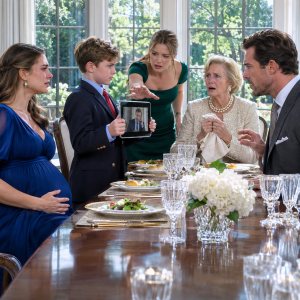
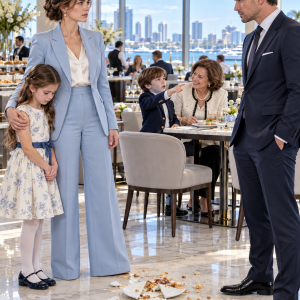
Aunt Vivian finally spoke.
“She doesn’t need to explain herself anymore.”
Everyone turned to her. She looked steadily at my parents.
“I drove nearly five hours to attend that funeral. I saw Claire standing beside those three caskets, and I saw Joan holding her because she could barely stand. I remember the empty seats. I remember the message you sent afterward, saying Brooke was hurt because Claire hadn’t called on her birthday.”
Brooke’s face tightened.
“That was a private family matter.”
“It was a choice,” Aunt Vivian replied. “And everyone here should be honest about it.”
My father sat down. He looked older than he had at the start of dinner.
“We made a mistake,” he said. “We should have come. We should have called. We should have been there for you. I’m sorry.”
It was the first apology I had heard from him.
My mother reached across the table.
“Me too, sweetheart.”
I looked at her hand but did not take it.
“I appreciate the apology,” I said. “But it doesn’t mean I can give you money.”
My father nodded, though my mother seemed surprised.
“Then maybe we can start again,” she said.
“We can start by being honest. I don’t know whether our relationship can be what it was before, but it can’t depend on what I can give you.”
Brooke leaned back.
“So you’re saying no?”
“Yes.”
She pushed her chair away from the table. My mother gathered her handbag, and my father stared down at his plate.
“I hope you understand what you’re doing,” he said.
“I do. I’m choosing not to let money become another reason to lose myself.”
Aunt Vivian left with me. Outside, the night air felt cold against my face. For a moment, I wanted to call Samuel and tell him how the dinner had gone. The wish came so naturally that it hurt all over again. I could not call him, or Annie, or Owen. But I could decide what happened next.
The following Monday, I met with Martin. We reviewed the foundation’s plans, its governance, and the separation between charitable and personal funds. I wanted the organization to be transparent and professionally managed.
“Then let’s build something that lasts,” I told him.
For the first time since the accident, I was not only reacting to what had happened. I was making a decision about the future.
A Door Left Open

A few days later, a handwritten letter arrived from my father. I recognized his writing before I opened it. I stood at the kitchen counter for several minutes, then unfolded the single page.
He wrote that he had been thinking about the day I called. He remembered hearing my voice while Brooke’s birthday celebration continued around him, and he remembered telling himself he would call me later. He admitted he had never called. He wrote that he should have been at the hospital and beside me at the funeral, and that he had failed me.
He was not asking for money, the letter said. He was asking whether I would meet him.
I read it more than once, then called Aunt Vivian.
“What do you think?” I asked.
“Meet him only if you want to,” she said. “If he’s sorry, he can show you.”
I did not want to spend the rest of my life angry, but I also did not want to pretend the hurt had disappeared. In the end, I agreed to meet him at a public park where Samuel used to take the children on weekends.
It was a cold afternoon. The trees were bare, and the walking paths were almost empty. My father was waiting on a bench. He stood when he saw me, then gestured for me to sit. For a few minutes, neither of us said anything.
A couple walked past with a little girl in a bright pink jacket. My father watched them.
“I keep thinking about Annie,” he said.
I waited.
“She used to send me drawings. She made me a birthday card once. I still have it.”
I nodded.
“She loved drawing.”
He rubbed his hands together.
“She wrote that I was the best grandfather in the world. I don’t know how I became someone who couldn’t even attend her funeral.”
I looked at the ground. It was the first time I had heard him speak about Annie without trying to change the subject.
“I don’t know either,” I said.
He nodded.
“Your mother and I kept telling ourselves that giving you space was the right thing. The longer we waited, the harder it got to call. Then we saw the headline, and I realized how much time had passed.”
I looked at him.
“Why did you ask about the money?”
He lowered his eyes.
“We were thinking about ourselves. Brooke had been talking about her business, and your mother and I were worried about our finances. We convinced ourselves it was reasonable to ask. We forgot what the money represented.”
“You forgot what happened to my family.”
He nodded.
“Yes.”
We watched a boy run down the path, trying to catch a leaf that had come loose from a tree. For a moment, I could almost imagine Owen doing the same. The ache arrived so quickly that I pressed my lips together.
When I looked back at my father, I asked the question I had been carrying since the funeral.
“Did you know I was alone afterward?”
He frowned.
“What do you mean?”
“Did you know I couldn’t sleep? That I kept walking into the children’s rooms because I didn’t know where else to go? Did you ever wonder whether I was eating, or how it felt to sit in the car because I couldn’t bring myself to walk into the house?”
His eyes filled.
“No. I didn’t know.”
“That was the problem. You didn’t ask.”
He covered his face for a moment.
“I should have known.”
“Yes.”
He reached toward my hand but stopped before touching it.
“I want to do better.”
I looked toward the path.
“Then don’t ask me to forget. Don’t ask me for money. And don’t expect everything to return to normal.”
“I understand.”
I was not sure he understood all of it, but for once he did not argue. When he asked whether he could visit sometime, I said not yet. Maybe later. He accepted that answer without pressing me.
That evening I went to see Joan and Peter. They had become the people I called when the world felt too heavy. Joan was making tea in the kitchen, and Peter was reading in the living room. I told them about the meeting.
Joan listened, then put her arms around me.
“I’m glad you had the conversation,” she said. “You don’t have to decide today whether you can forgive them.”
Peter brought over a small box. He and Joan had found it while sorting some of Samuel’s belongings. Inside were photographs: Samuel at the beach with Annie, Owen asleep against his father’s shoulder, and a folded note in Samuel’s handwriting.
It was addressed to me.
He had written that I made our house feel like home, that the children were lucky to have me, and that he hoped they would always know how deeply they were loved. I held the note against my chest and let myself cry. Joan stayed beside me while Peter quietly looked away.
I might never be the person I was before the accident. But I could still carry the love Samuel and the children had given me.
Over the next few months, the foundation began its work. We partnered with local organizations on child passenger safety education and began planning assistance for families facing the practical burdens that follow serious accidents. I wanted the foundation to be useful, not simply a monument to my sadness.
At our first public event, I stood beside a photograph of Samuel, Annie, and Owen. Annie was laughing, and Owen was making a silly face while Samuel smiled behind them.
“My name is Claire Bennett,” I began. “My husband and two children were lost in a road accident that could have been prevented.”
I told the audience their names and a little about who they were. Annie loved drawing flowers on anything she could find. Owen believed every passing truck deserved a wave. Samuel took care of the people around him as naturally as he breathed.
“I can’t give them another birthday or hear their laughter again,” I said. “But I can help make sure their names are connected to something that protects other children. This foundation exists because their lives mattered, and because the love they gave us still matters.”
Afterward, a woman approached me with her young son. Her husband drove long distances for work, she said, and she wanted to learn more about keeping their children safe.
“That’s why we’re here,” I told her.
A few weeks later, my mother asked if she could visit the foundation. I did not answer right away. Then I wrote that she was welcome to attend a public event, but I was not ready for private visits. She replied that she understood.
Brooke later sent an apology for making the dinner about her business. I read her message carefully before answering. I told her I needed her to remember Annie and Owen as people, not as the reason money had entered my life. Several days later, she wrote that she understood and was sorry.
I did not know what the future would hold with my parents or my sister. Perhaps we would rebuild something slowly. Perhaps we would not. I had stopped believing that being related to someone meant I had to accept whatever they offered.
One Sunday morning, I drove to the cemetery with three bouquets: white roses for Samuel, purple flowers for Annie, and small yellow daisies for Owen. The grass was damp from the night’s rain. I placed each bouquet carefully, then sat beside them and told them about the foundation.
I told Annie her name was helping other children. I told Owen that people were learning how to keep little passengers safer. I told Samuel that I was trying to live, and that I was trying to stop blaming myself for surviving.
“I miss you,” I whispered. “Every single day.”
When I returned home, the house was still quiet, but it no longer felt quite as frightening. Samuel’s coffee mug remained in the kitchen. Annie’s jacket still hung near the front door, and Owen’s shoes were still tucked beneath the bench. I was not ready to move them. Maybe I never would be. But now they reminded me that our home had once been full of love.
My father sent one more message that evening, saying he was sorry they had not been there when I needed them and that he hoped one day they could earn another chance.
I read it twice, then set my phone beside Samuel’s old coffee mug. I did not reply—not to punish him, but because I had learned that an apology can open a door without requiring me to walk through it before I am ready.
The settlement gave me financial security. The foundation gave me a purpose. Samuel, Annie, and Owen had given me a love I would carry for the rest of my life.
I had once believed that losing my husband and children meant losing my entire family. Now I understood that family was also Joan holding my hand beside three graves, Peter standing near me when I could not stand alone, and Aunt Vivian driving across the state because she believed I should not have to face the worst day of my life by myself.
I would always miss the people I had lost. Nothing could change that. But I was no longer waiting for the people who had abandoned me to give me permission to heal.
I had spent six months wondering why my family had not come to the funeral. Now I had a different question: What could I build with the love that remained?
I knew the answer. I would help children travel more safely. I would tell their stories. I would protect the names of the people I loved.
And I would never again confuse being wanted for what I had with being loved for who I was.