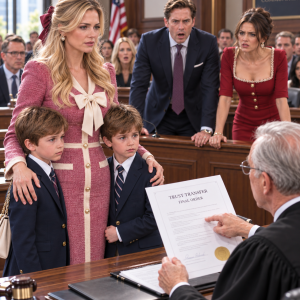
Connor stared at his shoes.
“There wasn’t anything left.”
“You should’ve called me.”
“You were working.”
Tommy rubbed one hand across his forehead.
“Buddy.”
Connor’s voice got smaller.
“I didn’t want you to leave work again.”
Tommy pulled out the chair and sat beside him.
For a few seconds, nobody said anything.
Then Tommy looked at me.
“Thank you for feeding him.”
“There’s more packed up for you.”
“No.”
“Tommy—”
“I appreciate what you did. I do. But we’re not taking bags of groceries or money or whatever else.”
I leaned back.
“I’m not offering you money.”
I told him about the job.
He stared at me.
“You don’t know me.”
“No.”
“You don’t know if I’m any good.”
“That’s why there’s an interview.”
That made him stop.
I slid Karen’s business card across the table.
“I’m not offering charity. I’m opening a door. You still have to walk through it.”
Tommy picked up the card.
He turned it over once.
“Twenty-eight?”
“If your experience checks out.”
“Benefits?”
“Day one.”
His eyes moved toward Connor.
“What time?”
“Nine tomorrow morning.”
Tommy slipped the card into his wallet.
“I’ll be there at eight forty-five.”
That should have been the end of it.
I thought I had helped a kid get dinner and helped his uncle get an interview.
Then Tommy told me where they lived.
The address sounded familiar.
Not the street itself, but the area.
It was a small cluster of older homes near an abandoned rail spur southeast of downtown. Mercer Logistics had once studied that corridor for a distribution project before we chose another site.
“You own the house?” I asked.
“My mother did. She left it to me and my sister. After my sister passed, her share was supposed to be protected for Connor.”
“Supposed to be?”
Tommy glanced at the boys.
“We’ve been getting letters.”
“What kind?”
“People claiming there are problems with the title. People offering to buy it for almost nothing. Last month somebody photographed the electric meter.”
Connor looked up.
“The man with the black truck?”
Tommy turned.
“What man?”
“He came again.”
Tommy’s expression changed.
“When?”
“Tuesday.”
“Connor, you never told me that.”
“You were asleep before work.”
I asked what the man looked like.
Connor couldn’t give me much.
Older. Gray hair. Black pickup.
Then he held up his right hand.
“He had a big silver ring. Like this.”
For reasons I couldn’t explain yet, that detail bothered me.
That night, after Elliot was asleep, I opened an old property file from Mercer Logistics.
I found a photograph taken seven years earlier near one of our former distribution sites.
Four men were standing beside a chain-link fence.
One of them had his hand resting on a clipboard.
A large silver ring was visible on his finger.
The next morning, I showed the photograph to Connor.
I didn’t point anyone out.
“Is the man you saw in here?”
Connor leaned closer.
Then his finger touched the screen.
“Him.”
I knew the face.
And I knew he had no reason to be photographing Connor’s house.
His name was Richard Cole.
He had once been the chief financial officer of my company.

The Signature Tommy Never Made
Richard had left Mercer Logistics eight years earlier.
By lunchtime, our attorney had pulled public property records connected to Tommy’s address.
The house was listed as having been transferred three years earlier to a company called Redline Asset Recovery.
The transfer carried Tommy Alvarez’s signature.
Tommy stared at the document on my laptop.
“I never signed that.”
“You’re sure?”
He looked at me.
“James, I’d remember giving away my mother’s house.”
There wasn’t much more to say.
The signature was enough to stop treating the situation as a misunderstanding.
Our attorney contacted the appropriate authorities and helped Tommy challenge the transfer.
I kept looking at Redline.
The company had purchased several small properties in the same corridor. Most belonged to families who had fallen behind on taxes, medical bills or repairs. But two owners had filed complaints alleging documents had been signed without their knowledge.
Then I found the reason the properties suddenly mattered.
A proposed transportation corridor was being considered for the area.
If the project moved forward, land values around the old rail line could rise sharply.
Redline had been buying cheap.
And Richard Cole controlled Redline.
I sat in my office staring at his name on the corporate filing.
Eight years earlier, I had shaken his hand when he left Mercer Logistics.
Now I was looking at records suggesting he had been using information and relationships developed during his time around our business to target properties.
I called Tommy.
“Don’t sign anything anybody brings to your house.”
“I haven’t.”
“Don’t meet anyone alone either.”
He was quiet.
“Is this bigger than my house?”
I looked at the list on my desk.
“Yes.”
Tommy exhaled.
“I knew something wasn’t right.”
Two days later, Richard walked into Mercer Logistics.
He didn’t call.
He didn’t make an appointment.
My assistant came into the conference room and said, “There’s a Richard Cole downstairs asking for you.”
I stood so quickly my chair rolled backward.
“Where are Elliot and Connor?”
It was Saturday. I had brought Elliot in for a few hours, and Connor was with him because Tommy was completing orientation paperwork downstairs.
“Break room.”
“Keep them there.”
Richard was waiting near reception when I came out.
He had aged, but not enough to make Connor’s identification difficult.
And on his right hand was the same silver ring.
“James.”
“Richard.”
He smiled.
“I hear you’ve been asking questions about Redline.”
“I have.”
“Then you know it’s a legitimate company.”
“I know Tommy Alvarez says his signature was forged.”
Richard’s smile disappeared.
“Tommy Alvarez doesn’t understand the paperwork his mother left behind.”
“Then investigators can explain it to him.”
Richard stepped closer.
“You’re turning a small title dispute into something it isn’t.”
“Why were you photographing his house?”
He didn’t answer.
Behind me, a door opened.
I turned.
Elliot and Connor had come into the hallway.
Richard’s eyes moved directly to Connor.
It lasted maybe two seconds.
That was enough.
I stepped between them.
“Don’t look at him.”
Richard gave a small laugh.
“You have no idea what that boy’s family is worth.”
I didn’t move.
“What does that mean?”
He glanced toward the elevators.
“His grandmother kept originals she had no business keeping. I tried to resolve it years ago.”
“Originals of what?”
He buttoned his jacket.
“Ask Tommy.”
“I’m asking you.”
Richard shook his head.
“You’re making this personal.”
“You came to my office and looked at a nine-year-old boy while talking about what his family is worth. You made it personal.”
The elevator doors opened.
Two investigators stepped out.
Richard’s expression changed when he saw them.